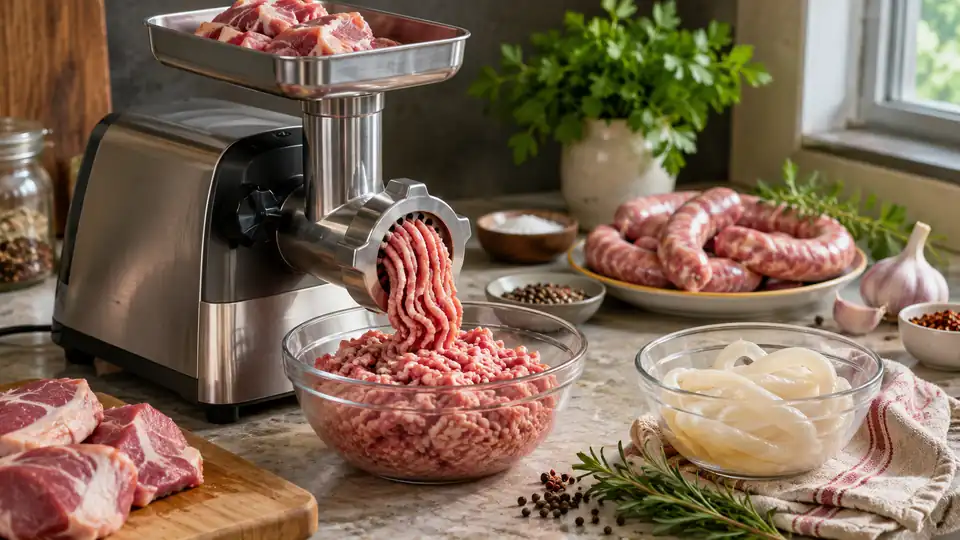
Making sausage at home starts long before the casing reaches the stuffing tube. The grinder has to cut chilled meat cleanly, offer a useful range of plate sizes, and support a controlled feed when you move from grinding to stuffing. A grinder that looks powerful on a product page may still be a poor fit if its peak wattage is unclear, its operating time is limited, or its stuffing accessories are awkward for the batches you actually prepare.
Common mistakes include choosing a machine by advertised maximum wattage alone, assuming every grinder can run continuously, and overlooking cleanup. Sausage makers also need to separate two jobs: grinding meat and filling casings. Some household grinders support both with tubes, while a dedicated stuffer may provide better control for larger batches. Construction, included plates, reverse operation, storage, and compatibility matter just as much as the motor description.
The comparison covers standalone electric grinders, stand-mixer attachments, and a manual option. Check which models include stuffing tubes, how much meat you plan to prepare, and whether a separate stuffer would better suit frequent sausage making.
Quick Answer
- Best Overall: The LEM Products BigBite #8 combines a documented 0.5 HP motor, three plates, stuffing tubes, stainless steel parts, and a published capacity claim of about 7 pounds per minute. It suits home sausage makers who expect regular small to medium batches.
- Best for Higher-Capacity Home Batches: The Weston #12 lists a 750-watt, 1 HP motor, two speeds, reverse, and a slower setting intended for stuffing. Its larger #12 format is a useful step up for shoppers processing more meat.
- Best for KitchenAid Owners: The KitchenAid KSMMGA uses a compatible stand mixer power hub, includes fine, medium, and coarse plates, and stores in its own case. It avoids adding another motorized appliance to the counter.
Best Meat Grinders for Sausage Making Comparison Table
| Product | Best For | Motor or Operation | Sausage Accessories | Main Trade-Off |
|---|---|---|---|---|
| LEM Products BigBite #8 | Regular home batches | 0.5 HP, electric | Stuffing tubes | Not for bones |
| Weston #12 | Larger home batches | 750 watts, 1 HP | Funnel and spacer | Larger footprint likely |
| AAOBOSI Digital Grinder | Preset-focused operation | 3000W maximum claim | Sausage and kibbe attachments | Continuous use limited to 10 minutes |
| Aiheal Electric Grinder | Flexible home sausage recipes | 300W rated, 3200W locked power | Three tubes | Attachments require hand cleaning |
| CHEFFANO Life Grinder | Simple multi-size grinding | 500W rated, 2000W maximum | Sausage tube and kubbe kit | No dishwasher cleaning |
| AAOBOSI 4-in-1 Grinder | Multi-use kitchen prep | 300W motor, electric | Sausage stuffer | Listing advises avoiding bones, tendons, and skin |
| GVODE KitchenAid Attachment | KitchenAid mixer owners | Stand mixer powered | Three tube sizes | Body is not dishwasher-safe |
| KitchenAid KSMMGA | Organized attachment storage | Stand mixer powered | Two tubes | Requires a compatible mixer |
| Manual Meat Grinder | Small, power-free batches | Hand crank | Filler funnel | Requires manual effort |
The detailed reviews explain how each grinder fits sausage preparation, from occasional links at home to larger batches and stand mixer setups.
1. LEM Products BigBite #8 Meat Grinder — Best Overall

The LEM BigBite #8 is a strong match for a sausage maker who wants a dedicated electric grinder rather than a small appliance used occasionally for burgers. Its listed 0.5 HP motor and #8 format place it in a practical home-kitchen category, while the published processing claim of about 7 pounds per minute gives shoppers a useful indication of its intended workload. That figure remains a manufacturer claim rather than a guaranteed continuous rate, but it points toward small and medium batches rather than one-pound trial runs.
Sausage preparation benefits from the included three plates, knife, stomper, and stuffing tubes. The stainless steel construction and noise-dampening design add appeal for repeat use, and the permanently lubricated motor reduces one maintenance task. A home cook preparing bratwurst on a Saturday morning gets a more purpose-built setup than a basic food processor, while a hunter can use it for boneless game and sausage recipes. The listing specifically says it is not for bones, so its strength is meat preparation, not broad food-processing experimentation.
Pros
- Documented 0.5 HP motor suits regular home grinding.
- Includes three plates and sausage-stuffing tubes.
- Stainless steel construction supports a dedicated countertop setup.
- Noise-dampening design is useful in a home kitchen.
- Five-year factory warranty and lifetime customer support are listed.
Cons
- It is specifically listed as unsuitable for bones.
- The published capacity is a claim, not an independently verified continuous rate.
This is the most balanced selection for someone who makes sausage often enough to care about construction, parts support, and a complete grinding setup. It may be more machine than a cook needs for a few links once a year, but the #8 format and included accessories avoid many of the compromises found in very compact grinders. Buyers should still chill meat properly, follow the operating instructions, and clean removable components after each session.
To buy this product, click here.
2. Weston #12 Electric Meat Grinder and Sausage Stuffer — Best for Higher-Capacity Home Batches

The Weston #12 brings a larger documented grinder size and a 750-watt, 1 HP motor to the comparison. The available information lists a claimed rate of 4 to 5 pounds per minute, which makes it relevant for cooks who regularly work through larger batches of pork, beef, turkey, or venison. The number should be read as a published specification, not as a promise that every mixture will move at that pace. Cold meat, connective tissue, plate choice, and feed rate all influence actual work.
Its two-speed design is particularly relevant to sausage making. The faster setting is intended for grinding, while the slower first speed is described for stuffing. That division gives the operator more control than a single-speed machine during the transition from ground meat to casings. A cam-action headlock also helps with attaching and removing the grinding head, and the die-cast aluminum body and metal gears support a sturdier construction profile. It is a better fit for a household that prepares several batches than for someone with almost no storage space.
Pros
- Documented #12 grinder size suits larger home batches.
- Lists a 750-watt, 1 HP motor.
- Two speeds separate grinding and slower stuffing tasks.
- Reverse operation helps address jams.
- Includes a sausage funnel and stuffing spacer.
Cons
- Its larger format may require more storage and counter space.
- The listed throughput is not an independently verified continuous rate.
Choose this Weston when batch size and operating control matter more than compact storage. It offers a meaningful alternative to smaller household units, especially for someone dividing a larger amount of prepared meat into several sausage styles. It is less compelling for a casual cook who wants the smallest possible appliance, and the listing does not establish that it is suitable for commercial food-service workloads.
To buy this product, click here.
3. AAOBOSI Multifunctional Digital Meat Grinder — Best for Preset-Focused Operation
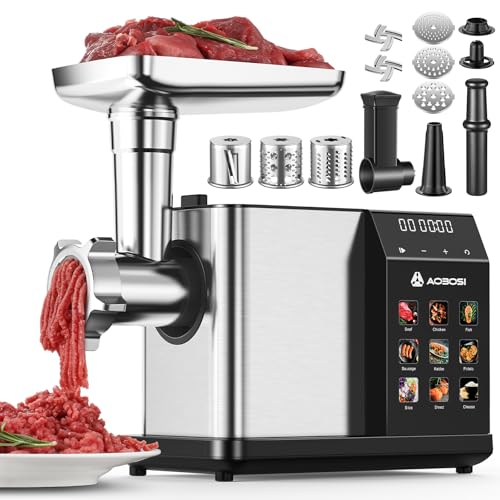
A digital control panel changes the feel of this AAOBOSI from a basic switch-operated grinder to a more feature-heavy countertop appliance. The listing describes nine touch-screen presets, nine speed settings, dedicated meat, sausage, and reverse modes, plus built-in storage for accessories. That arrangement may suit a household where the grinder lives in a cabinet between uses and the owner appreciates having plates and attachments kept with the machine rather than scattered through a drawer.
The product information lists a 3000W maximum claim and a stated capacity of up to 4 pounds per minute, but it also gives a clear operating restriction: continuous use should not exceed 10 minutes to help prevent overheating. That limitation matters for sausage makers planning long sessions. The included three plates, two blades, sausage and kibbe accessories provide flexibility, while the stainless steel blades and plates are listed as dishwasher-safe. Hand washing remains the better default for careful maintenance, especially when the product information itself recommends it.
Pros
- Nine touch-screen presets provide distinct operating controls.
- Includes meat, sausage, reverse, and speed functions.
- Built-in storage keeps accessories with the grinder.
- Three plates and two blades support different preparations.
- Stated 10-minute continuous-use limit is clearly disclosed.
Cons
- Continuous operation should not exceed 10 minutes according to the listing.
- The 3000W figure is a maximum claim and should not be treated as normal operating power.
This is a sensible choice for cooks who value controls and organized storage more than a simple mechanical interface. It can suit a batch of sausage prepared in stages, but it is a poor match for unattended or prolonged operation. The touch screen adds convenience, though it also gives the appliance a more electronic character than the straightforward LEM or Weston designs.
To buy this product, click here.
4. Aiheal Electric Meat Grinder With Sausage Stuffer — Best for Tube and Plate Variety

The Aiheal package is built around variety. It includes three grinding plates described as 2mm, 5mm, and 7mm, two stainless steel cutting blades, and three sausage tubes. For a home cook moving between fine breakfast sausage, a coarser bratwurst mixture, and different casing sizes, that accessory mix is more useful than a machine with a single general-purpose plate. The product also includes reverse operation for clearing a jam, along with a locking knob and overload protection.
Its power description needs careful reading. The listing identifies a 300W motor and a 3200W maximum locked-power figure. Those numbers are not interchangeable, and the larger figure should not be read as ordinary continuous motor output. The grinder is positioned for household use and lists beef, pork, chicken, venison, and fish among possible foods. A family preparing sausage after a grocery trip may appreciate the broad accessory set, while the hand-cleaning requirement means the owner should plan time for washing and drying the removable parts.
Pros
- Three listed plate sizes support varied sausage textures.
- Includes three sausage-stuffer tubes.
- Reverse operation can help clear jams.
- Overload protection and a locking knob are listed.
- Removable cutting components simplify access for cleaning.
Cons
- The product information says removable parts should not go in the dishwasher.
- The 3200W figure is maximum locked power, not a stated continuous rating.
This grinder makes sense for a household that wants many accessories without moving to a larger #8 or #12 machine. It is less suitable for buyers who want an explicitly documented long-duty grinder or dishwasher-focused cleanup. Keep the distinction between its rated motor description and maximum locked-power claim in mind before comparing it with other electric models.
To buy this product, click here.
5. CHEFFANO Life Electric Meat Grinder — Best for Simple Multi-Size Grinding

CHEFFANO Life keeps the controls and accessory list fairly direct. The available specifications describe a 500W rated motor, a 2000W maximum claim, two cutting blades, and three plates marked 7mm, 5mm, and 2mm. That combination gives a sausage maker a clear path from grinding meat to selecting a finer or coarser texture without purchasing extra plates. The sausage tube and kubbe kit add options for cooks who use the grinder for more than one recipe.
A reverse button is included for a stuck feed, and overload protection is described as shutting the unit off if it overheats or becomes overloaded. Those features are useful safeguards, but they do not remove the need to prepare meat properly or follow the operating instructions. The listing says the accessories are removable and should not be placed in a dishwasher. In a kitchen where sausage-making happens beside a sink, that is manageable. In a rushed household, the drying step may feel more significant than the accessory count suggests.
Pros
- Lists a 500W rated motor.
- Includes three clearly identified plate sizes.
- Provides a sausage tube and kubbe kit.
- Reverse operation addresses stuck material.
- Overload protection is included in the product description.
Cons
- Accessories should not be placed in the dishwasher.
- The 2000W figure is a maximum claim rather than the rated motor output.
This model is a practical fit for occasional sausage makers who want more texture choices than a very basic grinder provides. It does not offer the documented grinder size or larger-batch positioning of the LEM and Weston, so shoppers should keep expectations within household use. Its appeal comes from a straightforward feature set that covers grinding, stuffing, and kubbe without a complicated control system.
To buy this product, click here.
6. AAOBOSI 4-in-1 Electric Meat Grinder — Best for Multi-Use Kitchen Prep
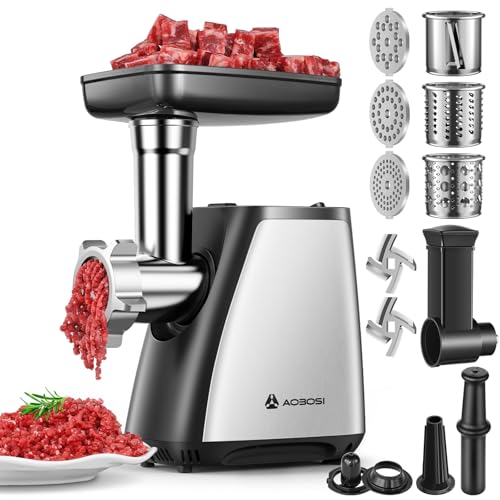
For some kitchens, the sausage function is only one reason to own a grinder. This AAOBOSI model adds cheese grating and vegetable slicing or shredding to its meat-grinding, sausage-stuffing, and kubbe functions. The product description lists a 300W motor and a claimed rate of 1.5 kilograms, or about 3.3 pounds, per minute with the 7mm plate. That gives a useful reference for home preparation, although actual throughput will vary with meat condition and feeding technique.
The stainless steel casing is paired with ABS material, and the listing describes heat-dissipation openings, overload protection, a thermostat system, and reverse operation. It also specifically advises avoiding bones, tendons, and skin because those materials may contribute to jams. That warning is valuable for sausage makers who might otherwise treat a broad “meat grinder” label as permission to process any scraps. Plates and blades are listed as dishwasher-safe, while alloy components should be hand-washed and dried to reduce oxidation concerns.
Pros
- Four-in-one design includes grinding, stuffing, kubbe, and grating or shredding.
- Lists a 300W motor and a stated 1.5 kg-per-minute claim.
- Includes three plates and two stainless steel blades.
- Reverse operation and overload protection are listed.
- Plates and blades are described as dishwasher-safe.
Cons
- The listing advises avoiding bones, tendons, and skin.
- Some alloy parts require hand washing and drying.
This is a good match for a cook who wants one appliance to handle several kitchen jobs around sausage day. It is less focused than the LEM or Weston, and the stated guidance against tough materials narrows the appropriate use. Buyers should select it for its accessory versatility rather than infer heavy-duty capability from the 2800W maximum figure in the title.
To buy this product, click here.
7. GVODE Metal Meat Grinder Attachment for KitchenAid — Best for Three-Size Stuffing Options

The GVODE attachment is aimed at KitchenAid stand mixer owners who already have the motor base and would rather add a grinder than store another standalone appliance. Its aluminum grinder body, stainless steel food tray, plates, and cutters create a metal-oriented setup, while four grinding plates offer more texture choices than some compact attachment kits. Three sausage tubes are included, which is the notable reason to choose this model for casings of different sizes.
Because the mixer supplies the power, this attachment should be judged differently from a standalone electric grinder. The product listing describes a claimed rate of 2 pounds of raw meat in one minute, but that remains a published claim dependent on the compatible mixer, meat preparation, and feed rate. All parts detach for cleaning, though the body is not dishwasher-safe and the instructions call for hand washing with warm water and soap below 122 degrees Fahrenheit. That requirement is easy to overlook when a household is accustomed to putting mixer accessories in the dishwasher.
Pros
- Designed for KitchenAid stand mixer use.
- Includes four grinding plates.
- Provides three sausage-stuffer tube sizes.
- Uses an aluminum body with stainless steel food-contact components listed.
- Detachable parts allow access for cleaning.
Cons
- The grinder body is not dishwasher-safe.
- It requires a compatible KitchenAid stand mixer to operate.
Choose GVODE if your mixer already occupies the counter and you want a broad plate and tube selection in a smaller storage package. It is less suitable for someone without a compatible KitchenAid machine or for a cook seeking an independent grinder with its own motor. Confirm the mixer and attachment fit before ordering, since “for KitchenAid” does not establish compatibility with every stand mixer configuration beyond the supplied description.
To buy this product, click here.
8. KitchenAid KSMMGA Food Grinder Attachment — Best for Organized Stand Mixer Storage
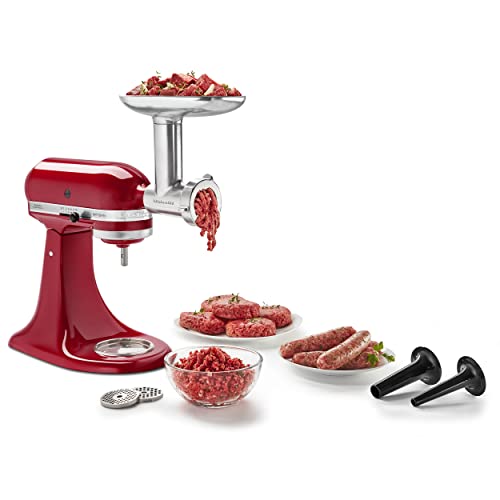
The KitchenAid KSMMGA takes a clean attachment-first approach. It connects to the power hub on a household KitchenAid stand mixer and uses the mixer motor to drive the metal food grinder. For a baker who already owns that mixer, the arrangement can be more appealing than adding a separate motor base, especially if storage is tight and the appliance lives in a cabinet between sausage sessions.
The kit includes fine, medium, and coarse grinding plates, a larger food tray, a pusher, and two sausage-stuffer tubes. The larger tray may reduce repeated loading during a batch, while the three plate choices cover the usual progression from a coarse first grind to a finer sausage mixture. The attachment can be chilled in a refrigerator or freezer before use, according to the listing, which is relevant because keeping meat and equipment cold is a practical part of controlled grinding. A storage case keeps the pieces together, though the product depends entirely on a compatible mixer.
Pros
- Compatible with household KitchenAid stand mixer power hubs.
- Includes fine, medium, and coarse grinding plates.
- Provides two sausage-stuffer tubes.
- Larger food tray supports fewer reloads during preparation.
- Includes an organized storage case.
Cons
- It cannot operate without a compatible KitchenAid stand mixer.
- It offers fewer sausage tubes than the GVODE attachment.
This is the sensible attachment for a KitchenAid owner who values brand-specific integration and tidy storage. It may be less attractive to a household that makes very large batches or does not already own the required mixer. The included plates are well matched to general grinding, while the two tubes provide basic sausage capability rather than the widest casing-size range.
To buy this product, click here.
9. Manual Meat Grinder With Sausage Stuffer — Best Power-Free Option

A hand-operated grinder changes the sausage-making routine completely. There is no motor, cord, or electrical storage requirement. The operator turns the crank to mince meat and uses the filler funnel for sausage preparation. That makes this product relevant for a small kitchen, a backup setup, or a cook who prepares modest amounts and wants direct control over the pace rather than maximum throughput.
The listing describes a one-piece forged aluminum-alloy body, a thick spiral auger, and a curved feed inlet intended to accept larger pieces of meat and vegetables. It also says the cutter head, feed tube, and crank handle can be removed without tools. Those features make the machine easier to store in a drawer or narrow cabinet than a countertop electric grinder. The trade-off is physical effort. A short batch may be manageable, but repeated cranking can become tiring as the meat quantity grows, and the available information does not provide an electric-style throughput figure or plate-size specification.
Pros
- Operates without electricity or a power cord.
- Compact storage profile suits small kitchens.
- Aluminum-alloy construction is described as rust-resistant.
- Includes a sausage-filling funnel.
- Components can be disassembled without tools.
Cons
- Grinding and stuffing require manual cranking effort.
- The supplied information does not specify plate sizes or processing capacity.
This manual grinder is best for occasional small batches where portability and simple storage outweigh speed. It is unlikely to satisfy someone preparing several pounds of sausage regularly, especially if that person wants a consistent electric feed. Still, it offers a useful alternative for cooks who do not want another appliance and who prefer a compact tool that can be cleaned and put away quickly.
To buy this product, click here.
Buying Guide
If you also grind meat for other meals, our broader meat grinder comparison covers different workloads.
Match the Grinder to Your Batch Size
A few pounds of pork for weekend bratwurst places different demands on a grinder than repeated batches for a large family. The LEM and Weston provide the clearest documented positioning for regular home use and larger workloads, while the compact electric models are more appropriate for ordinary household preparation. Published pounds-per-minute figures are useful for comparison, but they are claims rather than guarantees of continuous performance.
Read Motor Specifications Carefully
Rated power, maximum power, locked power, and horsepower are different descriptions. A 300W rated motor and a 3200W maximum locked-power claim should not be compared as though they were equivalent continuous outputs. The same caution applies to 2000W, 2800W, or 3000W maximum figures. Look for operating limits as well. The AAOBOSI digital model, for example, lists a 10-minute continuous-use restriction.
Choose Plates for Your Sausage Style
Plate openings influence the texture of the ground mixture, but manufacturers may describe sizes differently. Several products here list three plate options, while the KitchenAid attachment identifies fine, medium, and coarse plates. A first coarse grind followed by a finer pass is a common preparation pattern, yet the exact result depends on meat temperature, fat content, blade condition, and feeding speed.
Separate Grinding From Stuffing
A grinder with sausage tubes can handle both stages, but it is not automatically equal to a dedicated sausage stuffer. The Weston’s slower setting is specifically described for stuffing, while the smaller grinders provide tubes as part of a broader accessory set. Tube count and size matter if you make both narrow breakfast links and larger Italian or bratwurst-style sausages.
To understand the separate roles of each machine, read our meat grinder versus sausage stuffer guide.
Check Attachment Compatibility
KitchenAid attachments depend on a compatible stand mixer power hub. The GVODE product is described for KitchenAid mixers, while the KSMMGA is the KitchenAid-branded attachment. Neither replaces the mixer motor, and neither should be treated as a universal attachment for every stand mixer brand. Confirm the exact mixer and attachment relationship before purchase.
Plan for Cleaning and Drying
Meat residue can collect around plates, blades, augers, and stuffing tubes, so removable parts need prompt cleaning after use. The Aiheal and CHEFFANO listings say their accessories should not go in a dishwasher. The AAOBOSI 4-in-1 listing describes dishwasher-safe plates and blades but still calls for hand washing and drying of alloy parts. Never treat the motor housing as a washable component.
Respect Material and Operating Limits
Stainless steel, aluminum, ABS, and food-contact plastics appear across this selection, but the material of one component does not establish the composition of every part. Follow the product’s stated restrictions. The LEM listing says it is not for bones, and the AAOBOSI 4-in-1 description advises avoiding bones, tendons, and skin. A high wattage label does not change those limits.
Best Meat Grinders for Sausage Making FAQ
Is a meat grinder with sausage tubes enough for making sausage?
It can be enough for occasional home batches. The grinder handles the meat preparation and the tubes provide a way to fill casings, but stuffing control varies by design. A slower operating mode, such as the one listed for the Weston, can be useful. For frequent or large batches, a dedicated stuffer may offer a more specialized workflow.
What grinder size is suitable for home sausage making?
There is no single correct size for every household. The LEM is documented as a #8 grinder and the Weston as a #12. Smaller countertop grinders can suit occasional batches, while a #8 or #12 may make more sense for regular preparation. Grinder size does not directly establish motor power or commercial suitability, so compare the full specifications.
Does higher wattage mean a better sausage grinder?
No. Product listings may describe rated, maximum, or locked motor power, and those figures represent different things. A larger maximum number does not automatically indicate higher continuous output or better handling of difficult mixtures. Operating restrictions, plates, reverse function, construction, and intended workload provide better context.
Can these meat grinders process bones?
The supplied product information does not support general bone grinding for this selection. The LEM is specifically listed as not for bones, and the AAOBOSI 4-in-1 listing advises avoiding bones, tendons, and skin. Do not infer bone capability from a heavy-duty label or a high wattage claim.
Are grinder plates and blades interchangeable?
Not automatically. Compatibility depends on grinder size, plate diameter, center opening, thickness, mounting design, and blade geometry. The available information identifies included plates for each product but does not establish universal interchangeability. Use parts listed for the exact grinder model or follow the manufacturer’s compatibility information.
Are KitchenAid grinder attachments compatible with every KitchenAid mixer?
The KSMMGA listing describes compatibility with household KitchenAid stand mixer power hubs, while the GVODE listing identifies the attachment as designed for KitchenAid stand mixers. That does not remove the need to verify the exact mixer interface and model. A stand mixer attachment also requires the mixer itself to provide the operating power.
What is the best way to clean a sausage grinder?
Disconnect the electric machine, remove the grinder head and food-contact components, and follow the product’s washing instructions. Some parts in the AAOBOSI 4-in-1 and digital models are listed as dishwasher-safe, while Aiheal and CHEFFANO advise against dishwasher use. Hand washing, thorough rinsing, and complete drying are the safer general approach when the instructions are unclear.
Final Verdict
The LEM Products BigBite #8 is the strongest overall choice in this group for regular home sausage making. Its documented #8 format, 0.5 HP motor, three plates, stuffing tubes, stainless steel construction, and stated support policy create a balanced package without pretending to be a commercial food-service machine. It is particularly well suited to the cook who prepares sausage often and wants a dedicated grinder with a clearer home-workload identity.
The Weston #12 is the more suitable alternative for larger household batches and buyers who value separate grinding and stuffing speeds. KitchenAid owners may prefer the KSMMGA or GVODE attachment to avoid another powered appliance, while the manual grinder keeps storage simple for small occasional batches. Before choosing, compare your expected batch size, available counter space, preferred plate range, cleaning routine, and need for stuffing control. The best fit is the machine whose documented limits match the way you actually make sausage.
