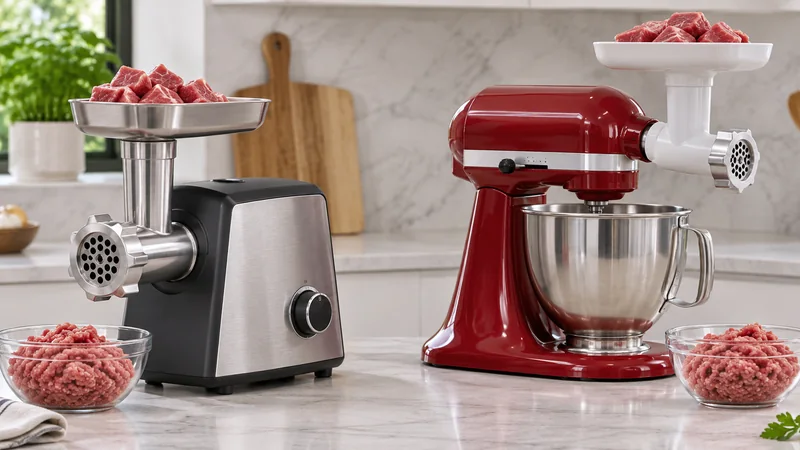
A standalone meat grinder has its own drive; a grinder attachment uses the motor of a compatible stand mixer. An attachment can make sense if you already own a supported mixer and want to add a grinding function. A standalone machine may be a better fit when a separate dedicated appliance suits your workload and workspace.
For compatible products, see our comparisons of KitchenAid grinder attachments and stand mixer grinder attachments.
Neither format is automatically faster or suitable for a given amount of meat. Compare the specific attachment and mixer combination with the particular standalone grinder, using their published limits and instructions.
How the two setups differ
| Question | Standalone grinder | Mixer attachment |
|---|---|---|
| What supplies power? | Its own motor, if electric | The compatible mixer motor |
| What must already fit? | Work surface and power requirements | Mixer model and attachment interface |
| Storage | Entire appliance and parts | Attachment and parts, plus the mixer |
| Operating instructions | Grinder’s manual | Instructions for the attachment and mixer |
Start with compatibility
If you own a mixer, identify its brand and exact model before choosing an attachment. Check the attachment maker’s stated fit and any limitations. A similar-looking hub is not evidence that an accessory fits or is supported.
For a concrete example, KitchenAid says its KSMMGA metal grinder attachment connects to household KitchenAid stand mixer power hubs. That statement applies to the named attachment and its stated mixer range; it is not a promise about every third-party attachment.
Replacement parts require another check. A plate or knife for one attachment series may not fit another even if both connect to the same mixer. Verify the exact attachment model before buying components.
Match the workload to the documented limits
An attachment borrows the mixer’s motor, so its practical use depends on both devices. Read both sets of instructions for speed, food preparation, supported materials, and operating restrictions. KitchenAid’s instructions for its named metal attachment, for example, specify a mixer speed; do not transfer that setting to other attachments without checking their manuals.
Standalone grinders also vary substantially. Look for rated versus peak power, stated processing capacity, run-time limits, feed arrangement, and replacement part support. Do not treat advertised peak wattage or a large head number as proof of continuous performance.
Think through counter space and setup
An attachment adds pieces to store but relies on the mixer already occupying or needing space. Consider whether there is clearance for the tray, the feed tube, and a bowl at the outlet. The mixer must sit on a stable surface while in use.
A standalone grinder needs its own storage and setup area. Larger examples may be heavy, while a compact unit may fit a household counter. Check dimensions and weight for the actual model rather than assuming that every separate machine is larger than a mixer setup.
Cleaning and food safety
Both formats require disassembly of the food-contact parts. Turn off and unplug the power unit before removing parts, use the manufacturer-approved pusher, and keep the motor or mixer housing out of water. KitchenAid’s cleaning instructions show why dishwasher compatibility needs to be checked part by part.
Choose the setup whose compatibility, supported workload, and cleanup fit how you cook. Owning a mixer makes an attachment possible; it does not by itself establish that the combination meets every processing need.
