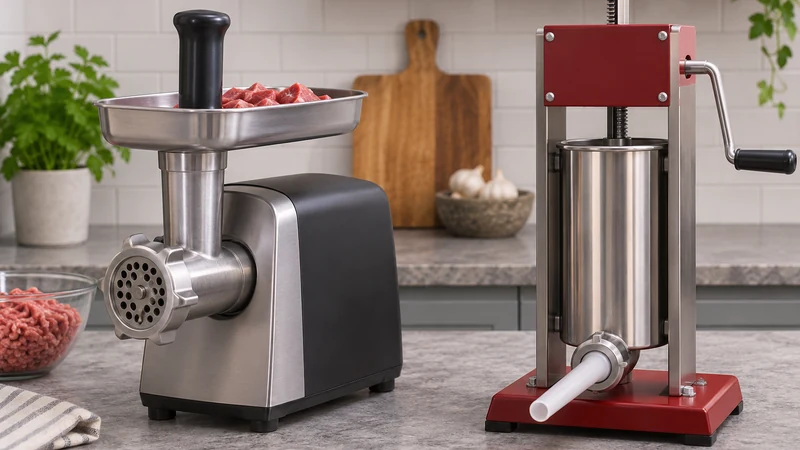
A meat grinder cuts meat and pushes it through a perforated plate. A sausage stuffer pushes a prepared sausage mixture through a tube into casings. Some grinders accept a stuffing attachment, but a stuffing tube does not turn every grinder into the same kind of machine as a dedicated stuffer.
To compare individual machines, see our guides to sausage stuffers and grinder and stuffer combinations.
For sausage from whole cuts, grinding, mixing, and stuffing are separate tasks. Whether one device can handle more than one step depends on the accessories and instructions for that exact model.
Grinding and stuffing compared
| Task | Meat grinder | Dedicated sausage stuffer |
|---|---|---|
| Primary job | Cut and reduce meat through a plate | Move prepared mixture into casings |
| Key parts | Auger, knife, and perforated plate | Cylinder, drive, and stuffing tube |
| Input | Meat prepared for the machine | Prepared sausage mixture |
| Can it do the other job? | May stuff with approved accessories | Does not normally grind meat |
What happens in a grinder?
The auger moves food toward a knife and grinding plate. Plate openings influence the texture of the output, while the knife and plate must fit and be assembled as directed. Grinder head size and plate hole size are different measurements.
Some grinder packages include a stuffing tube or offer one separately. Check whether a particular model requires a special stuffing plate or changes to the cutting assembly. For example, an LEM countertop grinder manual describes a model-specific stuffing assembly. Its directions must not be copied to other grinders without checking their manuals.
What does a dedicated stuffer do?
A dedicated stuffer holds the prepared mixture in a cylinder. A piston or other drive moves that mixture toward a tube so it can fill a casing. Models can be vertical or horizontal, and the drive may be manual or powered. Capacity, tube sizes, mounting, and cleaning access vary.
A stuffer does not replace the grinding step when the recipe starts with whole cuts. Likewise, a mixer combines ingredients but does not automatically grind or fill casings. These distinctions help prevent buying a device that cannot perform the intended task.
When is a grinder attachment enough?
If you already own a compatible grinder and make sausage occasionally, its approved stuffing accessories may provide a way to fill casings without storing another complete appliance. Check the included parts, supported tube sizes, and the manufacturer’s procedure first.
For more frequent sausage sessions or larger batches, compare a dedicated stuffer’s stated cylinder capacity, stability, drive, loading, and cleaning requirements with your routine. Capacity is not the same as a verified processing speed, and a larger cylinder can also take more room to handle and wash.
Choose the right tube and casing
Check the tube dimensions and the casing maker’s instructions. A tube must attach to the specific machine and suit the casing being used; a generic listing does not establish compatibility. Avoid assuming every tube fits every grinder or stuffer.
Follow the equipment manual for loading and operation. Keep hands and utensils away from moving mechanisms, and turn off and disconnect powered equipment before clearing or disassembling it.
Clean between raw-meat tasks
Wash the parts and surfaces that contact raw meat according to their material and manufacturer instructions. USDA’s guidance on cross-contamination explains why raw-meat utensils should not be reused for finished food without washing. Keep the mixture refrigerated during preparation and follow appropriate cooking instructions for its ingredients.
If you need to make ground meat, start with grinding capability. If you already have a prepared mixture and need to fill casings, focus on stuffing capability. An approved grinder attachment can bridge the two jobs, with the limitations of its particular design.
