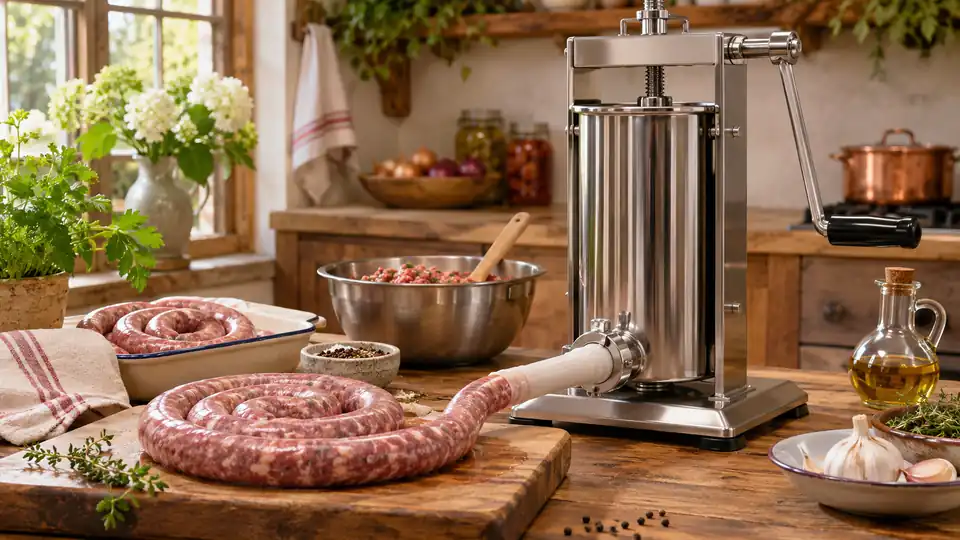
Stuffing sausage at home can feel wonderfully old-fashioned until the casing bunches up, the cylinder needs constant refilling, and air pockets leave every link looking like a small balloon. A dedicated vertical sausage stuffer solves that particular problem by using a piston and stuffing tube to push seasoned meat into the casing with more control than a grinder attachment usually provides. The right machine depends on whether you are filling a few pounds of breakfast sausage on a quiet Sunday or preparing a much larger batch of salami, bratwurst, or wild-game sausage.
Capacity is an easy specification to overvalue. A large cylinder reduces refills, but it also takes more counter space and can be awkward for a small household batch. Tube selection matters just as much because narrow tubes suit snack sticks and smaller links, while larger tubes support bratwurst, summer sausage, and salami-style casings. Gear construction, air release, removable parts, and the way the base stays planted during cranking all affect the experience. Manual operation also means the buyer should choose for realistic batch size rather than an impressive listing claim.
The comparison looks at vertical stuffers in several sizes, from compact home models to larger cylinders. Capacity, tube sizes, gearing, stability, and disassembly matter when matching a machine to a regular batch.
Quick Answer
- Hakka 7Lb/3L Sausage Stuffer is the Best Overall choice for many home sausage makers because it combines a 3-liter cylinder, two filling speeds, stainless food-contact parts, four tube sizes, and an air-release piston.
- VEVOR 15 Lb/7L Vertical Sausage Stuffer is the strongest large-batch alternative in this group. Its 7-liter capacity reduces refilling, and the listing describes removable parts as dishwasher-compatible.
- MASTER FENG 2.5-pound Vertical Stuffer fits occasional, smaller-batch work. Its compact capacity and eight included tubes make it more approachable for buyers who do not need a large cylinder.
Best Vertical Sausage Stuffers Comparison Table
| Product | Best For | Capacity | Configuration | Included Tubes |
|---|---|---|---|---|
| Hakka 7Lb/3L | Best overall home use | 7 lb / 3 L | Manual, two speed | 4 stainless tubes |
| LEM MightyBite 5 lb | Small batches and stable setup | 5 lb | Manual, clamped base | 3 plastic tubes |
| MASTER FENG 2.5 lb | Occasional sausage making | 2.5 lb | Manual, vertical | 8 tubes |
| VEVOR 15 lb / 7 L | Large household batches | 15 lb / 7 L | Manual, dual speed | 4 tubes |
| EKway 7 lb / 3 L | Tube variety and stainless parts | 7 lb / 3 L | Manual, two speed | 5 stainless tubes |
| MEAT! 15 Pound | Large batches with simple controls | 15 lb | Manual, vertical | 3 tubes |
| LEEVOT 11 lb / 5 L | Mixed casing sizes | 11 lb / 5 L | Manual, two speed | 5 stainless tubes |
| Hakka 15 lb / 7 L | Large stainless batches | 15 lb / 7 L | Manual, two speed | 4 stainless tubes |
| LEM MightyBite 15 lb | High-capacity home preparation | 15 lb | Manual, geared | 3 plastic tubes |
The detailed reviews below explain how the capacities, gear systems, tube sets, and cleaning arrangements translate into practical sausage-making choices.
1. Hakka 7Lb/3L Sausage Stuffers and Vertical Sausage Makers — Best Overall

The Hakka 7Lb/3L lands in a useful middle ground. A 3-liter cylinder is large enough for a meaningful family batch without committing the counter space associated with a 7-liter machine. Its two-speed system gives the crank a faster setting for raising or lowering the piston and a slower setting for controlled filling, which is the mode that matters most once a casing is fitted over the tube.
Its all-stainless construction extends across the base plate, cylinder, stuffing tubes, and canister, according to the supplied product information. Four tube sizes cover small and large sausage formats, including 16, 22, 32, and 38 mm options. The piston also includes an air-release feature. That combination is useful during a Saturday batch where the priority is steady casing fill rather than racing through the meat. The machine still requires manual cranking and a suitable stable work surface, but it offers a practical balance for households that make sausage several times a year.
Pros
- 3-liter capacity suits medium home batches without the footprint of a 7-liter stuffer.
- Two filling speeds provide quicker piston movement and slower casing control.
- Stainless steel base plate, cylinder, canister, and tubes support a consistent food-contact setup.
- Four tube diameters cover narrow links through larger sausage formats.
- Air-release piston can help limit trapped air during stuffing.
Cons
- Manual cranking still requires physical effort during a full cylinder.
- The four-tube set offers less size variety than the five- or eight-tube kits in this roundup.
This is the easiest product here to recommend without knowing the buyer’s exact sausage style. It has enough capacity for holiday batches and wild-game preparation, while its tube selection avoids forcing the owner into one casing format. Buyers who make very large batches may prefer a 7-liter cylinder, and people who only fill a pound or two may find this size more machine than they need. For the broadest home-use match, though, the Hakka 3L has the most even set of documented features.
To buy this product, click here.
2. LEM Products MightyBite 5 lb Sausage Stuffer — Best for a Stable Small-Batch Setup

A five-pound cylinder makes the LEM MightyBite a sensible fit for cooks who want dedicated stuffing equipment without stepping into a large-batch format. The included clamps are a meaningful detail. A stuffer that shifts across the counter while one hand manages the casing can turn a tidy process into a messy one, so the ability to secure the unit supports one-person operation.
The product uses precision-machined metal gears and a stainless steel cylinder with an air-release valve. The cylinder is removable for filling and hand cleaning. Three plastic tubes, sized at 11/16, 7/8, and 1 inch outside diameter, focus the kit on common small and medium sausage styles. The supplied information also lists a two-year factory warranty and lifetime customer support, plus replacement parts for a range of products. This is a more focused kit than the stainless-heavy Hakka options, but the geared mechanism and clamping arrangement give it a clear place in a small household setup.
Pros
- Five-pound capacity fits small and moderate sausage batches.
- Included clamps help secure the stuffer for one-person use.
- Precision-machined metal gears are specified instead of plastic gears.
- Removable stainless steel cylinder simplifies loading and hand cleaning.
- Three tube sizes cover snack sticks, bratwurst, Italian sausage, and similar formats.
Cons
- The included tubes are plastic rather than stainless steel.
- Three tube sizes provide less range for very narrow or very large casings.
The MightyBite 5 lb is a good choice for someone who values controlled setup over maximum capacity. It should appeal to the home cook who makes a few batches each season and wants the stuffer to stay put on the worktop. The plastic tubes and hand-wash requirement mean it does not have the same all-metal feel as several competitors, while buyers making 10 or 15 pounds at a time will spend more time refilling. Its practical advantage is the combination of manageable size, metal gearing, and included clamps.
To buy this product, click here.
3. MASTER FENG Sausage Stuffer — Best for Occasional Small Batches

The MASTER FENG takes a different path from the large stainless machines. Its stated 2.5-pound capacity is better suited to the person who wants to try homemade sausage, make a small batch of salami, or fill a few links without storing a tall, heavy cylinder. That smaller chamber can also make sense when the recipe changes frequently and the cook would rather load only the amount needed.
The supplied information describes a stainless steel body, sturdy base, ergonomic handle, vertical design, and eight stuffing tubes. That tube count is the product’s most distinctive feature in this group. Buyers should still check the tube dimensions and casing requirements before purchase because the product data confirms quantity but does not provide each diameter. A smaller capacity means more refills for a family gathering, yet it also keeps the operation proportionate for a trial batch on a compact kitchen counter.
Pros
- 2.5-pound capacity suits occasional and test batches.
- Vertical layout uses the cylinder efficiently on a countertop.
- Stainless steel construction is specified for the stuffer body.
- Eight included stuffing tubes offer broad format variety.
- Sturdy base and ergonomic handle support manual operation.
Cons
- Small capacity requires more refilling for family-size or game-processing batches.
- The supplied information does not identify the diameter of each included tube.
This model makes the most sense for a buyer who expects modest output and values tube variety over a large hopper. It is easier to justify for occasional kitchen use than a 15-pound machine, especially where storage space is tight. Someone preparing a full deer batch or several large coils should look higher in the ranking. The missing tube-diameter details also deserve attention before ordering, since casing fit is central to choosing a sausage stuffer.
To buy this product, click here.
4. VEVOR Manual Sausage Stuffer 15 lbs/7L — Best for Large Batches

For a large batch, the VEVOR 7L model addresses the most obvious nuisance: stopping to reload. Its listed 15-pound capacity is the largest in the roundup alongside the other 15-pound machines, and the tilting barrel should make loading less awkward than working around a fixed vertical cylinder. A two-speed arrangement lets the operator move the piston quickly when the barrel is being filled, then switch to a slower setting for casing control.
The product information describes stainless steel construction across the barrel, tubes, frame, and base, plus a pressure plate with air-release holes. Four tubes cover approximately 0.63, 0.87, 1.26, and 1.50 inches by the listed measurements. Removable parts are described as dishwasher-compatible, which may reduce hand-cleaning time, although the manufacturer’s instructions should still govern care for the exact components. This machine is physically more demanding to store than a 2.5- or 3-liter stuffer, but the capacity is compelling for large family batches, hunting-season preparation, or repeated filling sessions.
Pros
- 7-liter capacity can hold a large batch and reduce interruptions for refilling.
- Dual-speed operation supports quick piston movement and controlled stuffing.
- Stainless steel barrel, frame, base, and tubes are specified.
- Air-release holes in the pressure plate are intended to limit trapped air.
- Removable parts are described as dishwasher-compatible in the supplied listing.
Cons
- The large 7-liter format takes more storage and counter space.
- Four tube sizes provide less variety than several five- and eight-tube kits.
Choose this VEVOR when batch size is the primary concern. It is a practical match for cooks who would rather load once and keep working, provided they have a stable place to operate and store it. A small household making two pounds of breakfast links may find the cylinder excessive, and the listing’s “commercial” language should not be treated as proof of suitability for every food-service workload. Its strongest case is large home preparation with a preference for stainless components and reduced refilling.
To buy this product, click here.
5. EKway 7Lb/3L Sausage Stuffer — Best for Tube Variety in a Mid-Size Stuffer
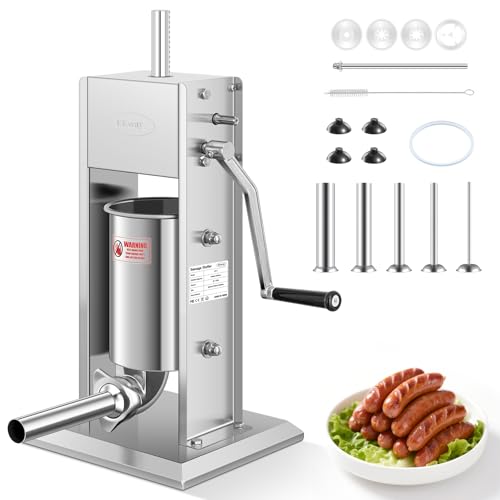
The EKway occupies the same useful capacity class as the Hakka 3L, but it adds a fifth stainless steel tube. That extra option matters for a cook who moves between narrow breakfast links, standard sausages, thicker salami, and other fillings. The listing describes a removable regulating handle for switching between two speeds, so the operator can use a faster piston movement while loading and a slower movement when filling a casing.
Its cylinder is listed at 2.8 quarts or 3 liters, with 304 stainless steel construction and precision-machined steel gears. The two-way piston valve is intended to vent air, while the removable cylinder supports filling and cleaning. The supplied information also mentions a one-year maintenance offering, long-term customer service, and replacement parts. Those support details may matter to buyers who expect to keep a stuffer for recurring seasonal work, although they do not replace the need to inspect the included tube sizes and operating instructions before use.
Pros
- 3-liter capacity balances batch size and countertop demands.
- Five stainless steel tubes provide more format flexibility than many similar machines.
- Two-speed operation allows quicker loading and slower casing filling.
- 304 stainless steel construction and steel gears are specified.
- Removable cylinder and air-venting piston support loading and cleanup.
Cons
- The 3-liter chamber still requires refilling for very large batches.
- The supplied product data does not give the exact dimensions of all five tubes.
EKway is a thoughtful pick for cooks who want mid-size capacity but dislike being restricted to three or four nozzle options. It competes closely with the Hakka 3L, with the deciding factor likely to be the tube set and the buyer’s preference for the listed construction details. A high-volume sausage maker should move to a 5- or 7-liter model, while a beginner making tiny batches may prefer the compact MASTER FENG.
To buy this product, click here.
6. MEAT! 15 Pound Vertical Sausage Stuffer — Best for Large Capacity with Simple Tube Selection

The MEAT! vertical stuffer is aimed at the buyer who wants a 15-pound cylinder but does not need a long list of accessories. Its removable stainless steel cylinder is useful during the two moments that tend to make sausage preparation drag: loading the meat and cleaning afterward. The ergonomic handle is another practical touch because a full manual cylinder puts more demand on the crank than a small batch does.
The included tube sizes are 17, 21, and 30 mm. That is a narrower selection than the five-tube kits from EKway or LEEVOT, but the sizes cover several common sausage formats. Stainless steel gears are listed, and the product includes the cylinder, handle, and three tubes. Buyers should read the tube dimensions against their preferred casings before purchase. The machine’s large capacity suits substantial preparation, yet the listing does not provide a verified continuous operating rate, so its 15-pound designation should be read as cylinder capacity rather than a promise of commercial throughput.
Pros
- 15-pound capacity reduces the number of refills for large batches.
- Stainless steel gears are specified for the manual drive system.
- Removable stainless steel cylinder supports loading and cleaning.
- Ergonomic handle is intended to make cranking more manageable.
- 17, 21, and 30 mm tubes cover several common sausage sizes.
Cons
- Three tubes offer less casing flexibility than the five- and eight-tube alternatives.
- The large format demands more storage space than compact stuffers.
This model suits a buyer who has already decided that 15 pounds is the right batch size and wants a straightforward kit. Its simpler accessory set can be a benefit if you already know which casings you use, but it is less appealing for experimentation across many sausage styles. It should be viewed as a large-capacity manual stuffer for home preparation, not as documented proof of continuous commercial operation.
To buy this product, click here.
7. LEEVOT 11LBS/5L Manual Sausage Stuffer — Best for Mixed Casing Sizes
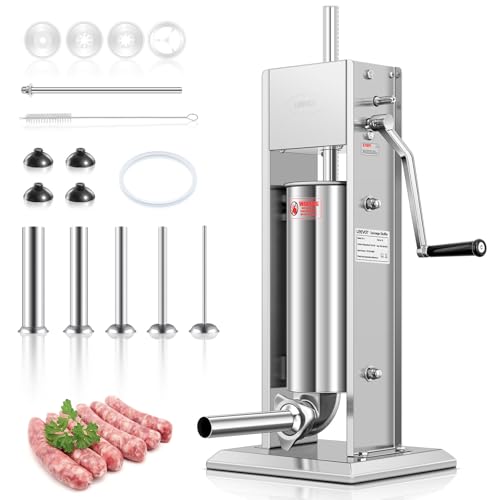
The LEEVOT 5L model is a useful middle step between compact household stuffers and 15-pound machines. Its stated 11-pound capacity gives a batch maker more room than a 3-liter cylinder while avoiding the full scale of a 7-liter unit. That can be a good fit for a household preparing several varieties in one session, especially where a 15-pound barrel would spend much of its time only partly filled.
The tube kit is a strong part of the specification. Five stainless steel tubes are listed at 10, 16, 22, 32, and 38 mm, giving the owner a broad range from smaller links to large salami-style fillings. The dual-speed system, detachable cylinder, and piston with dual release valve are also documented. Four churro nozzles and two sealing rings are included, although those accessories matter less to a buyer focused solely on sausage. The all-stainless cylinder, base plate, and tubes provide a coherent food-contact arrangement, while the one-year warranty and replacement-parts support add ownership context.
Pros
- 5-liter capacity supports larger batches without the full footprint of a 7-liter machine.
- Five stainless tubes span 10 to 38 mm according to the supplied specifications.
- Two speeds allow faster piston movement and more controlled casing filling.
- Detachable cylinder and dual-release piston support loading and air management.
- All-stainless cylinder, base plate, and tubes are specified.
Cons
- The 5-liter format is less compact than a 2.5- or 3-liter stuffer.
- The extra churro accessories add components that sausage-only buyers may not need.
LEEVOT is a strong match for the cook who changes casing size often. Its five-tube selection is more versatile than the three-tube MEAT! kit, while its capacity remains easier to justify for household use than the largest models. Buyers who make only occasional two-pound batches may find it bulky, and the inclusion of non-sausage accessories should not be confused with additional stuffing performance. Its distinction is the combination of medium-large capacity and clearly specified tube range.
To buy this product, click here.
8. Hakka 15 Lb/7 L Sausage Stuffer — Best Stainless Option for Large Batches

The Hakka 15-pound model scales up the same basic approach as the smaller Hakka stuffer. A 7-liter cylinder is appropriate for buyers who regularly prepare large quantities and would rather spend the session filling casings than reloading meat. Its two filling rates provide a quick position for the piston and a slower setting for stuffing, a distinction that becomes more useful as the cylinder gets larger.
The supplied information lists an all-stainless base plate, cylinder, stuffing tubes, and canister, along with an air-release piston. Four tubes are included at 16, 22, 32, and 38 mm. That set covers a practical range, but it does not offer the narrower 10 mm tube included with LEEVOT. The machine’s size also changes the ownership equation. A 7-liter stuffer needs a deliberate storage location and a stable operating surface, so the capacity advantage is most useful for a buyer who has frequent large batches rather than occasional small recipes.
Pros
- 7-liter capacity reduces refilling during large sausage sessions.
- Two filling rates support faster piston movement and slower stuffing control.
- Stainless steel construction is specified across the main food-contact components.
- Air-release piston is included for managing air during filling.
- Four tube sizes cover medium through large sausage formats.
Cons
- The large cylinder requires more storage and counter space.
- The tube set lacks the smaller 10 mm option listed with the LEEVOT model.
Choose the Hakka 15L when capacity and all-stainless construction matter more than compact storage or maximum nozzle variety. It is particularly relevant for large family batches and seasonal preparation. A buyer who fills snack sticks or narrow breakfast casings often may prefer a kit with a smaller tube. The available information supports its large manual capacity and component construction, but it does not establish a continuous commercial duty cycle.
To buy this product, click here.
9. LEM Products MightyBite 15 lb Vertical Sausage Stuffer — Best for Large-Batch LEM Buyers

The large MightyBite is built for the buyer who likes the smaller LEM’s approach but needs a 15-pound cylinder. Its removable stainless steel cylinder is central to the design because a full batch is much easier to load when the barrel can be separated from the rest of the machine. The air-release piston is also retained, helping the operator manage air as the meat moves into the casing.
Precision-machined carbon steel gears and a protective gearbox cover are listed, along with three plastic tubes at 11/16, 7/8, and 1 1/4 inches. Those sizes cover several familiar sausage types, though the kit offers less tube variety than the five-tube LEEVOT or EKway sets. The supplied information identifies this machine for large-batch sausage making and lists beef, pork, poultry, venison, and other ground meats as suitable food types. It does not establish a verified throughput rate or unrestricted commercial duty cycle, so its strongest use case remains substantial home preparation.
Pros
- 15-pound capacity suits large sausage-making sessions.
- Removable stainless steel cylinder supports filling and hand cleaning.
- Precision-machined carbon steel gears are specified for the drive system.
- Air-release piston helps address trapped air during stuffing.
- Two-year factory warranty and lifetime customer support are listed.
Cons
- Three plastic tubes provide less material and size variety than several competing kits.
- The large cylinder is excessive for occasional small-batch sausage making.
This is the LEM option for a buyer who has moved beyond five-pound batches and values the brand’s listed support and replacement-part availability. It makes less sense for a first-time sausage maker with limited storage, especially because the three-tube set is relatively focused. Buyers choosing between this and the Hakka 15L should compare the tube materials, tube sizes, and preferred support arrangement rather than assuming the larger cylinder alone determines the better fit.
To buy this product, click here.
Buying Guide
Match Cylinder Capacity to Your Batch
Capacity should reflect the amount of meat you usually prepare at one time. A 2.5- or 3-liter cylinder is sensible for occasional family batches, recipe testing, and kitchens where storage space is tight. Five liters gives more breathing room for a larger session, while 7-liter machines reduce refilling when preparing roughly 15 pounds according to the supplied product listings. A larger chamber does not automatically make a stuffer better. It can be cumbersome if the batch is small, and a tall machine needs a stable place to operate and dry after cleaning.
Use Two Speeds for Control, Not as a Throughput Promise
Several products include two filling rates. The faster setting is useful for moving the piston while loading or resetting the cylinder. The slower setting is more relevant once a casing is on the tube, because controlled pressure helps the operator manage the fill. Dual-speed operation does not establish a measured stuffing rate or guarantee continuous performance. Treat it as a control feature that can make the manual process easier to manage.
Compare Tube Sizes with Your Casings
Tube diameter determines which casings are practical, so a long accessory list is useful only when the sizes match your recipes. LEEVOT lists five tubes from 10 to 38 mm, while the Hakka models list 16, 22, 32, and 38 mm options. LEM’s smaller and larger MightyBite products use three plastic tubes, and the MASTER FENG listing confirms eight tubes without identifying each diameter in the supplied information. Check the exact tube measurements before purchase rather than choosing by tube count alone.
Look at the Gear and Piston Design
Manual stuffing places force on the gears, piston, and crank. The listings identify precision-machined metal or carbon steel gears on the LEM models, stainless steel gears on MEAT!, and precision-machined steel gears on EKway. Other products emphasize stainless construction and air release. An air-release piston or pressure plate can help reduce trapped air, but it does not remove the need to guide the casing and regulate the crank. A buyer should also inspect the gear housing and follow the supplied assembly and operating instructions.
Separate Food-Contact Material from General Construction
“Stainless steel” can describe the cylinder, tubes, base, or several components rather than every part of the machine. Hakka lists stainless steel for its base plate, cylinder, tubes, and canister, while LEEVOT specifies stainless steel for its cylinder, base plate, and tubes. LEM’s tubes are plastic even though its cylinder is stainless steel. This distinction matters for buyers who want an all-metal food-contact path, and it also helps set realistic expectations about cleaning and long-term care.
Plan for Cleaning and Storage
Removable cylinders make it easier to load meat and reach surfaces after a batch. VEVOR’s 15-pound listing describes removable parts as dishwasher-compatible, while the LEM listings specify hand washing for their plastic tubes. Do not generalize one model’s cleaning directions to another. Remove food-contact parts according to the instructions, wash and dry them as directed, and keep electrical or enclosed drive components away from water. Large vertical stuffers also need a storage plan because their height and weight can make repeated cabinet movement inconvenient.
Do Not Confuse Cylinder Capacity with Commercial Duty
A 15-pound cylinder tells you how much meat the barrel is listed to hold. It does not verify a continuous processing rate, commercial sanitation program, or duty cycle. The supplied products are manual vertical stuffers, and the listings may mention home, hunting, or commercial use, but those phrases do not establish suitability for every food-service environment. Buyers with regulated commercial requirements should verify local rules, operating instructions, cleaning procedures, and support documentation before purchase.
Best Vertical Sausage Stuffers FAQ
What is a vertical sausage stuffer used for?
A vertical sausage stuffer pushes seasoned ground meat from a cylinder through a stuffing tube and into a casing. It is intended for the stuffing stage of sausage preparation. It does not automatically grind meat or mix ingredients unless separate equipment performs those tasks. The products in this roundup are dedicated manual stuffers rather than meat grinders with basic stuffing attachments.
Is a larger sausage stuffer always better?
No. A larger cylinder reduces refilling during a substantial batch, but it also takes more storage and counter space. A 2.5- or 3-liter machine may be easier to manage for occasional household recipes, while a 5- or 7-liter unit better suits repeated larger batches. Choose the capacity that matches your normal preparation rather than the largest number in a product title.
Are two-speed sausage stuffers worth choosing?
Two speeds can be useful because the faster setting helps reposition the piston and the slower setting gives more control while filling a casing. That feature is especially helpful with a full cylinder, where pressure management matters. It should not be interpreted as proof of a particular stuffing speed or continuous operating capacity.
How many stuffing tubes do I need?
The right number depends on the casing sizes you use. Three accurately sized tubes can be more useful than eight tubes with unclear dimensions. Narrow tubes suit smaller links and snack-stick-style preparations, while larger tubes are intended for thicker sausages and salami-style casings. Confirm the actual diameters, especially when the product listing gives only a tube count.
Can a sausage stuffer grind the meat?
No. A dedicated stuffer is built to move already ground meat into casings. You generally need a separate meat grinder for grinding and suitable equipment or a mixing process for combining seasonings. A stuffer can improve the casing-filling stage, but it should not be treated as a three-in-one grinder, mixer, and stuffer without specific documentation.
Are stainless steel tubes better than plastic tubes?
Stainless steel tubes may appeal to buyers who want a consistent metal food-contact setup and a tube that matches the rest of the machine. Plastic tubes can still be useful and may be lighter to handle. The material alone does not establish better stuffing results. Compare the tube sizes, cleaning directions, and compatibility with your casings before choosing.
Can these stuffers be used for commercial production?
The supplied listings describe some machines for commercial or professional use, but a capacity label does not verify commercial duty-cycle performance. A buyer with commercial requirements should confirm the manufacturer’s operating limits, sanitation procedures, replacement parts, electrical or workplace requirements, and any applicable local regulations. For household or seasonal preparation, the main questions are capacity, stability, tube selection, and cleanability.
What should I do about air pockets in sausage?
Air-release features in the piston or pressure plate are intended to help vent trapped air as the meat moves through the cylinder. The operator still needs to fill the cylinder properly, keep the casing positioned correctly, and use controlled pressure. If a product has a slower filling setting, that mode can help with casing control. Follow the specific assembly and operating instructions for the stuffer you choose.
Final Verdict
The Hakka 7Lb/3L is the strongest overall match for most home sausage makers in this group. Its capacity is large enough for a meaningful batch without the storage burden of the biggest machines, and its two-speed operation, air-release piston, stainless food-contact components, and four tube sizes address the practical parts of stuffing. Buyers making very small batches should look at the MASTER FENG or LEM MightyBite 5 lb, while cooks preparing 10 to 15 pounds at a time will save refilling effort with the VEVOR 7L, Hakka 7L, MEAT!, or LEM 15 lb models.
LEEVOT stands out for its clearly listed five-tube range and 5-liter middle ground, while EKway offers a similar capacity with five stainless tubes and two-speed control. The final choice should follow your casing sizes, typical batch weight, available storage, and tolerance for manual cranking. Check the exact tube dimensions and cleaning directions before ordering, and treat large capacity as a convenience rather than proof of continuous commercial performance. For a balanced household setup, the Hakka 3L remains the easiest recommendation.
