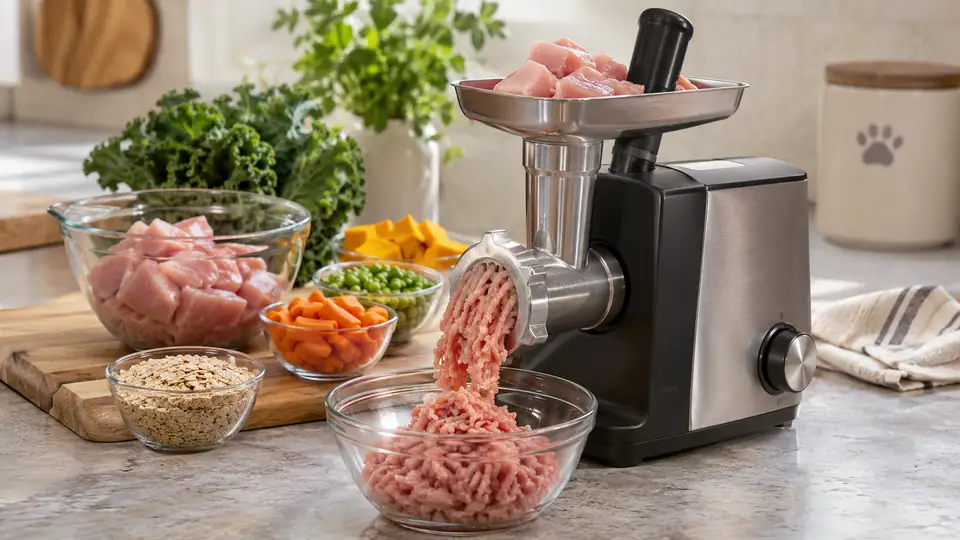
Preparing raw dog food at home can turn a small kitchen task into a noisy, messy production line, especially when meals include ground meat, cartilage, or manufacturer-approved soft bones. The right grinder can make batch preparation more manageable, but the wrong machine may leave you with an unsuitable texture, frequent jams, difficult cleanup, or a motor that is poorly matched to the workload. A grinder marketed for burgers is not automatically appropriate for raw pet food, and a high peak-wattage claim does not by itself prove bone-grinding capability.
The most useful specifications here are the product’s stated support for soft pet-food ingredients, motor description, included plates, construction, cleaning instructions, and operating restrictions. A large household grinder may suit someone preparing several days of meals at once, while a compact pet-food processor may be more practical for small servings. Buyers should also separate soft-bone claims from hard-bone use. The products below do not all support the same ingredients: some are presented for boneless meat, while others have listing claims about specific soft bones. Check the exact model’s current manufacturer instructions before processing any bone; a pet-food label alone does not establish bone-grinding capability.
The electric grinders below serve different batch sizes and ingredient preparations. Check the instructions for the exact model and ingredients: a general meat grinder should not be assumed suitable for bones or frozen food.
Quick Answer
- Sinyder Electric Meat Grinder 3500W: Best Overall for home raw dog food preparation because its listing specifically supports soft pet-food bones, includes multiple grinding options, and uses internal metal gears.
- STX International Turboforce II 4000: A strong choice for larger household batches, with a documented No. 12 grinder size, high-capacity tray, soft-bone support, and extensive accessories.
- Pet Food Grinder Pro: Best for small portions and pet-focused preparation, with a compact bowl-style design and a listing that specifically mentions small bones up to 5 mm.
Best Meat Grinders for Raw Dog Food Comparison Table
| Product | Best For | Documented Pet-Food Use | Motor or Capacity Claim |
|---|---|---|---|
| Sinyder Electric Meat Grinder 3500W | Overall home use | Soft bones and raw pet food | 5 to 7 lb/min claim, peak power |
| STX Turboforce II 4000 | Larger batches | Soft chicken, rabbit, squirrel, and quail bones | No. 12, 220 to 260 lb/hr claim |
| Sinyder Electric Meat Grinder with Touch Modes | Texture control | Soft bones and raw pet food | 5 to 7 lb/min claim, peak power |
| Pet Food Grinder Pro | Small pet-food portions | Bones up to 5 mm listed | 300W listing, 2 lb/min claim |
| Aiheal Electric Meat Grinder | General home batches | General meat use, no specific bone support | 300W rated, 3200W locked maximum |
| STX International Magnum | Higher-capacity home grinding | Soft chicken, rabbit, squirrel, and quail bones | No. 12, 220 to 260 lb/hr claim |
| AAOBOSI 3-Speed Meat Grinder | Controlled household use | Raw pet food listed | 350W rated, 4 lb/min claim |
| AAOBOSI 4-In-1 Meat Grinder | Beginners and kitchen versatility | Bone grinding is specifically discouraged | 300W, 3.3 lb/min claim |
| CHEFFANO Life Electric Grinder | Basic home grinding | General meat use | 500W rated, 2000W maximum |
The detailed reviews explain which machines have the clearest raw pet-food fit and which require more caution around bones, batch size, and cleanup.
1. Sinyder Electric Meat Grinder 3500W — Best Overall

The Sinyder earns the top position because its supplied description addresses the central concern directly: home-prepared raw pet food containing soft bones. The listing identifies chicken wings, cartilage, and fish as suitable applications, while also drawing a clear boundary around hard pork and beef bones and continuous commercial processing. That distinction matters. A machine can be useful for soft pet-food ingredients without being a general-purpose bone mill.
Its 3500W figure is identified as peak power, so it should not be read as continuous operating power. The product also claims a 5 to 7 pound-per-minute output, six touch modes, a timer, and internal metal gears. Those features could appeal to a household preparing several meals at once, while the built-in storage compartment helps keep plates, blades, and attachments together. The stainless steel food-contact parts require hand washing according to the supplied instructions, which adds time but gives the owner a clear routine after handling raw ingredients.
Pros
- Listing specifically supports soft bones and raw pet-food preparation.
- Internal metal gears are documented for heavy household use.
- Includes coarse, medium, and fine grinding options.
- Built-in storage keeps plates and attachments together.
- Touch controls and a timer offer more control over batch processing.
Cons
- Soft-bone use does not extend to hard pork or beef bones.
- Peak wattage and published output are manufacturer claims, not independent measurements.
This is the strongest match for dog owners who want a conventional electric grinder with explicit soft-bone guidance and enough flexibility for recurring meal preparation. It may be more machine than needed for a single small serving, and buyers should plan for hand washing the removable food-contact parts. The clearest advantage over the general-purpose models below is the direct raw pet-food positioning paired with a stated application boundary.
To buy this product, click here.
2. STX International Turboforce II 4000 — Best for Larger Batches
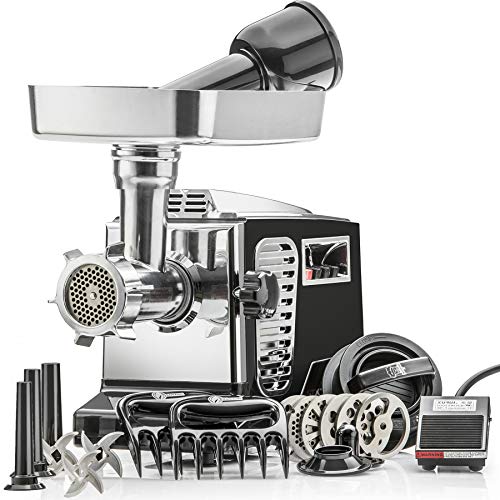
For owners preparing larger quantities, the Turboforce II brings a more substantial format than the compact grinders. The supplied information identifies it as a No. 12 grinder with a high-capacity tray that holds more than three pounds, a two-inch feed tube, and a 2.5-inch output. Its soft-bone examples include chicken, rabbit, squirrel, and quail, giving it one of the clearest documented matches for raw dog-food preparation in this group.
The listing describes a 2000 maximum-watt motor, air-cooling system, circuit breaker, and a claimed 220 to 260 pounds per hour depending on plate and meat type. That is a published throughput claim rather than a promise of continuous real-world operation. The package includes five grinding plates, three stainless steel blades, and a foot pedal, along with sausage and kibbe accessories. Those extras are useful for a household that also processes regular food, although they create more pieces to wash and store after a raw-food session.
Pros
- Documented No. 12 grinder size suits larger household batches.
- Listing specifically identifies several soft-bone applications.
- High-capacity tray accommodates more than three pounds.
- Includes five grinding plates and three stainless steel blades.
- Foot pedal and circuit breaker add operating flexibility and protection features.
Cons
- Larger size requires more counter and storage space than compact machines.
- Published hourly capacity should not be treated as a verified continuous duty rate.
This is a sensible pick for multi-dog households or owners who portion several days of food in one session. It is less appealing for someone with limited storage or very small batches, where the larger tray and accessory set may feel excessive. The soft-bone guidance is useful, but ingredients still need to match the listed examples and the machine’s operating instructions.
To buy this product, click here.
3. Sinyder Electric Meat Grinder with Touch Modes — Best for Texture Control

This Sinyder variant shares the raw pet-food focus of the top pick but presents its included equipment a little differently. The supplied information lists 5 mm and 7 mm stainless steel plates, two stainless steel blades, a fan plate, and three sausage-filler tubes. For a dog owner adjusting meal texture, those plate choices provide a more concrete starting point than a machine with a single general-purpose plate.
The six preset touch modes and timer are useful for repeatable household routines, while the internal storage compartment keeps the smaller accessories from wandering into a drawer. The product description identifies a 3500W maximum motor and a 5 to 7 pound-per-minute claim, so the same caution about peak power applies here. It also states that only the blades are dishwasher-safe and recommends hand washing the other components. That distinction is easy to miss after a messy raw-meat session, yet it should shape the cleanup routine.
Pros
- Product information directly supports soft bones and homemade raw pet food.
- Includes documented 5 mm and 7 mm grinding plates.
- Six touch modes and a timer support repeatable processing.
- Internal storage reduces loose accessory clutter.
- Includes sausage, kibbe, and vegetable-processing accessories.
Cons
- Hard pig and beef bones are specifically outside the stated application.
- Most removable components require hand washing rather than dishwasher cleaning.
Choose this model if texture options and organized storage matter as much as basic grinding. It suits owners who prepare recurring batches and want a conventional grinder with explicit soft-bone guidance. It is not the right choice for hard bones or commercial production, and buyers should avoid treating the touch panel as evidence of higher continuous capacity.
To buy this product, click here.
4. Pet Food Grinder Pro — Best for Small Portions

The Pet Food Grinder Pro takes a different route from the larger hopper-style machines. It is a compact bowl-based appliance aimed directly at homemade food for dogs, cats, and rabbits. The listing states that it handles fresh meat, vegetables, kibble, and bones up to 5 mm. That small-bone limitation is significant. It gives the buyer a clearer boundary for ingredient preparation, but it also means this appliance should not be treated as a substitute for a larger grinder with broader soft-bone guidance.
The product information lists a 300W motor, a claimed two-pound-per-minute capacity, removable blades, and dishwasher-safe parts. It also describes use for spices, grains, herbs, and coffee, which may appeal to owners who want one compact appliance for several kitchen jobs. A bowl format can be convenient for a single meal or small portion, but it offers less of the tray-and-plate flexibility found in the larger machines. The supplied data does not establish a continuous-duty rating, so short, sensible batches are the safer interpretation.
Pros
- Purpose-built listing focus for homemade pet food.
- Specifically lists bones up to 5 mm.
- Compact bowl design suits small portions and limited storage.
- Removable blades and listed dishwasher-safe parts simplify cleanup.
- Can also process kibble, vegetables, herbs, spices, and coffee.
Cons
- Small-bone guidance limits its use compared with larger grinders.
- Does not provide the plate selection or hopper format of a conventional meat grinder.
This is the most targeted option for a dog owner making modest servings and preparing ingredients to the stated size limit. It may be a poor match for a household that freezes large batches or needs varied grinding textures. The compact format is its appeal, but the narrow bone specification should remain the deciding factor rather than the general-purpose accessory claims.
To buy this product, click here.
5. Aiheal Electric Meat Grinder — Best Plate Variety for General Home Use

The Aiheal is a general household meat grinder rather than a machine whose supplied description centers on raw pet food. It includes 2 mm, 5 mm, and 7 mm plates, two stainless steel blades, and three sausage tubes. That range can help an owner prepare different meat textures, but the available information does not specifically confirm bone grinding. Its listing discusses chicken, beef, pork, venison, and fish, which supports ordinary meat processing rather than a clear claim for soft pet-food bones.
The motor description separates a 300W motor from a 3200W maximum locked-power figure. Those numbers should not be compared directly with a conventional rated-wattage specification. Overload protection, automatic shutoff, and a reverse button are useful operating features, especially when a batch begins to bind. The grinder head can be removed for cleaning, but the instructions say not to use the dishwasher and to dry the parts with a soft cloth. That maintenance requirement matters after raw-food preparation.
Pros
- Includes three plate sizes for varied meat textures.
- Provides two stainless steel cutting blades.
- Reverse function may help address minor clogs.
- Overload protection and automatic shutoff are documented.
- Removable cutting attachment supports more thorough hand cleaning.
Cons
- Supplied information does not specifically confirm bone grinding for raw dog food.
- Attachments should not be placed in the dishwasher.
This model belongs on the list for owners who mainly need a household meat grinder and are willing to prepare boneless ingredients unless the manufacturer provides additional guidance. It is less suitable for anyone choosing primarily around soft-bone processing. Its plate range and reverse function are practical, but they do not replace application-specific bone support.
To buy this product, click here.
6. STX International Magnum — Best Higher-Capacity Alternative
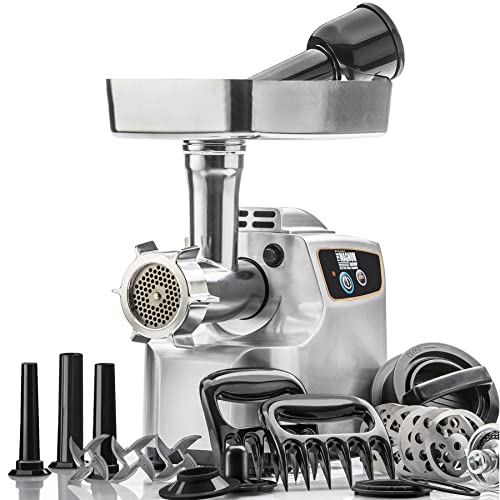
The STX Magnum is closely related in purpose to the Turboforce II, with a documented No. 12 format, high-capacity tray, two-inch feed tube, and soft-bone examples that include chicken, rabbit, squirrel, and quail. It can therefore appeal to owners who want a larger machine for recurring meal preparation. The listing claims 220 to 260 pounds per hour depending on the plate and meat, but that figure should remain a manufacturer-stated maximum rather than a planning guarantee for continuous home operation.
The package includes five grinding plates, three 304 stainless steel blades, a sausage plate, three stuffing tubes, a kibbe attachment, meat claws, and a patty press. That broad accessory set gives the appliance plenty of non-pet-food uses, although it also increases the cleaning workload. The 1800 maximum-watt description and air-cooling system are relevant to household processing, but neither establishes commercial suitability. Owners should follow the stated restrictions and avoid hard bones or prolonged unsupported operation.
Pros
- Documented No. 12 grinder size suits larger home batches.
- Listing specifically identifies several soft-bone applications.
- High-capacity tray holds more than three pounds.
- Includes five plates and three stainless steel blades.
- Air-cooling system and circuit breaker are listed features.
Cons
- Its larger footprint may be inconvenient in a small kitchen.
- Published capacity does not establish continuous commercial operation.
The Magnum makes sense for owners who want a large household grinder and will use its broader accessory package for regular kitchen projects. It is a weaker fit for one-dog households making small portions, where setup and washing may outweigh the larger tray. Compared with the Turboforce II, it offers a similar application profile, so buyers should compare the exact package and current listing details before choosing between them.
To buy this product, click here.
7. AAOBOSI 3-Speed Meat Grinder — Best for Controlled Household Sessions

The AAOBOSI combines a compact home-grinder format with a color touch screen and three operating settings identified as meat, sausage, and reverse. Its description includes raw pet food among the intended uses, along with two blades, three plates, and built-in storage. The reverse setting is particularly useful as a response to a jam, though it should not be read as permission to force through oversized or unsuitable bones.
The listing separates a 350W rated motor from a 3000W maximum figure and states a capacity of up to four pounds per minute. It also advises avoiding continuous use beyond 10 minutes to prevent overheating. That limitation has a direct effect on meal planning. The machine may fit a household preparing moderate batches, while someone processing a large freezer load should look toward a documented No. 12 option. The blades and plates are listed as dishwasher-safe, but the same description recommends hand washing attachments for best results.
Pros
- Raw pet food is included among the listed applications.
- Three modes include meat, sausage, and reverse.
- Built-in storage keeps the included accessories organized.
- Three plates and two blades provide useful configuration options.
- Listing provides a clear 10-minute continuous-use restriction.
Cons
- Continuous operation beyond 10 minutes is discouraged.
- Peak and rated power figures should not be treated as equivalent.
This is a practical match for a dog owner who wants touch controls and a clearly stated household operating limit. It may be easier to plan around than a listing that gives only a large maximum wattage, but it remains a home appliance rather than a commercial machine. Use it for appropriately prepared ingredients and modest sessions, then clean the removable parts promptly.
To buy this product, click here.
8. AAOBOSI 4-In-1 Meat Grinder — Best for Kitchen Versatility
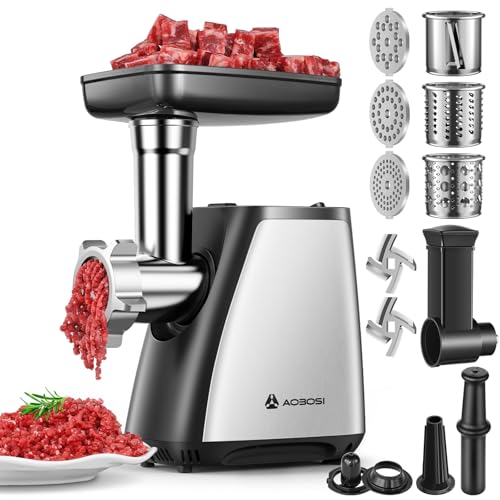
The 4-In-1 AAOBOSI is aimed at buyers who want a general kitchen machine that can grind meat, stuff sausage, make kibbe, and slice or shred ingredients. It includes three grinding plates, two blades, and additional slicing and shredding components. The listing describes a 300W motor and a 3.3-pound-per-minute claim using the 7 mm plate, giving it a useful household profile for boneless meat preparation.
Raw dog food requires extra caution with this model because the supplied instructions specifically advise avoiding meat with bones, tendons, or skin to prevent jamming. That warning makes it a poor choice for owners whose main objective is grinding soft bones. It can still serve someone preparing boneless meat and vegetables for a homemade diet, provided the ingredients and food plan are appropriate. Overload protection, a thermostat system, and a reverse button are listed, while plates and blades can be disassembled for hand washing.
Pros
- Four functional uses help reduce the need for separate kitchen appliances.
- Includes three grinding plates and two stainless steel blades.
- Reverse function may help with minor blockages.
- Overload and thermostat protection are documented.
- Disassembled plates and blades can be hand washed.
Cons
- Listing advises against grinding bones, tendons, or skin.
- Its raw-food suitability is limited mainly to appropriately prepared boneless ingredients.
Pick this machine for general food preparation with boneless raw ingredients, especially if the slicing, shredding, and kibbe accessories will see regular use. Skip it if soft-bone processing is the reason you are shopping. The clear bone warning is more useful than a broad marketing claim because it tells the buyer exactly where this model should stop.
To buy this product, click here.
9. CHEFFANO Life Electric Grinder — Best Basic Plate Selection

The CHEFFANO Life is a straightforward household grinder with three plates identified as 2 mm, 5 mm, and 7 mm. It also includes two blades, a sausage tube, and a kibbe kit. The listing mentions beef, chicken, pork, venison, and fish, so it is clearly intended for ordinary meat processing. It does not specifically support bone grinding in the supplied information, which places it below the pet-food-focused machines for this particular search.
The motor description lists 500W rated power and 2000W maximum power, plus overload protection and automatic shutoff. A reverse button is included for a stuck batch. These features may be useful during routine home preparation, but they do not establish a continuous duty cycle or support for hard ingredients. All accessories are removable, yet the instructions say to avoid the dishwasher and dry the parts after washing. That is a manageable routine, although raw food preparation rewards prompt disassembly.
Pros
- Three plate sizes support varied boneless meat textures.
- Includes two cutting blades and sausage-making accessories.
- Reverse function is provided for stuck material.
- Overload protection and automatic shutoff are listed.
- Removable components allow access for hand cleaning.
Cons
- Supplied information does not confirm bone-grinding support.
- Accessories should be kept out of the dishwasher.
This model suits a buyer who needs a basic electric grinder for boneless meat and wants several plate options without moving into a larger No. 12 format. It should not be selected for soft bones based on wattage or the word “heavy duty” in the product title. Owners preparing raw dog food should treat it as a boneless-meat machine unless the exact manufacturer guidance says otherwise.
To buy this product, click here.
Raw pet food can carry harmful bacteria that may affect both pets and people. Keep raw ingredients and equipment separate from ready-to-eat food, clean and sanitize food-contact surfaces after use, and discuss the nutritional balance of a homemade diet with a veterinarian.
Buying Guide
Match the Machine to the Actual Ingredients
Raw dog food can mean very different workloads. Some owners prepare boneless meat and vegetables, while others want to include soft chicken parts or cartilage. The supplied products do not share the same permissions. Sinyder and STX list specific soft-bone applications, the Pet Food Grinder Pro limits bones to pieces up to 5 mm, and the 4-In-1 AAOBOSI advises against bones altogether. Start with the ingredients you genuinely plan to process, then eliminate machines whose instructions do not support them.
Read Rated, Peak, and Locked Power Separately
A large number printed in a product title can be misleading. The Sinyder descriptions use a 3500W peak figure, Aiheal separates a 300W motor from 3200W locked power, and AAOBOSI lists both rated and maximum values. These figures describe different aspects of motor operation and should not be ranked as if they were identical measurements. A published capacity claim is also separate from motor power and should be treated as a listing claim rather than a guaranteed continuous rate.
Plan for Your Batch Size
The No. 12 STX grinders have larger trays and feed tubes than the compact household models, making them more suitable for owners portioning several meals at once. A bowl-style Pet Food Grinder Pro is easier to place in a small kitchen and may fit single-meal preparation better. The AAOBOSI 3-Speed model states that continuous use beyond 10 minutes should be avoided, so it needs a different workload plan from a machine marketed around larger batches.
Compare Plates and Texture Options
Plate numbers and hole sizes affect the finished texture, but a plate does not make a grinder suitable for bones by itself. Sinyder supplies 5 mm and 7 mm plates in one version, while Aiheal and CHEFFANO list 2 mm, 5 mm, and 7 mm options. The STX machines include five plates, giving more configuration choices. Check the exact included components for the specific ASIN rather than assuming every product in a brand family uses the same set.
Take Cleaning Seriously
Raw meat and pet-food ingredients leave residue around plates, blades, augers, and feed areas. The Sinyder instructions call for hand washing most parts, Aiheal and CHEFFANO say to avoid the dishwasher, and AAOBOSI lists dishwasher-safe blades and plates while still recommending hand washing attachments. Motor housings should remain separate from washing water. A grinder that takes a few extra minutes to disassemble may be easier to maintain than one with inaccessible food-contact areas.
Respect Bone and Operating Limits
Soft bones are not interchangeable with hard pork or beef bones. The Sinyder listing excludes hard pork and beef bones, the Pet Food Grinder Pro provides a 5 mm limit, and the 4-In-1 AAOBOSI warns against bones, tendons, and skin. These boundaries should guide food preparation. Never use a higher wattage number as a reason to ignore the stated limits, and do not feed unsuitable material into a grinder simply because it fits the hopper.
Best Meat Grinders for Raw Dog Food FAQ
What is the best grinder for raw dog food in this comparison?
The Sinyder Electric Meat Grinder 3500W is the strongest overall match because its supplied information specifically supports soft bones and raw pet food, includes internal metal gears, and provides multiple grinding options. It remains a household machine with limits, so it should not be used for hard pork or beef bones or continuous commercial production.
Can these meat grinders process chicken bones?
Only products whose supplied descriptions specifically support that application should be considered for chicken bones. The Sinyder models list soft chicken-related applications, and the STX models identify chicken among their soft-bone examples. The Pet Food Grinder Pro lists bones up to 5 mm. The Aiheal, CHEFFANO, and 4-In-1 AAOBOSI information does not provide equivalent support, and the 4-In-1 model specifically advises against bones.
Does a higher wattage mean a grinder is better for raw pet food?
No. The listings use peak, rated, maximum, and locked-power descriptions that are not directly interchangeable. Higher advertised power does not prove a machine can process a particular bone type or operate continuously. Ingredient support, plate and blade design, workload limits, and the manufacturer’s application guidance matter more for this use.
Should I choose a No. 12 grinder?
A No. 12 grinder can make sense for larger household batches because the STX Turboforce II and Magnum include larger trays and feed tubes. It also takes more space and may be excessive for one small portion. Grinder size does not automatically establish bone capability, so the machine still needs explicit support for the ingredients you plan to use.
Is a food processor suitable for raw dog food?
A compact food processor can work for small portions when its listing supports the ingredients and the desired texture. The Pet Food Grinder Pro is specifically aimed at pet food and lists bones up to 5 mm. The Ganiza-style chopper data is not included in this ranking because it does not provide the same direct raw pet-food or bone guidance. A processor should not be treated as equivalent to a plate-style meat grinder.
Are the grinding plates dishwasher-safe?
Instructions vary. The AAOBOSI 3-Speed listing says its stainless steel blades and plates are dishwasher-safe but recommends hand washing attachments. Sinyder, Aiheal, and CHEFFANO provide hand-cleaning guidance or say to avoid the dishwasher for their relevant parts. Check the exact product instructions before placing any component in a dishwasher, and keep the motor housing away from water.
Can I use these machines for hard beef or pork bones?
The supplied information does not support that use. The Sinyder listing specifically excludes hard pork and beef bones, while the Pet Food Grinder Pro gives a small-bone limit. A general-purpose meat grinder should not be assumed to handle hard bones merely because its title includes a large wattage figure or the words “heavy duty.”
Final Verdict
The Sinyder Electric Meat Grinder 3500W is the best overall choice in this group for home raw dog food preparation. Its supplied description directly addresses soft pet-food bones, identifies internal metal gears, includes several grinding options, and provides storage for the parts that tend to scatter across a kitchen drawer. Its peak-power and output figures remain listing claims, and its restriction against hard pork or beef bones should guide every use.
For larger household batches, the STX Turboforce II 4000 and STX Magnum offer documented No. 12 formats, high-capacity trays, and specific soft-bone examples, though they demand more space. The Pet Food Grinder Pro is the better fit for small portions and a compact setup, provided ingredients stay within its 5 mm bone guidance. Buyers who plan to grind only boneless meat can also look at the AAOBOSI, Aiheal, and CHEFFANO machines, but their supplied information does not provide the same bone-processing support. Match the grinder to the food, batch size, cleaning routine, and operating limits rather than choosing by wattage alone.
