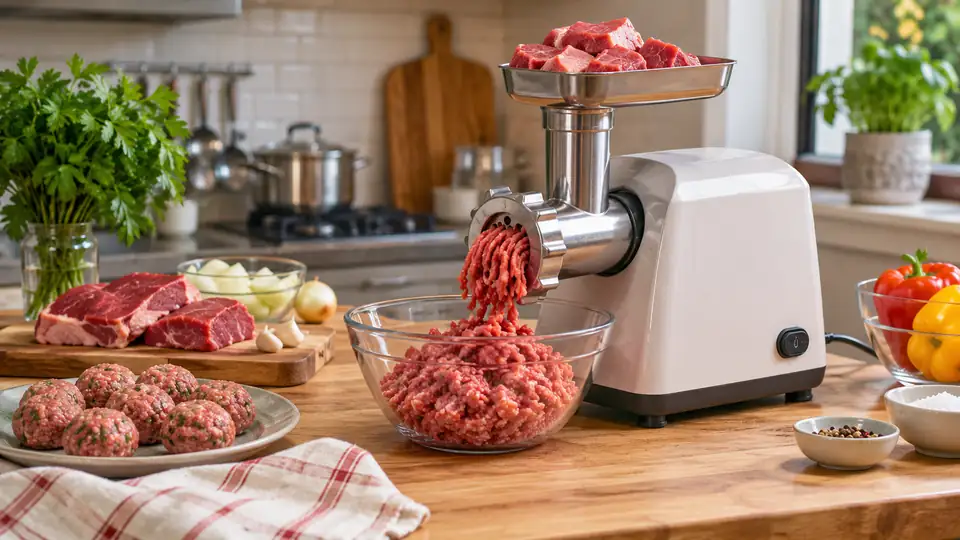
A budget meat grinder can turn a family-size pack of chuck, a batch of venison, or a tray of chicken into burgers and sausage without relying on pre-ground meat. The challenge is separating useful low-cost equipment from listings that lean heavily on inflated peak-wattage numbers. A grinder that looks powerful on paper may still be intended for short household sessions, while a manual model can be a better fit for occasional small batches if you have no interest in storing another electric appliance.
For this category, the practical details matter more than a dramatic number on the box. Rated motor power, included plate options, overload protection, reverse operation, cleaning instructions, and the machine’s intended workload all deserve attention. A grinder with a sausage tube may help with occasional links, but it will not necessarily match the control of a dedicated stuffer. Likewise, a stainless steel housing does not mean every internal part is stainless steel. Different buyers have different priorities, so this list includes compact household machines, a manual option, and larger units for shoppers whose idea of “budget” includes buying less often and keeping equipment longer.
The comparison looks at features, included plates, operating limits, and the equipment required for different types of grinder. Prices and availability change, so check current listings and compare the complete setup against your budget before deciding.
Quick Answer
- Aiheal Electric Meat Grinder: Best overall for buyers who want a versatile household grinder with three plates, sausage tubes, and overload protection.
- Oaomi 3200W Max Electric Meat Grinder: A strong alternative for home cooks who want a broad accessory set, including a kubbe kit and dishwasher-compatible selected parts.
- LHS Manual Meat Grinder: The simplest choice for small portions, occasional food preparation, and kitchens where an electric appliance is inconvenient.
- LEM Products BigBite #8: The higher-cost choice for buyers who expect more regular grinding and want a published 0.5 HP motor, stainless steel construction, and support for replacement parts.
Best Budget Meat Grinders Comparison Table
| Product | Best For | Motor or Operation | Included Grinding Options | Main Trade-Off |
|---|---|---|---|---|
| Aiheal Electric Meat Grinder | Versatile home use | 300W rated, 3200W max claim | Three plates, two blades | Attachments require hand cleaning |
| Oaomi 3200W Max Electric Meat Grinder | Accessory variety | 3200W max claim | Three plates, two blades | Mixed cleaning requirements |
| CHEFFANO Life Electric Meat Grinder | Home sausage and kubbe | 500W rated, 2000W max claim | Three plates, two blades | Hand-wash care recommended |
| LHS Manual Meat Grinder | Small batches without electricity | Hand crank | Stainless steel blades | Manual effort limits volume |
| AAOBOSI 3-Speed Electric Meat Grinder | Organized kitchen storage | 350W rated, 3000W max claim | Three plates, two blades | Continuous use limited to 10 minutes |
| AAOBOSI 3-in-1 Electric Meat Grinder | Beginners and everyday recipes | 300W motor, 2800W max claim | Three plates, two blades | Manual drying and care required |
| MEAT! Pro-Grade #12 Grinder | Residential larger batches | 500W motor | Coarse and fine plates | Fewer operating details supplied |
| LEM Products BigBite #8 | Repeated home processing | 0.5 HP motor | Three plates, knife | Higher-cost, larger investment |
| MEAT! Pro-Grade #22 Grinder | Higher-volume household processing | 1 HP motor | Coarse and fine plates | Large commercial-style footprint likely requires space |
The detailed reviews below put each grinder’s motor information, accessories, cleaning needs, and workload claims into practical context.
1. Electric Meat Grinder, Sausage Stuffer with 3 Sausage Tubes — Best Overall

The Aiheal grinder earns the top position by covering the jobs most home cooks actually ask of a budget machine. It includes three grinding plates identified as 2 mm, 5 mm, and 7 mm, along with two stainless steel cutting blades and three sausage tubes. That gives a buyer room to move from a finer mixture for meatballs to a coarser burger texture without purchasing extra plates at the start.
The listing separates a 300W motor specification from a 3200W maximum locked-power claim, so those figures should not be treated as equivalent measures of continuous performance. The useful features are the practical ones: a reverse button for clearing a feed obstruction, a locking knob, and overload protection that is described as shutting the machine off if it overheats or overloads. The removable cutting attachment should make access easier after a chili-making Saturday or a small venison session, although the parts should be washed by hand and dried carefully.
Pros
- Includes three useful plate sizes for varied home recipes.
- Provides three sausage-stuffing tubes and a kibbe-related accessory function.
- Offers reverse operation for clearing a jam.
- Lists overload protection and a locking knob.
- Removable cutting attachment supports more thorough cleaning.
Cons
- The 3200W figure is a maximum locked-power claim, not the stated regular motor rating.
- Attachments should not be placed in the dishwasher and require drying after washing.
This is a sensible fit for a household that wants one compact machine for burgers, sausage experiments, and occasional bulk preparation. Buyers processing large quantities repeatedly should read the operating instructions carefully rather than assume the peak figure indicates commercial endurance. For ordinary home portions, the combination of plate choices and protection features gives the Aiheal a broader role than many low-cost grinders.
To buy this product, click here.
2. 3200W Max Electric Meat Grinder with Sausage Tubes — Best for Accessory Variety
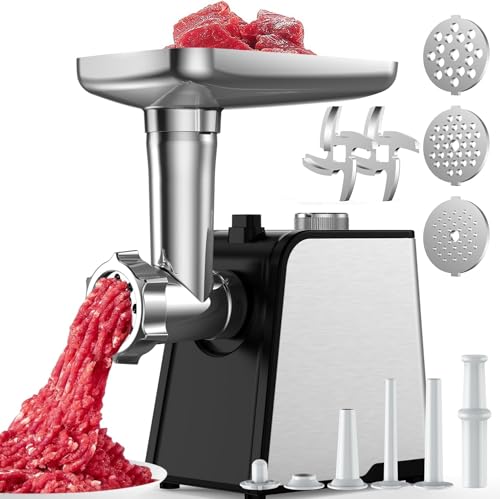
Oaomi’s main appeal is the amount of functionality included in a household-oriented package. Along with two cutting blades and three grinding discs, it includes three sausage tubes and a kubbe kit. A cook planning a weekend of burgers on Saturday and stuffed sausage on Sunday may appreciate having those attachments ready instead of treating the grinder as a single-purpose appliance.
The available information describes a pure copper motor and a 3200W maximum rating, but it does not provide a regular wattage or a published pounds-per-minute capacity. That makes it more useful to judge by its controls and accessory set than by the large number in the title. Reverse operation, safety locks, overload protection, and a thermostat system are listed for household operation. Selected blades, kubbe components, and plastic parts may be dishwasher-compatible, while the cutting board, feed screw, and retaining ring should be washed by hand.
Pros
- Includes three grinding plates for different recipe textures.
- Provides three sausage tubes and a kubbe kit.
- Lists reverse operation to help clear obstructions.
- Includes overload protection and a thermostat system.
- Selected components may be placed in the dishwasher.
Cons
- The listing does not provide a regular motor rating or stated processing capacity.
- Cleaning is split between dishwasher-compatible parts and components requiring hand washing.
Choose this model if accessory breadth matters more than a clearly documented throughput figure. It could suit a cook who wants to explore several recipes without filling a drawer with separate tools. A buyer seeking predictable larger-batch processing should look toward the LEM or MEAT! models below, where motor and capacity information is more specific.
To buy this product, click here.
3. CHEFFANO Life Electric Meat Grinder — Best for Home Sausage and Kubbe

CHEFFANO Life presents a straightforward home setup with a listed 500W motor rating and a 2000W maximum claim. The three plates are identified as 7 mm, 5 mm, and 2 mm, which gives the cook a clear spread from coarse to fine preparation. Its sausage tube and kubbe kit add useful range for a kitchen that may make meatballs one week and filled preparations the next.
The controls are uncomplicated. Meat goes into the hopper, the motor is switched on, and the reverse button is available if the feed becomes stuck. That simplicity can be welcome for a first-time grinder owner standing over a chilled tray of meat with a recipe open on the counter. Locking hardware and overload protection are listed, with automatic shutdown described for overheating or overloading. All accessories detach for cleaning, but the supplied care guidance calls for hand washing and thorough drying.
Pros
- Lists a 500W motor rating alongside a lower maximum-power claim than several rivals.
- Includes 7 mm, 5 mm, and 2 mm grinding plates.
- Provides sausage and kubbe attachments.
- Offers reverse operation for stuck material.
- Includes locking and overload-protection features.
Cons
- Attachments should be hand washed rather than placed in the dishwasher.
- The supplied information does not state a pounds-per-minute processing capacity.
This grinder is a good match for buyers who want recognizable controls and a broad recipe range without stepping into a larger machine. Its absence of a stated throughput figure means it should be treated as a home-use appliance rather than a confirmed high-volume processor. Keep portions manageable, prepare meat appropriately, and allow the machine’s protection features to do their intended job rather than forcing the feed.
To buy this product, click here.
4. LHS Manual Meat Grinder with Suction Base — Best Manual Option
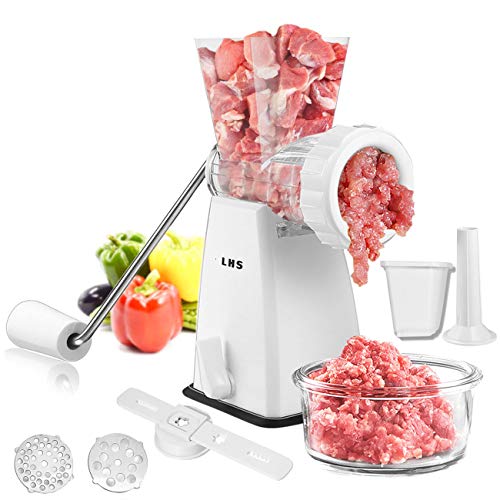
The LHS takes a different route from the electric machines. A hand crank powers the grinding action, so there is no motor rating, cord, or electrical storage issue. That can be handy in a small apartment kitchen, a backup setup, or a household preparing modest portions of chicken, meatballs, or baby food rather than processing a freezer full of meat.
Its suction base is intended for a smooth, dry counter, with the grinder positioned near the edge so the cup can form a seal. That mounting detail matters. On a damp or textured surface, the base may not hold as intended, and the person turning the crank may spend more time stabilizing the appliance. The enlarged hopper and enclosed stainless steel blades support basic preparation, while replacement blades, sausage tubes, and handles are listed as available. Manual operation still means more physical effort and slower batch work than an electric grinder.
Pros
- Works without electricity or a motor.
- Suction base is intended to stabilize the grinder on a smooth, dry counter.
- Uses stainless steel blades.
- Enlarged hopper supports more food per loading than a very small hand grinder.
- Replacement blades, tubes, and handles are listed as available.
Cons
- Hand-crank operation is less suitable for large or repeated batches.
- The suction base depends on a smooth, dry counter and correct placement.
For a student kitchen making a few burgers or a parent preparing a small portion, this manual grinder may be more practical than storing an electric appliance. A hunter or bulk-meal cook should choose an electric model instead, since the crank introduces a clear limit on both speed and physical comfort. It is a budget choice in the equipment sense, but its real advantage is simplicity rather than high output.
To buy this product, click here.
5. AAOBOSI Electric Meat Grinder with 3-Speed Touch Control — Best for Organized Storage

AAOBOSI adds a color touch interface and built-in accessory storage to the usual home grinder format. The listing gives a 350W rated power figure, a 3000W maximum claim, and a stated capacity of up to 4 pounds per minute. That capacity remains a published product claim rather than an independently verified result, but it gives shoppers a clearer reference point than a maximum wattage number alone.
Three operating modes cover meat, sausage, and reverse, while the included set has two blades, three grinding plates, and sausage and kibbe attachments. The built-in storage can help prevent a small plate or tube from disappearing into a crowded drawer. A significant operating restriction is also supplied: continuous use should not exceed 10 minutes to reduce overheating risk. The listing says the blades and plates are dishwasher-safe, although it recommends hand washing attachments for the best care.
Pros
- Provides three operating modes through a touch control panel.
- Lists a stated capacity of up to 4 pounds per minute.
- Includes three plates, two blades, and sausage and kibbe attachments.
- Built-in storage keeps accessories with the machine.
- Includes an auto-reverse function and overload-oriented operating protection.
Cons
- Continuous operation should be limited to 10 minutes.
- The 3000W figure is a maximum claim, while the listed rated power is 350W.
This model suits a busy home cook who values controls and storage as much as raw grinding hardware. Imagine pulling the grinder out for a meal-prep afternoon and finding every plate in its compartment instead of searching through three drawers. It is less appealing for anyone who expects uninterrupted processing, since the 10-minute limit needs to shape the size and rhythm of each batch.
To buy this product, click here.
6. AAOBOSI 3-in-1 Electric Meat Grinder — Best for Beginners

This AAOBOSI model keeps the first steps fairly clear for someone buying a grinder for the first time. Its stated 300W motor is paired with a 2800W maximum claim, and the listing gives a published rate of 1.5 kilograms, or about 3.3 pounds, per minute when using the 7 mm plate. That figure should be understood as a manufacturer-stated capacity rather than a promise for every meat type or preparation method.
The package includes three stainless steel plates, two blades, a sausage stuffer, and a kubbe maker. Reverse operation is available for clearing a jam, while a thermostat system and built-in circuit breaker are listed as protection features. The instructions caution against bones, tendons, and skin, which is a meaningful boundary for buyers thinking about pet-food preparation or tough wild-game trimming. Plates and blades are identified as dishwasher-safe, but the other parts should be hand washed and dried to help prevent oxidation.
Pros
- Includes a published capacity claim tied to the 7 mm plate.
- Offers three stainless steel plates and two stainless steel blades.
- Provides sausage and kubbe attachments.
- Lists reverse operation, a thermostat system, and a circuit breaker.
- Gives clear guidance against grinding bones, tendons, and skin.
Cons
- The 2800W figure is a maximum claim rather than the listed regular motor rating.
- Several components require hand washing and careful drying.
New grinder owners may appreciate the balance of familiar accessories and straightforward limits. The machine can cover burgers, sausage projects, and ordinary household grinding, but the warning about hard or fibrous material should guide preparation. Buyers who frequently process large quantities or need a machine for demanding game work should look higher in the ranking.
To buy this product, click here.
7. MEAT! 500 Watt Pro-Grade Meat Grinder #12 — Best Residential #12 Option

The MEAT! #12 moves the discussion away from large headline wattage and toward a documented grinder size. Its #12 designation is useful for shoppers who specifically want that format, while the 500W motor is listed for residential use. The product information states a capacity of 4 pounds per minute, giving it a clearer workload reference than several compact machines in this roundup.
Coarse and fine grinding plates support common burger and sausage preparations, and stainless steel construction is listed throughout the machine. Stuffing tubes are included, so the grinder can assist with sausage making, although a grinder tube should not be confused with the control and consistency of a dedicated stuffer. The available details do not provide a continuous-duty schedule, so buyers should still follow the operating guidance supplied with the machine and avoid treating the #12 designation as proof of commercial suitability.
Pros
- Uses a documented #12 grinder size.
- Lists a 500W motor for residential use.
- Provides a stated capacity of 4 pounds per minute.
- Includes coarse and fine grinding plates.
- Includes sausage-stuffing tubes and stainless steel construction.
Cons
- The available information does not specify a continuous-duty operating schedule.
- Only coarse and fine plate options are identified.
This grinder is a reasonable step up for a home cook who wants a clearly identified #12 machine and expects regular batches. It is less suited to a buyer who wants the smallest possible countertop appliance or a full accessory collection. Its published specifications are more useful than a peak-wattage headline, but they still do not establish that it belongs in a commercial food-service environment.
To buy this product, click here.
8. LEM Products BigBite #8 Meat Grinder — Best for Repeated Home Processing

The LEM BigBite #8 is a different kind of budget decision. It costs more than the compact household machines, but its documented 0.5 HP motor, stainless steel construction, and #8 head size offer a more substantial equipment profile. The listing states that it can process about 7 pounds per minute for small to medium batches, while also positioning it for burgers, sausage, pet food, and game processing.
Three plates, a knife, a stomper, and stuffing tubes are included. The noise-dampening design may be welcome in a kitchen where a grinder operates near conversation or meal preparation, although no independent noise measurement is supplied. The permanently lubricated motor reduces one maintenance task, and the machine disassembles for cleaning. It is specifically identified as unsuitable for bones, an important restriction for anyone considering it for pet-food work or wild-game scraps.
Pros
- Uses a documented #8 grinder size and 0.5 HP motor.
- Lists a published processing rate of about 7 pounds per minute.
- Includes three plates, a knife, stomper, and stuffing tubes.
- Uses stainless steel construction and a permanently lubricated motor.
- Includes a five-year factory warranty and lifetime customer support according to the listing.
Cons
- It is a larger financial investment than compact household grinders.
- The product is explicitly not intended for grinding bones.
The BigBite makes sense for a buyer who has learned that occasional grinding has become a regular kitchen routine. A family processing bulk meat or a hunter preparing boneless game may value the stronger equipment profile and stated support. Someone grinding a pound of meat a few times a year will likely find the size and investment harder to justify, especially if the extra capacity will sit unused.
To buy this product, click here.
9. MEAT! 1 HP Pro-Grade Meat Grinder #22 — Best for Higher-Volume Home Processing
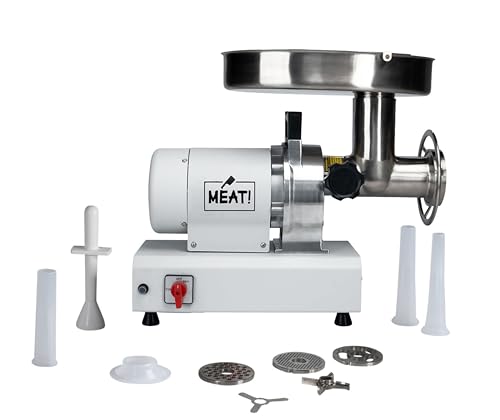
The MEAT! #22 is the largest and most workload-oriented machine in this selection. Its 1 HP motor and #22 size place it well beyond the compact electric grinders, while the listing states a processing range of 11 to 14 pounds per minute. That is a manufacturer-provided claim, not a verified continuous rate, but it indicates the intended buyer is someone preparing substantially larger batches at home.
Stainless steel construction is listed throughout the grinder, and the package includes coarse and fine plates plus stuffing plates and tubes. The machine is also compatible with a MEAT! foot pedal switch for hands-free operation, although that accessory is separate. A larger grinder needs more counter and storage planning, and its output is unnecessary for a household that only needs a few patties. The #22 designation also should not be read as automatic proof of commercial suitability without additional electrical and duty-cycle information.
Pros
- Uses a documented #22 grinder size and 1 HP motor.
- Lists a manufacturer-stated capacity of 11 to 14 pounds per minute.
- Uses stainless steel construction.
- Includes coarse and fine grinding plates plus stuffing accessories.
- Supports a separately available foot pedal for hands-free operation.
Cons
- Its larger size is excessive for very small household batches.
- The stated throughput does not establish continuous commercial-duty operation.
This is the right kind of choice for a household that buys meat in bulk, prepares several recipes in one session, or wants equipment with more room to grow. It is a poor fit for a tiny kitchen where the grinder must be lifted from a cabinet for every use. Buyers should plan the work area, electrical setup, cleaning routine, and storage before choosing a #22 machine over a smaller model.
To buy this product, click here.
Buying Guide
Match the Grinder to Your Batch Size
A person grinding a few pounds for burgers has different equipment needs from someone preparing bulk sausage after a hunting trip. Compact machines such as the Aiheal, CHEFFANO, and AAOBOSI models offer useful household accessories, while the LEM #8 and MEAT! #12 provide clearer size and capacity information. The MEAT! #22 is aimed at considerably larger workloads. Published pounds-per-minute figures are useful for comparison, but they should not be treated as guaranteed continuous output.
Read Motor Ratings Carefully
Several compact grinders list both a regular or rated motor figure and a much larger maximum or locked-power number. A 300W motor paired with a 3200W maximum claim is not directly comparable with a 500W motor simply by choosing the larger number. Rated power, maximum power, horsepower, and published capacity describe different aspects of a machine. Use the regular motor specification and any stated operating restriction as the more useful starting points.
Choose Plates for the Recipes You Make
Plate openings influence the texture of the meat as it exits the grinder. The Aiheal, CHEFFANO, and AAOBOSI 3-in-1 models provide three plate choices, while the MEAT! grinders identify coarse and fine options. A plate’s listed hole size or description belongs to that exact product and should not be assumed interchangeable with another grinder. Cutting blades also need to match the grinder’s design, so replacement parts should be selected by exact compatibility rather than appearance.
Decide Whether Manual Operation Fits
The LHS manual grinder avoids electrical requirements and can be convenient for a small kitchen, but the hand crank creates a physical limit. It is sensible for modest portions of meat or occasional food preparation. Electric machines reduce the repetitive effort and are better suited to larger batches, although they require counter space, cord storage, and more attention to motor operating limits.
Check the Sausage Accessories
A sausage tube lets a grinder assist with stuffing, but it is still a different arrangement from a dedicated sausage stuffer. Compare the number of tubes, the included plate configuration, and the type of recipes you expect to make. The Aiheal, Oaomi, CHEFFANO, and AAOBOSI models provide broad accessory sets, while the MEAT! and LEM machines focus more heavily on grinding with stuffing support included.
Plan Cleaning and Storage
Grinding attachments need prompt disassembly and cleaning because meat residue can remain around the plate, blade, feed screw, and retaining ring. The Oaomi listing allows selected components in the dishwasher but requires hand washing for others. Aiheal and CHEFFANO call for hand washing and drying, while AAOBOSI identifies dishwasher-safe blades and plates but still recommends hand washing for best care. Motor housings should not be immersed, and removable metal parts should be dried according to the product instructions.
Respect Operating Limits
Overload protection, reverse operation, and automatic shutdown features can help manage a household grinder, but they do not make it suitable for unattended use or unsupported materials. Prepare meat according to the instructions, use the supplied pusher, and avoid assuming that a grinder marketed for venison can process bones. The AAOBOSI touch-control model specifically lists a 10-minute continuous-use limit, while the LEM BigBite explicitly excludes bones.
Best Budget Meat Grinders FAQ
Are budget meat grinders suitable for venison?
Some can be suitable for boneless venison prepared in manageable batches. The Aiheal, CHEFFANO, LEM, and several AAOBOSI listings mention venison or game-related use, but marketing language does not establish a universal capacity for every hunting session. Remove bones and tough unsuitable material unless the exact product explicitly supports it, and match the machine to the amount you expect to process.
Does a higher wattage number mean a better grinder?
No. The product data includes maximum or locked-power figures that are much higher than the regular motor ratings. Those figures are not interchangeable with rated power or a verified processing rate. A grinder with a clearly stated motor specification, capacity claim, and operating limit may be easier to evaluate than one promoted mainly through a large maximum-wattage number.
What grinder size is best for home use?
There is no single answer. Compact household grinders can suit occasional burgers and sausage, while a documented #8 or #12 grinder may be more appropriate for repeated batches. A #22 machine provides more capacity but takes more space and may be unnecessary for small portions. Grinder size does not automatically establish motor power or commercial suitability.
Can a meat grinder grind bones?
Do not assume so. The LEM BigBite listing specifically says it is not for bones, and the AAOBOSI 3-in-1 information advises against bones, tendons, and skin. A heavy-duty label or large wattage claim is not enough evidence. Only use a machine for bone grinding if the exact product information explicitly supports that application.
Are the included sausage tubes enough for frequent sausage making?
They can support occasional sausage preparation, but a grinder attachment and a dedicated sausage stuffer perform different roles. Tube size, casing fit, filling control, and batch volume matter. If sausage is the main reason for buying equipment, compare dedicated stuffers separately rather than assuming every grinder’s tube will provide the same control.
Can meat grinder parts go in the dishwasher?
Follow the exact product instructions. The Oaomi listing identifies selected blades, kubbe parts, and plastic components as dishwasher-compatible, while other pieces require hand washing. AAOBOSI lists dishwasher-safe blades and plates but recommends hand washing attachments. Aiheal and CHEFFANO recommend hand washing. Motor housings and electrical parts should never be treated as dishwasher components.
Final Verdict
The Aiheal electric grinder is the strongest overall match for Best Budget Meat Grinders because it combines three plate choices, two blades, sausage tubes, reverse operation, and overload protection in a home-focused design. Its 300W motor specification should be distinguished from the 3200W maximum locked-power claim, but the practical package remains broad enough for burgers, meatballs, sausage projects, and occasional prepared game.
The Oaomi and CHEFFANO models are useful alternatives for cooks who care about sausage and kubbe accessories, while the LHS is the better fit for small portions and kitchens that do not need electricity. Buyers processing meat regularly should look at the LEM BigBite #8 or MEAT! #12, and the MEAT! #22 is the logical step for larger household batches. The right choice depends on workload, available counter space, cleaning habits, and whether a peak-wattage headline has been mistaken for continuous grinding power.
