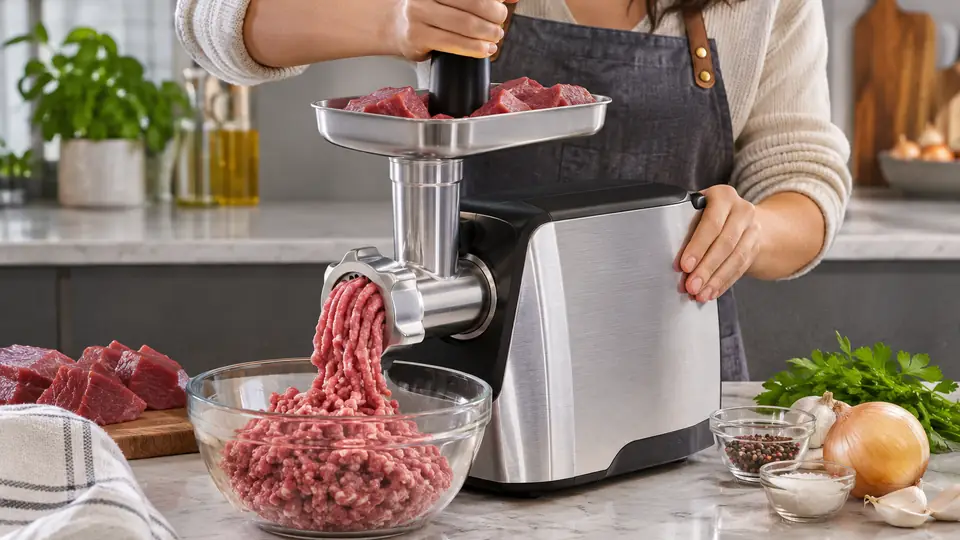
A Saturday spent trimming a venison roast or preparing several pounds of chuck can make a small electric grinder feel like the right kitchen upgrade. These machines save the hand-crank effort, give you more control over grind texture, and often add sausage-stuffing or kibbe attachments for cooks who want one countertop appliance to handle several jobs. The challenge is separating useful motor information from dramatic peak-wattage claims, since a large number on the box does not automatically describe continuous grinding ability.
For electric meat grinders, the useful details are the ones that affect actual ownership. Grinder head size, rated motor power, published capacity, plate selection, reverse operation, construction, and cleaning requirements all matter. A compact household machine may suit burgers and occasional sausage batches, while a #12 grinder with a larger hopper makes more sense for repeated wild-game or bulk-meat sessions. Some buyers will prioritize storage and simple controls, while others will accept a larger footprint for a metal drive system and higher stated throughput.
The grinders below differ in head size, motor specifications, included plates, and operating restrictions. Compare those details with your usual batch size, available space, and the cleaning required after each session.
Quick Answer
- Best Overall: The LEM Products BigBite #8 combines a 0.5 HP motor, stainless steel components, three plates, sausage tubes, and a published capacity of about 7 pounds per minute for small to medium household batches.
- Best for Higher-Capacity Home Processing: The STX International Turboforce II 4000 is a documented #12 grinder with a large hopper, multiple plates, foot pedal, and a published soft-bone capability that is specific to the product listing.
- Best Metal-Bodied Alternative: The Weston #12 offers a 1 HP motor, die-cast aluminum body, metal gears, two speeds, reverse, and a stated 4 to 5 pounds per minute capacity.
Best Electric Meat Grinders Comparison Table
| Product | Best For | Grinder Size | Motor Specification | Main Trade-Off |
|---|---|---|---|---|
| LEM Products BigBite #8 | Most home kitchens | #8 | 0.5 HP | Smaller head than #12 models |
| Weston #12 | Metal-bodied batch grinding | #12 | 750 W, 1 HP | Die-cast aluminum body adds size |
| STX Turboforce II 4000 | Large home-processing sessions | #12 | 2,000 W locked motor claim | Household use, not general commercial use |
| STX Turboforce 3000 | Accessory-heavy home setups | #12 | 3,000 W locked motor claim | Will not grind bones |
| 1 HP #12 Electric Grinder | Two-speed grinding and stuffing | #12 | 600 W rated, 3,600 W peak | Only two grinding plates listed |
| Sinyder Electric Meat Grinder | Storage and metal gears | Not stated | 700 W rated, 3,000 W maximum | Plate selection is less extensive |
| AAOBOSI Digital Grinder | Preset-driven kitchen use | Not stated | 3,000 W maximum | Continuous use limited to 10 minutes |
| Aiheal Electric Grinder | Simple home grinding and sausage | Not stated | 300 W, 3,200 W locked power | Attachments require hand cleaning |
| AAOBOSI 4-in-1 Grinder | Grinding plus grating and shredding | Not stated | 300 W, 2,800 W maximum | Listing advises against bones, tendons, and skin |
The detailed reviews explain how these machines differ in workload, controls, included equipment, and maintenance, so you can match the grinder to the way you actually prepare meat.
1. LEM Products BigBite #8 Meat Grinder — Best Overall

The LEM Products BigBite #8 lands in a useful middle ground for home cooks who want a real grinder rather than a small occasional-use gadget. Its 0.5 HP motor and #8 format are aimed at small to medium batches, and the listing states a capacity of about 7 pounds per minute. That figure should be read as a published claim rather than a guarantee for every meat temperature, cut, or feeding speed, but it gives this machine a clearer workload position than vague peak-wattage marketing.
Its stainless steel construction, three grinding plates, knife, stomper, and sausage-stuffing tubes make the package practical for burgers, sausage, game, and meal preparation. The noise-dampening design may appeal to buyers who do not want a shrieking appliance running beside the kitchen counter. The permanently lubricated motor and parts availability are useful ownership details, especially for someone planning to keep the grinder for repeated seasonal batches rather than replacing it after a year.
Pros
- Documented #8 grinder format suits many household batches.
- 0.5 HP motor and published capacity provide clearer workload guidance.
- Stainless steel construction and included three-plate setup.
- Includes sausage-stuffing tubes and a meat stomper.
- Five-year factory warranty and lifetime customer support are listed.
Cons
- It is not intended for grinding bones.
- The #8 head is smaller than the #12 formats suited to larger sessions.
This is the most balanced choice for a household that grinds meat regularly but does not need a commercial-sized machine. It also makes sense for hunters handling manageable batches of boneless game. Buyers processing very large quantities may prefer a #12 model with a larger hopper, while cooks who want elaborate digital controls will find the LEM more straightforward than feature-heavy countertop machines.
To buy this product, click here.
2. Weston #12 Electric Meat Grinder — Best Metal-Bodied Alternative

The Weston #12 is a stronger fit for shoppers who want a larger grinder head and a clearly documented metal drive arrangement. Its listing identifies a 750-watt, 1 HP motor, a #12 format, metal gears, and a die-cast aluminum body. It also states a grinding rate of 4 to 5 pounds per minute. That published rate places the Weston among the more substantial household choices in this group, although real output will still depend on meat preparation and operating conditions.
Two speeds give the machine a useful division of labor. The faster setting is intended for grinding, while the slower setting supports sausage stuffing. Reverse operation can help clear a jam without dismantling the head immediately. A cam-action headlock also makes the grinding head easier to secure and remove, which matters after a cold batch of meat has left greasy residue around every connection.
Pros
- Documented #12 grinder head for larger household batches.
- 1 HP motor and 750-watt specification are clearly stated.
- Die-cast aluminum body and metal gears.
- Two speeds support separate grinding and stuffing tasks.
- Includes stainless steel grinding plates and sausage accessories.
Cons
- The larger #12 format requires more storage and counter space than a #8 grinder.
- The listing does not provide a detailed duty-cycle specification.
Choose the Weston when a metal-bodied #12 grinder feels more appropriate than a compact kitchen appliance. It is particularly appealing for repeated burger, sausage, and boneless game preparation. A buyer who grinds only a pound or two at a time may find its larger format unnecessary, while anyone expecting commercial food-service operation should verify workload requirements rather than relying on the household grinder label.
To buy this product, click here.
3. STX International Turboforce II 4000 — Best for Higher-Capacity Home Processing
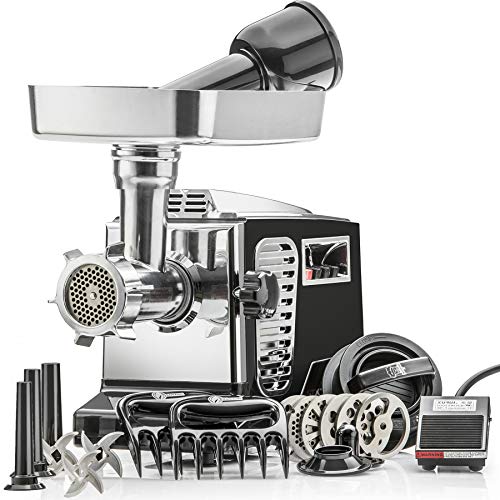
The Turboforce II 4000 is built around a #12 head and a high-capacity home-processing setup. Its product information lists a 2,000-watt locked motor claim, a large tray that holds more than 3 pounds of prepared meat, three stainless steel cutting blades, five grinding plates, and a dedicated sausage-stuffing plate. The listing also publishes a rate of 220 to 260 pounds per hour depending on plate choice and meat type. That figure is a manufacturer claim, not an independently confirmed continuous result.
This model has one of the broadest accessory packages in the group. A foot pedal offers an alternate control method, and the box includes sausage tubes, a kibbe attachment, meat claws, and a burger-slider press. The listing specifically describes support for soft bones from chicken, rabbit, squirrel, and quail. That claim should not be generalized to hard bones or to other grinders, and the machine is still presented as a household product rather than a universal commercial processor.
Pros
- Documented #12 head and high-capacity meat tray.
- Five grinding plates and three stainless steel cutting blades.
- Includes foot pedal, sausage tubes, kibbe attachment, and meat tools.
- Published listing includes a specific soft-bone application.
- Three-year warranty is listed.
Cons
- Soft-bone capability is application-specific and should not be extended to hard bones.
- The extensive accessory set requires more storage and cleaning.
This is a sensible pick for a household that processes larger prepared batches and will use more than the basic grinding function. The foot pedal can be useful when both hands are occupied with feeding and guiding meat, though some cooks will prefer the simpler controls of the LEM or Weston. Skip it if your routine is limited to occasional burgers and you have little room for a large tray and accessory collection.
To buy this product, click here.
4. STX International Turboforce 3000 Series — Best Accessory Package

The Turboforce 3000 Series takes a similar large-home-grinder approach but gives buyers a particularly broad collection of included parts. It has a documented #12 polished aluminum grinding head, an extra-large hopper that holds approximately 3 pounds of prepared meat, three stainless steel blades, five grinding plates, three stuffing tubes, a kibbe attachment, and a foot pedal. The published locked motor wattage is 3,000 watts, while the listing says normal use under load is between 800 and 1,200 watts. Those figures should not be treated as interchangeable measurements.
The model is intended for meat rather than general kitchen experimentation. Its product information specifically says not to grind tendons, vegetables, plants, nuts, or fruit, and clearly states that it will not grind bones. That clarity is valuable because it prevents buyers from confusing a substantial household meat grinder with a multipurpose food processor. The 110-volt, 60 Hz requirement also deserves a check before purchase.
Pros
- Documented #12 head with a large meat hopper.
- Five grinding or stuffing plates offer texture and sausage flexibility.
- Includes three stainless steel cutting blades.
- Foot pedal, kibbe attachment, stuffing tubes, and meat tools are included.
- Three-year warranty is listed.
Cons
- The product is explicitly for household use and is not a commercial machine.
- It will not grind bones and has several stated material restrictions.
The 3000 Series fits cooks who appreciate a complete meat-preparation kit and understand its boundaries. It is a strong candidate for burger, sausage, and prepared game sessions where the larger hopper reduces repeated loading. Buyers wanting to process vegetables or bones should choose a different tool entirely, and anyone who does not need the extra plates may find the package more elaborate than necessary.
To buy this product, click here.
5. 1 HP #12 Electric Meat Grinder — Best for Two-Speed Grinding and Stuffing

This grinder is aimed at home users who want a documented #12 head and separate high and low operating modes without moving to a dedicated sausage stuffer. Its listing identifies a 600-watt rated, 3,600-watt peak, 1 HP motor and publishes a capacity of 8.8 pounds per minute. Since peak and rated power describe different things, the larger peak figure should not be read as continuous operating power or as proof of a particular real-world throughput.
The low-speed setting is intended for stuffing, while the faster setting handles grinding. A reverse function helps clear the auger when a prepared batch becomes difficult to feed. The die-cast aluminum body, stainless steel plates, stainless steel blade, sausage nozzle, and kibbe kit form a practical core package, though the listing names two grinding plates rather than the five supplied with some STX models.
Pros
- Documented #12 head and 1 HP motor specification.
- Separate high and low speeds support grinding and stuffing.
- Reverse function is included for clearing clogs.
- Die-cast aluminum body with stainless steel cutting components.
- Includes sausage nozzle and kibbe attachment.
Cons
- Only two grinding plates are listed in the supplied product information.
- The 8.8-pound-per-minute figure is a published claim, not an independent measurement.
This model suits a buyer who values a larger head and straightforward two-speed operation. It can be a good match for family meal preparation, sausage making, and boneless wild game, provided the purchaser treats the stated capacity as a reference rather than a promise. Those who want more texture choices or a larger accessory collection may prefer either STX option above.
To buy this product, click here.
6. Sinyder Electric Meat Grinder — Best for Integrated Storage

The Sinyder focuses on a tidy home-kitchen arrangement. Its product information lists a stainless steel body, metal gears, a 700-watt rated motor, and a 3,000-watt maximum output. It also states a published capacity of up to 5 pounds per minute. The listing does not identify a grinder head size, so shoppers who need a specific #8 or #12 replacement ecosystem should not infer one from the capacity claim.
The included equipment covers the main household jobs: two stainless steel blades, grinding plates, three sausage-filler tubes, a kibbe kit, and a storage box that can also serve as a meat receiver. One-button operation and reverse control keep the interface simple. Some plates and blades may be dishwasher-safe according to the listing, but the motor housing, tray, and other specified parts must stay out of the dishwasher, making careful sorting part of cleanup.
Pros
- Stainless steel body and listed metal gears.
- 700-watt rated motor specification is provided.
- Includes sausage tubes, kibbe kit, two blades, and grinding plates.
- Storage box helps organize loose attachments.
- Reverse, thermal protection, and circuit-breaker features are listed.
Cons
- The supplied information does not identify a grinder head size.
- The listing gives different cleaning instructions for different components.
Sinyder is a reasonable choice for a cook who wants a multifunctional grinder that does not leave every tube and plate scattered in a drawer. It fits burgers, sausage, meatballs, and similar household jobs. Buyers comparing it with a documented #12 machine should remember that capacity claims and head-size information are not equivalent, especially if seasonal processing involves many consecutive batches.
To buy this product, click here.
7. AAOBOSI Multifunctional Digital Meat Grinder — Best for Preset-Driven Controls
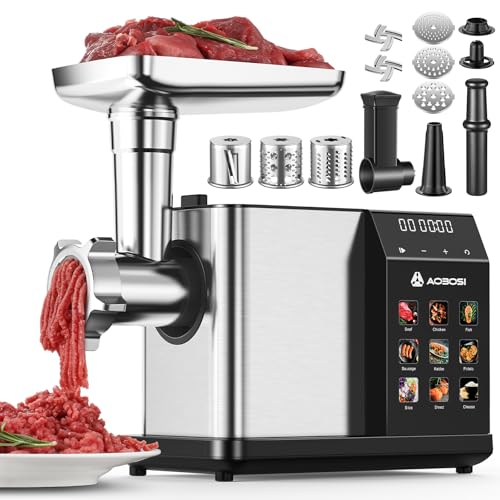
The AAOBOSI digital model takes a different route from the mechanical controls on the larger grinders. Its color touch screen provides nine presets and nine speed settings, with dedicated meat, sausage, and reverse modes. That arrangement may appeal to a cook who prefers selecting a function on a screen rather than managing a basic switch. The listing states a 3,000-watt maximum output and a published capacity of up to 4 pounds per minute, but it also advises avoiding continuous use beyond 10 minutes.
Built-in storage keeps the included blades, plates, sausage components, kibbe attachment, and vegetable-cutting parts with the main unit. That makes the appliance attractive for a busy kitchen where a loose accessory pile tends to vanish behind mixing bowls. Stainless steel blades and plates are identified as dishwasher-safe, although the listing recommends hand washing for best results. Preset controls add convenience, but they do not change the machine’s stated operating limit or make it a commercial grinder.
Pros
- Nine touch-screen presets and nine speed settings.
- Auto-reverse function is included to help address jams.
- Built-in storage keeps attachments with the grinder.
- Includes meat, sausage, kibbe, and vegetable-processing accessories.
- Published capacity reaches up to 4 pounds per minute.
Cons
- Continuous use should not exceed 10 minutes according to the listing.
- The grinder head size is not identified in the supplied information.
This model is best for home cooks who value interface flexibility and accessory organization over a documented grinder-size designation. It can handle varied kitchen projects, from burger meat to sausage and grated ingredients, in appropriately limited sessions. Buyers preparing long processing runs may prefer a simpler machine with clearer heavy-workload positioning and should pay close attention to the 10-minute operating guidance.
To buy this product, click here.
8. Aiheal Electric Meat Grinder — Best for Three-Plate Home Use

The Aiheal is a straightforward household grinder with a useful selection of included components. Its listing identifies a 300-watt motor and 3,200-watt locked-power claim, along with three plates described as 2 mm, 5 mm, and 7 mm. Those plate sizes give cooks several texture options for burgers, meatballs, and sausage preparation. The power descriptions should remain separate, since locked or maximum wattage does not establish continuous operating performance.
Two stainless steel cutting blades, three sausage tubes, and a kibbe function broaden the appliance beyond basic ground meat. A reverse button helps with clearing the auger, while a locking knob and overload protection are listed for operation. The cutting attachment comes apart for cleaning, but the supplied instructions say not to put the parts in the dishwasher and recommend drying them with a soft cloth.
Pros
- Three documented plate sizes offer varied grinding textures.
- Includes two blades and three sausage-stuffing tubes.
- Kibbe function adds another supported food-preparation use.
- Reverse button and overload protection are listed.
- Detachable cutting attachment simplifies access during cleaning.
Cons
- The product information advises against dishwasher cleaning.
- The grinder head size and continuous duty cycle are not stated.
Aiheal fits a home kitchen where versatility matters more than a formal head-size designation. It is suitable for ordinary beef, pork, chicken, fish, and boneless game preparation when used within the machine’s instructions. Buyers planning repeated high-volume sessions should step up to a documented #8 or #12 machine, while occasional sausage makers may appreciate the three tube sizes.
To buy this product, click here.
9. AAOBOSI 4-in-1 Meat Grinder — Best for Grinding and Grating Versatility
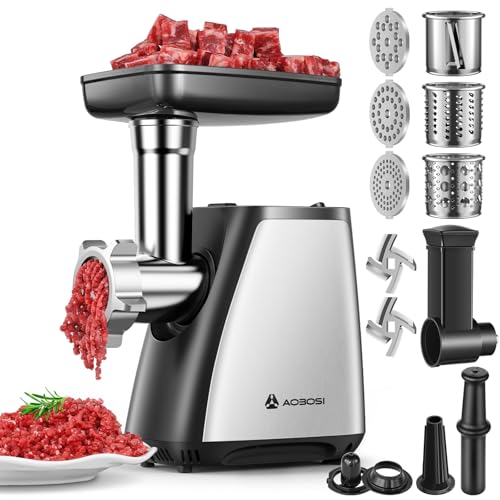
This AAOBOSI model is aimed at cooks who want several prep functions in one appliance. Alongside meat grinding, it includes sausage stuffing, kibbe making, cheese grating, and vegetable slicing or shredding attachments. The listing identifies a 300-watt motor, a 2,800-watt maximum claim, and a published rate of 1.5 kilograms, or about 3.3 pounds, per minute with the 7 mm plate. That rate remains a manufacturer-stated figure and depends on preparation and use.
The stainless steel casing and ABS material are paired with three grinding plates, two meat blades, and three slicing or shredding blades. Reverse operation, overload protection, a thermostat system, and an automatic circuit breaker are listed. The instructions advise avoiding bones, tendons, and skin, which is a meaningful boundary for anyone comparing this compact multifunction unit with larger game-processing grinders.
Pros
- Four supported functions cover grinding, stuffing, kibbe, and grating or shredding.
- Includes three grinding plates and two meat blades.
- Published output is up to about 3.3 pounds per minute.
- Reverse, overload, thermostat, and circuit-breaker features are listed.
- Grinding plates and blades are identified as dishwasher-safe.
Cons
- The listing advises against bones, tendons, and skin.
- The grinder head size is not provided.
This is a practical option for a cook who wants one appliance for several small kitchen jobs and has limited storage for separate graters or shredders. It is less appropriate for large wild-game sessions where a documented #12 head would provide a clearer workload match. Hand washing the remaining components and drying alloy parts carefully also remains part of ownership, despite the dishwasher guidance for selected blades and plates.
To buy this product, click here.
Buying Guide
For a broader look at different grinder types and workloads, see our meat grinder comparison.
Match the Grinder Head to the Workload
A grinder size gives more useful context than a peak-wattage figure by itself. The LEM is identified as a #8, while the Weston and STX models are documented as #12 machines. A #12 grinder may be a better fit for large prepared batches, but it also generally takes more room and may be unnecessary for someone grinding a small bowl of meat for dinner. Do not assume that two machines with similar capacity claims use interchangeable plates or knives.
If you are still deciding on the power source, our manual versus electric comparison explains the trade-offs.
Separate Rated Power From Peak or Locked Power
Product listings use several power descriptions, including rated watts, peak watts, locked motor wattage, and horsepower. These terms describe different parts of a motor specification. The 600-watt rated and 3,600-watt peak figures on one #12 grinder should not be compared as though both represent normal continuous output. A 0.5 HP motor, such as the one listed for the LEM, also needs to be judged alongside head size, included parts, stated capacity, and operating restrictions.
Read Published Capacity as a Reference
A stated rate such as 4 pounds per minute, 7 pounds per minute, or 220 to 260 pounds per hour is useful for positioning products, but it is not an independently verified promise. Meat temperature, fat content, connective tissue, plate choice, preparation, and feeding speed can change the result. Capacity claims also do not establish a duty cycle. If a model says continuous use should stay below 10 minutes, that limitation still applies regardless of its maximum wattage.
Compare Plates, Blades, and Stuffing Accessories
Grinding plates control the size of the openings through which meat exits, while the cutting blade works against the plate to cut the meat. More plates provide more texture choices, but they also create more parts to wash and store. Sausage tubes are useful for stuffing, though a tube on a grinder does not make that machine equivalent to a dedicated sausage stuffer. Check the included tube sizes and plate details rather than assuming every accessory fits every grinder.
Check Cleaning Instructions Before Buying
Electric grinders require separation between washable food-contact parts and the motor housing. Some products identify selected plates and blades as dishwasher-safe, while others instruct owners to hand wash every attachment and dry parts promptly. The Sinyder listing, for example, distinguishes dishwasher-suitable accessories from the tray and machine components. A grinder that takes several minutes to disassemble may be less appealing after frequent sausage sessions, even if its accessory list looks impressive.
Stay Within the Stated Application
Boneless meat is the normal comparison point for household electric grinders. The STX Turboforce II listing makes a specific soft-bone claim for certain small animal bones, while the Turboforce 3000 explicitly says it will not grind bones. The AAOBOSI 4-in-1 listing advises against bones, tendons, and skin. These statements are product-specific. Do not transfer a bone claim from one model to another, and do not treat a heavy-duty label as permission to process unsupported materials.
Best Electric Meat Grinders FAQ
Are electric meat grinders better than manual grinders?
Electric models reduce hand-crank effort and are generally more convenient for repeated batches. They also require a suitable power outlet, counter space, and more attention to motor operating limits. A manual grinder can still make sense for very small batches or situations where electricity is unavailable, but the products in this roundup are designed for powered household grinding.
What grinder size should I choose for home use?
A #8 model such as the LEM can suit many household batches, while a documented #12 model may be more appropriate for larger prepared quantities. Head size is only one factor. Motor specification, hopper size, plate compatibility, capacity claims, and storage all affect the decision. Do not assume that a larger number automatically means a better texture or unlimited operating time.
Does a higher wattage mean a better meat grinder?
No. Listings may show rated power, peak power, or locked motor wattage, and those figures are not interchangeable. The motor should be considered alongside the grinder head, construction, published capacity, and operating restrictions. A machine with a dramatic maximum-wattage number may still have a short recommended operating period.
Can these grinders process venison?
Several listings describe their machines for venison or wild game, including the LEM, Weston, and other household models in this roundup. That generally refers to properly prepared boneless meat. Trim away unsuitable connective tissue according to the product instructions, keep the workload within the stated limitations, and do not infer bone-grinding capability from a hunting-related product description.
Can I use an electric meat grinder to make sausage?
Many of these machines include stuffing tubes or a sausage attachment. The low-speed setting on models such as the Weston and the 1 HP #12 grinder is specifically associated with stuffing. A grinder with tubes can help with occasional sausage batches, but a dedicated sausage stuffer may offer a more specialized setup for larger or frequent casing-filled batches.
Are the grinding plates dishwasher-safe?
It depends on the product and the specific component. AAOBOSI identifies selected blades and plates as dishwasher-safe, while Aiheal and CHEFFANO-style instructions in this category commonly call for hand washing. The supplied information for the selected products also distinguishes washable attachments from motor housings, trays, or parts that should be dried carefully. Follow the instructions for the exact model.
Can these household grinders be used commercially?
The supplied products are positioned for home use, even when their listings use terms such as heavy duty or describe substantial capacities. Household construction and published capacity do not establish suitability for commercial food-service workloads. Buyers with a professional processing requirement should verify electrical, sanitation, duty-cycle, service, and capacity requirements separately.
Final Verdict
The LEM Products BigBite #8 is the best overall choice for most home cooks seeking an electric meat grinder with a clear, balanced specification set. Its documented 0.5 HP motor, #8 format, stainless steel construction, three plates, sausage tubes, and stated support package cover everyday burgers, sausage, meal prep, and manageable boneless game batches. The Weston #12 is the better alternative for shoppers who want a larger head, a 1 HP motor, metal gears, and a die-cast aluminum body.
For larger home-processing sessions, the STX Turboforce II 4000 offers the most substantial package and a specific soft-bone claim that must be kept within its stated scope. The STX Turboforce 3000 is attractive for its accessories but clearly excludes bones and several other materials. Compact AAOBOSI, Aiheal, and Sinyder models make more sense for ordinary kitchen use, accessory variety, or storage convenience. Choose by batch size, head size, rated motor information, cleaning routine, and supported applications rather than by the largest wattage number on the product page.
