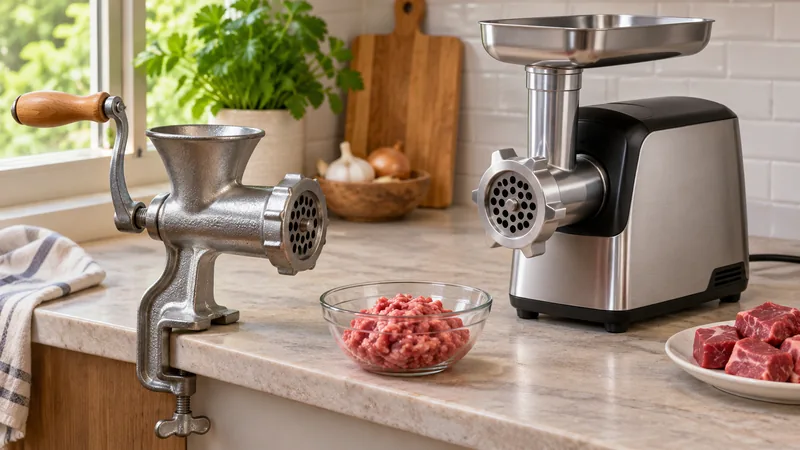
A manual grinder can suit occasional small batches when you have a stable mounting surface and do not mind turning a crank. An electric grinder supplies the drive for you and may be more practical for frequent or larger sessions, provided its documented workload and operating limits match the job.
For individual models, compare our guides to electric meat grinders and manual meat grinders.
Neither design guarantees a particular texture or processing speed. The useful choice depends on how much you grind, where you work, and how much setup and cleanup you are willing to handle.
At a glance
| Consideration | Manual grinder | Electric grinder |
|---|---|---|
| Power | Hand crank | Motor and suitable electrical outlet |
| Setup | Usually requires a secure mount | Requires stable counter space |
| Effort | Continuous hand effort | Motor drives the auger |
| Workload | Often considered for smaller sessions | Varies considerably by model |
| Cleaning | Disassemble food-contact parts | Disassemble parts; keep motor housing out of water |
When a hand-crank grinder makes sense
A manual grinder works without an electrical outlet. It can be useful when grinding is occasional, storage is limited, or the owner prefers a mechanically simple device. You still need enough space to turn the handle and a mounting arrangement that stays secure throughout the job.
Check the clamp opening against the thickness and shape of your counter. Some designs use another mounting method, so confirm what hardware and support the manufacturer requires. A weak overhang or unstable table can make feeding and cranking awkward.
Manual operation also sets a practical limit: a longer session demands more physical effort. The amount a person can comfortably process varies with the machine, preparation, and individual. Do not assume a stated head size removes that effort.
When electric power helps
An electric grinder turns the cutting assembly with its own motor. That reduces cranking effort, but machines vary from small household units to larger equipment with different power supplies, footprints, and operating restrictions. For specific machines across several uses, explore our overall meat grinder comparison.
Look for the rated motor specification when supplied and distinguish it from peak or locked-motor wattage. High peak wattage alone does not establish normal output or continuous-duty capability. Compare published processing claims alongside the manual’s actual operating limits.
Consider the feed tray, included plates, weight, and room needed to remove the head. A reverse function may help address certain jams when the manufacturer permits it, but it does not replace proper preparation or the instructions for clearing an obstruction.
Texture depends on more than the power source
Both types use a cutting assembly and a perforated plate. Plate holes, the condition and fit of the knife and plate, and meat preparation all influence the result. A manual label does not guarantee a coarse grind, and a motor does not automatically produce a finer one.
Follow the manufacturer’s directions for feeding and for the materials the machine can process. Use the supplied or approved pusher; never put fingers or utensils into an operating feed tube. Do not assume either type can grind bone.
Cleaning and food handling
Both designs contact raw meat and need to be taken apart and cleaned according to their instructions. Wash the work surface and utensils used with raw meat; USDA explains how cross-contamination can occur. Unplug an electric machine before disassembly and do not immerse its electrical housing.
Dishwasher suitability is specific to the part. For example, KitchenAid’s metal attachment instructions require hand-washing its metal parts; that is an example, not a rule for every grinder.
Choose the design that fits your regular batch and your workspace. A compact manual setup is not automatically inadequate, and a large electric machine is not automatically necessary for every home user.
