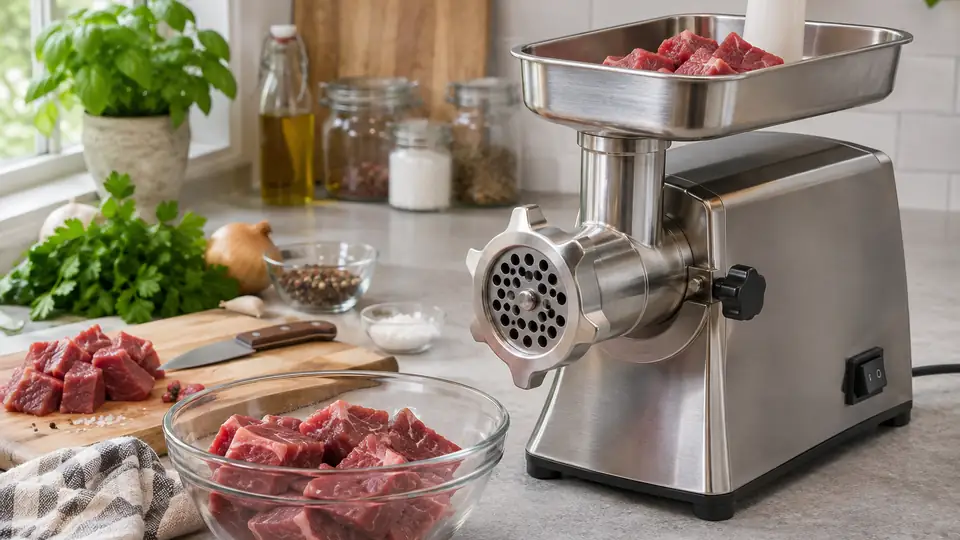
A #12 meat grinder is the point where occasional burger making gives way to serious batch preparation. The larger head size can suit families buying meat in bulk, hunters processing boneless venison, and home sausage makers who want more control over texture and ingredients. The catch is that a #12 designation does not tell you everything. Motor ratings, published throughput, plate dimensions, construction, stuffing attachments, and operating restrictions still vary considerably.
A common mistake is comparing peak wattage figures as if they were equal measures of working power. A listing that advertises 3,000 or 3,600 watts may be quoting peak output, while another model lists rated wattage or horsepower. The same caution applies to replacement plates and knives. A part can be labeled #12 and still fail to fit a particular auger or drive shaft. Batch size, meat preparation, cleaning access, and the type of sausage work you plan to do matter far more than a bold number on the box.
The comparison focuses on complete #12 grinders with different controls, included equipment, and workload claims. Check the published head size, operating limits, cleaning instructions, and available accessories before choosing a machine.
Quick Answer
- LEM Products BigBite #12 is the strongest overall match for larger home batches, game processing, and sausage preparation. Its 0.75 HP motor, stated output of up to 11 pounds per minute, three plates, and stainless steel components give it a well-rounded setup.
- Valley Sportsman #12 is a practical alternative for buyers who want full stainless steel construction, overload protection, two plates, and three stuffing tubes.
- Weston #12 suits home users who value two speeds, reverse operation, a cam-action headlock, and a more compact feature set for grinding and stuffing.
Best #12 Meat Grinders Comparison Table
| Product | Best For | Motor or Set Details | Main Trade-Off |
|---|---|---|---|
| LEM BigBite #12 | Overall home and game use | 0.75 HP, up to 11 lb/min stated | More substantial investment |
| Valley Sportsman #12 | Stainless steel batch processing | 0.75 HP, up to 450 lb/hr stated | Published rate is not independently verified |
| Weston #12 | Home grinding and sausage stuffing | 750 W, 1 HP, 4 to 5 lb/min stated | Die-cast aluminum body |
| MEAT! Pro-Grade #12 | Coarse and fine grinding | 0.75 HP, 7 to 10 lb/min stated | Foot pedal sold separately |
| Barton Commercial #12 | Home or small commercial prep | 1100 W, two plates included | Large countertop footprint |
| AAOBOSI #12 | Wild game and portable use | 3000 W peak, 7 lb/min stated | Peak wattage is not rated operating power |
| VEVOR #12 | Accessory-rich grinding | 750 W, 1 HP, up to 552 lb/hr stated | Not suitable for bones or frozen meat |
| Electric #12 Grinder | Two-speed home use | 600 W rated, 3600 W peak, 1 HP | Peak figure needs careful interpretation |
| STX Turboforce 3000 Series | Home grinding and sausage preparation | 3,000 W locked-motor claim; foot pedal | Home-use machine; peak figure is not continuous power |
The detailed reviews explain where each option fits, which specifications are documented, and where buyers should slow down before ordering.
1. LEM Products BigBite #12 Meat Grinder — Best Overall

The LEM BigBite has the most complete documented package in this group for a buyer who wants one machine to cover burgers, sausage, bulk meat, and boneless game. Its 0.75 HP motor is paired with a published capacity of up to 11 pounds per minute, although that figure should be treated as a manufacturer-stated rate rather than a promise of continuous real-world output. The stainless steel construction and noise-dampening design also make sense for a grinder that may be used repeatedly during a busy preparation session.
Its included equipment helps explain the ranking. Three grinding plates, a knife, stomper, and stuffing tubes mean fewer immediate accessory decisions, while the permanently lubricated motor reduces one maintenance task. The grinder is described for beef, pork, poultry, lamb, and venison, and the listing also mentions raw chicken bones. That specialized claim should be checked against the current operating instructions before use, since bone hardness and preparation can vary substantially.
Pros
- Documented 0.75 HP motor and stated capacity of up to 11 pounds per minute.
- Stainless steel construction suits frequent food-processing work.
- Includes three plates, a knife, stomper, and sausage-stuffing tubes.
- Noise-dampening design and permanently lubricated motor are useful ownership details.
- Five-year factory warranty and lifetime customer support are listed advantages.
Cons
- The published throughput is not independent test data or a guaranteed continuous duty rate.
- Its larger feature set may be more machine than occasional small-batch users need.
This is the best fit for buyers who want a complete #12 setup and expect to process more than a few pounds at a time. It also has the clearest support and replacement-parts story in the supplied information. Buyers focused on occasional grinding or a lighter countertop setup may prefer the Weston, while anyone considering bones should verify the exact instructions rather than relying on a broad listing claim.
To buy this product, click here.
2. Valley Sportsman Commercial Meat Grinder #12 — Best Stainless Steel Construction

For a buyer who wants stainless steel across the listed body, head, auger, and tray, the Valley Sportsman presents a straightforward specification sheet. Its 3/4 HP, 120-volt motor includes overload protection, and the listing states a maximum output of up to 450 pounds per hour. That capacity is useful for comparing intended workload, but it should remain a published claim rather than an independently confirmed production rate.
The included plate selection is practical for mixed preparation. A 10 mm coarse plate and 4.5 mm fine plate cover two distinct stages, while three stuffing tubes support different sausage formats. The enhanced auger is described as reducing the need for manual pushing, but meat still needs to be cut and prepared appropriately. Full stainless construction can also make cleanup feel more direct, although every removable component should be washed and dried according to the supplied instructions.
Pros
- Documented #12 format with full stainless steel body, head, auger, and tray.
- 0.75 HP motor includes listed overload protection.
- Includes 10 mm and 4.5 mm grinding plates.
- Three stuffing tubes broaden sausage-making options.
- Six-year limited warranty and lifetime customer support are listed.
Cons
- The 450-pound-per-hour figure is a published maximum claim, not verified continuous performance.
- Its commercial-oriented format may require more storage space than a compact home machine.
This grinder makes sense for serious home butchers, hunters, and small preparation spaces that prefer stainless food-contact components. It stands apart from the Weston through its listed stainless construction and plate sizes, while the LEM offers a higher stated pounds-per-minute figure and more included plates. Confirm the available electrical setup and countertop room before choosing it for a regular processing station.
To buy this product, click here.
3. Weston #12 Electric Meat Grinder and Sausage Stuffer — Best Two-Speed Home Option

The Weston takes a more controlled approach to home processing with two speeds and a reverse function. The listing states a 750-watt, 1 HP motor and a rate of 4 to 5 pounds per minute. That combination places it in a useful range for family meal prep, small game batches, and sausage work without relying on a peak-wattage headline.
The slower setting is intended for stuffing, while the faster setting handles grinding. Reverse operation can help clear a jam, which is particularly useful when connective tissue gathers around the cutting area. Its die-cast aluminum body, metal gears, and cam-action headlock emphasize assembly and structural stability, though buyers seeking an all-stainless machine may prefer the Valley Sportsman or LEM.
Pros
- Two speeds separate grinding and sausage-stuffing tasks.
- Reverse function provides a way to address jams.
- Lists a 750-watt, 1 HP motor and 4 to 5 pound-per-minute capacity.
- Die-cast aluminum body and metal gears support a sturdy setup.
- Includes stainless steel plates, stuffing funnel, and spacer.
Cons
- Die-cast aluminum construction is different from the full stainless designs in this roundup.
- The stated capacity is lower than the published rates of several larger-oriented alternatives.
Choose the Weston if your sessions involve grinding followed by sausage stuffing and you want controls suited to both jobs. It is also a sensible option for people who would rather have a defined rated motor figure than compare large peak numbers. A dedicated commercial workflow may call for more capacity, while a buyer who needs several plate sizes out of the box may find the LEM better equipped.
To buy this product, click here.
4. MEAT! .75 HP Pro-Grade Meat Grinder #12 — Best for Coarse and Fine Grinding

The appeal here is simple: the MEAT! grinder includes both coarse and fine grinding plates, so a buyer can choose the first-pass texture or run meat through again for a finer result. Its 0.75 HP motor is associated with a stated range of 7 to 10 pounds per minute. That is a useful indication of intended workload, though the available information does not establish a continuous duty cycle or independently measured output.
All-stainless construction is listed throughout the machine, including the bolts, which may appeal to users who want a consistent metal build. Stainless stuffing plates and tubes extend its use into sausage preparation. The optional foot pedal compatibility is a distinctive touch for hands-free control, but the pedal is an added accessory rather than part of the base package.
Pros
- 0.75 HP motor with a stated 7 to 10 pound-per-minute range.
- Includes coarse and fine grinding plates.
- All-stainless construction is listed for the machine.
- Includes sausage-stuffing plates and tubes.
- Compatible with a separate foot pedal for hands-free operation.
Cons
- The foot pedal is not included with the grinder.
- The stated output range does not establish a verified continuous operating rate.
This is a strong match for a household sausage maker who wants texture flexibility without immediately buying extra plates. It also suits buyers who appreciate the option of foot control during repetitive preparation. The LEM offers more documented included plates and a higher stated rate, while the MEAT! model has the cleaner coarse-and-fine focus for people whose recipes depend on two-stage grinding.
To buy this product, click here.
5. Barton Commercial #12 Electric Meat Grinder — Best Accessory Package

The Barton is aimed at buyers who want a #12 grinder with a broad starting kit for meat and sausage projects. Its listing gives an 1100-watt motor, a stainless steel cutting blade, two plates measuring 6 mm and 8 mm, and three sausage tube sizes with inner diameters of 15, 20, and 22 mm. Those details make the package easier to evaluate than a machine sold with vague accessory language.
Its listed dimensions are 18 by 10.5 by 14.7 inches, so this is a countertop appliance that deserves a fixed storage plan. The machine is described for beef, pork, chicken, venison, home kitchens, restaurants, and small commercial preparation. Those broad intended uses do not establish suitability for every commercial workload, but the removable grinding components and food-contact materials are relevant for frequent home prep.
Pros
- Documented #12 grinding head and 1100-watt motor.
- Includes 6 mm and 8 mm grinding plates.
- Provides three listed sausage tube sizes.
- Stainless steel cutting blade and food-contact components are included.
- Removable grinding parts support routine cleaning.
Cons
- Published dimensions indicate a substantial countertop footprint.
- The supplied information does not state a pounds-per-minute or pounds-per-hour capacity.
The Barton is a good choice for someone who wants a versatile kit and already has room for a larger appliance. It may be easier to live with than a bare machine that requires immediate accessory purchases, but the absence of a stated throughput makes it harder to compare for high-volume work. Buyers whose priority is documented capacity should look toward the LEM, Valley Sportsman, or VEVOR instead.
To buy this product, click here.
6. AAOBOSI #12 Heavy Duty Meat Grinder — Best for Portable Wild Game Prep

The AAOBOSI is shaped around hunting and wild-game preparation, with a carry handle, anti-slip grinding head, reverse function, and built-in accessory storage. The listing states a 3,000-watt peak motor and up to 7 pounds per minute. Peak power should not be read as the same thing as rated operating power, so the machine is better judged by its complete feature set than by the largest number in the title.
A 3 mm stainless steel housing, pure copper motor, and all-metal gearbox are listed construction details. The reverse function may help when sinew or tough pieces slow the auger, while quick disassembly is useful after a messy venison session. The product information also says the blades and plates are dishwasher-safe, but the motor housing must be kept out of water. Buyers moving equipment between a kitchen, garage, and camp will find the handle more relevant than a decorative finish.
Pros
- Documented #12 format with a stated 7-pound-per-minute rate.
- Carry handle and built-in storage support portable use.
- Reverse function is included for clearing jams.
- Lists a stainless housing, copper motor, and all-metal gearbox.
- Blade and plate dishwasher suitability is specifically stated.
Cons
- The 3,000-watt figure is peak power, not a stated continuous rating.
- The supplied information is less detailed about included plate sizes and stuffing accessories.
This model fits hunters and home processors who need to move a grinder rather than leave it permanently on a counter. It is less compelling for a buyer who wants a clearly documented plate assortment or a conservative rated-power comparison. Prepare game properly and follow the operating instructions, since a hunting-oriented label alone does not establish support for bones or every type of wild meat.
To buy this product, click here.
7. VEVOR #12 Electric Meat Grinder — Best for Included Accessories

VEVOR packs a lot of functional equipment into this #12 setup. The supplied information lists a 750-watt, 1 HP motor, a three-stage auger, two cross blades, 6 mm and 8 mm plates, three stuffing tubes, a kibbe kit, and a meat pusher. The listing states up to 552 pounds per hour, which signals a higher-volume intended application but should still be treated as a published maximum claim.
Cleaning is one of its clearer strengths on paper. The removable blades, plates, tubes, grinding head, auger, and meat pan are listed as dishwasher-safe, while the motor housing should only be wiped. The machine is also described with anti-vibration feet, a cooling system, and a fixed locking knob. Most useful of all is the explicit restriction that it is unsuitable for bones or frozen meat, a limitation that should guide preparation rather than being overlooked.
Pros
- 750-watt, 1 HP motor and stated capacity of up to 552 pounds per hour.
- Includes two plates, two cross blades, three stuffing tubes, and a kibbe kit.
- Removable food-contact components are listed as dishwasher-safe.
- Anti-vibration feet and a locking knob support countertop stability.
- Product information clearly excludes bones and frozen meat.
Cons
- It cannot be used for bones or frozen meat according to the supplied listing.
- The published hourly capacity is not independent evidence of continuous throughput.
VEVOR suits a buyer who wants one machine for ordinary meat grinding, sausage work, and kibbe preparation, with cleanup details spelled out clearly. It is a poor match for anyone shopping specifically for bone processing. Compared with the Barton, it offers more explicitly listed accessories; compared with the LEM, it has a lower stated pounds-per-minute figure and a more restrictive application profile.
To buy this product, click here.
8. Electric #12 Meat Grinder with Sausage Stuffer — Best Two-Speed Value of Features

This electric #12 grinder combines a 600-watt rated motor with a listed 3,600-watt peak figure and 1 HP designation. Those specifications need careful reading because peak output, rated power, and horsepower are different descriptions. The listing also states 8.8 pounds per minute, but that should be viewed as a manufacturer claim rather than a verified rate. For ordinary home users, the more immediately useful features may be the two speeds and reverse operation.
The low speed is intended for sausage stuffing, while the higher speed handles grinding. Two plates, a sausage nozzle, and a kubbe attachment provide a reasonable starting kit. Its die-cast aluminum body and stainless steel blade and plates offer a mixed-material construction, so it will appeal more to buyers who value function and accessory range than to those specifically seeking a full stainless machine.
Pros
- Documented #12 head with two speeds and reverse.
- Includes two grinding plates, sausage nozzle, and kubbe attachment.
- Lists a 600-watt rated, 1 HP motor alongside its peak figure.
- Die-cast aluminum body provides a metal housing.
- Stainless steel blade and plates are included.
Cons
- The 3,600-watt specification is peak power and should not be compared directly with rated wattage.
- Construction is not presented as all stainless steel.
This model is suited to home cooks who want grinding, stuffing, and kubbe attachments in one package and are comfortable interpreting motor specifications carefully. It offers more task flexibility than a simple grinder, but buyers planning long processing sessions may prefer a model with clearer workload documentation. The Weston is the stronger alternative for buyers who place greater emphasis on a defined two-speed design and cam-action headlock.
To buy this product, click here.
9. STX International Turboforce 3000 Series #12 Meat Grinder — Best for Foot-Pedal Control

The Turboforce 3000 is a complete electric grinder rather than a replacement plate set. The Amazon listing identifies this configuration as a #12 model with a foot pedal, several grinding plates, cutting blades, and sausage-making accessories. That assortment gives a home cook several ways to prepare boneless meat without buying a separate machine for each texture.
STX describes the 3,000-watt figure as locked-motor power and gives a lower range for use under load. Neither number establishes a continuous-duty rating or guarantees a particular output for every cut. The pedal provides an additional way to control operation, but the grinder is a home-use machine, so buyers preparing repeated large batches should check the current operating instructions.
Pros
- Listed as a complete #12 electric meat grinder.
- Includes a foot pedal for an alternative operating control.
- Several grinding plates offer a choice of textures.
- The package includes sausage-stuffing accessories.
- Multiple speed settings offer operating choices.
Cons
- The accessory collection takes additional storage and cleaning space.
- Its home-use designation may not suit a commercial processing schedule.
This model suits a household that wants a larger grinding head and a broad accessory package. A buyer who values a simpler setup may prefer a machine with fewer loose parts. Confirm the exact package and current operating guidance before ordering.
To buy this product, click here.
Buying Guide
Match the Workload to the Published Capacity
A stated pounds-per-minute or pounds-per-hour figure helps show how a manufacturer positions a grinder, but it is not a guarantee of continuous output. Meat temperature, connective tissue, preparation, plate choice, and feed rate all affect the process. Someone grinding a few pounds for weekend burgers needs a different workload profile from a hunter processing several batches of boneless venison.
Read Motor Ratings Carefully
Rated wattage, peak wattage, locked motor wattage, and horsepower describe different things. The AAOBOSI and electric grinder above list large peak figures, while the Weston and Valley Sportsman provide other motor descriptions. Do not rank machines by the biggest number alone. A clearly stated operating rating and a realistic workload are more useful than headline wattage without context.
Confirm the #12 Components
The #12 designation identifies a nominal grinder size, but plates and knives can still differ in diameter, thickness, center opening, and drive geometry. Before ordering replacement parts, compare the original plate and knife with the listed dimensions and check the grinder’s documentation. A part that fits one #12 machine may not fit another.
Choose Plates for the Food You Make
Coarse and fine plates support different preparation stages. A 4.5 mm plate can suit a finer second grind or many sausage recipes, while larger openings produce a coarser result. Descriptions vary between manufacturers, so rely on the listed hole dimensions rather than assuming every product uses the same texture terminology.
Separate Grinding from Sausage Stuffing
A grinder with stuffing tubes can prepare sausage, but it is not automatically equivalent to a dedicated stuffer. The Weston offers a low speed for stuffing, while several other models include tubes or stuffing plates. If sausage is a major part of your routine, examine tube sizes, speed control, cleanup, and how easily the head can be assembled for that task.
Plan for Cleaning and Storage
Food-contact parts should be removed, cleaned, dried, and stored according to the product instructions. VEVOR specifically lists several removable parts as dishwasher-safe, while the AAOBOSI description identifies dishwasher-safe blades and plates and warns against wetting the motor housing. Full-size #12 grinders also need a stable storage location, especially models with dimensions such as the Barton.
Respect Application Limits
Do not treat a heavy-duty label as permission to grind bones, frozen meat, or other hard materials. VEVOR specifically excludes bones and frozen meat. The LEM listing includes a bone-related claim, but that application should still be checked against current instructions and preparation requirements. For ordinary meat and boneless game, cut pieces appropriately and use the supplied pusher rather than hands or utensils.
Best #12 Meat Grinders FAQ
What does #12 mean on a meat grinder?
#12 is a nominal grinder size associated with the head and compatible grinding components. It does not directly specify motor strength, capacity, machine weight, plate diameter, or commercial suitability. Two #12 machines can have different motors, included plates, and operating limits.
Is a higher wattage always better?
No. Peak and rated wattage are different specifications, and a large peak figure does not establish continuous grinding capacity. Compare the motor description with the published workload, included components, operating features, and restrictions.
Can these grinders process frozen meat?
Do not assume so. The VEVOR listing specifically says it is unsuitable for frozen meat. Other products in the supplied information do not establish general frozen-meat support, so meat should be prepared according to the exact product instructions.
Can a #12 grinder process bones?
Only use a grinder for bones when the exact manufacturer information supports that application. A heavy-duty label or hunting-oriented design does not prove bone capability. The LEM listing mentions raw chicken bones, while VEVOR specifically excludes bones, showing why model-specific instructions matter.
Are all #12 replacement plates interchangeable?
No. Check plate diameter, thickness, center opening, hole size, mounting geometry, and knife compatibility against the original components and the grinder manufacturer’s instructions.
Are meat grinder stuffing tubes as capable as a dedicated sausage stuffer?
They can be useful for occasional sausage making, but a grinder attachment and a dedicated stuffer perform different jobs. Review tube sizes, speed control, casing requirements, capacity, and cleanup before choosing a machine primarily for sausage production.
Which #12 grinder is best for venison?
The LEM BigBite, Valley Sportsman, AAOBOSI, Barton, and other listed machines include venison among their described applications. The best choice depends on batch size, portability, plate selection, and whether the meat is boneless. A hunting label alone does not establish support for bones or continuous commercial processing.
Final Verdict
The LEM Products BigBite #12 is the strongest overall recommendation because its documented package is unusually complete. It combines a 0.75 HP motor, a stated capacity of up to 11 pounds per minute, stainless steel construction, three plates, stuffing tubes, and a listed five-year factory warranty. The Valley Sportsman is the better alternative for buyers who prioritize stainless steel throughout the listed body, head, auger, and tray, while the Weston is attractive for home users who want two speeds and reverse operation.
MEAT! is the more focused choice for coarse and fine grinding, VEVOR offers a broad accessory package with clearly stated restrictions, and AAOBOSI makes sense for buyers who need a carry handle and wild-game orientation. The Barton has a useful starting kit but needs substantial counter space. The STX is another home-use option for buyers who want a foot pedal and several accessories. Match the grinder to your actual batch size, verify every replacement-part dimension, and treat published capacity and peak power as specifications to interpret rather than promises of unlimited operation.
