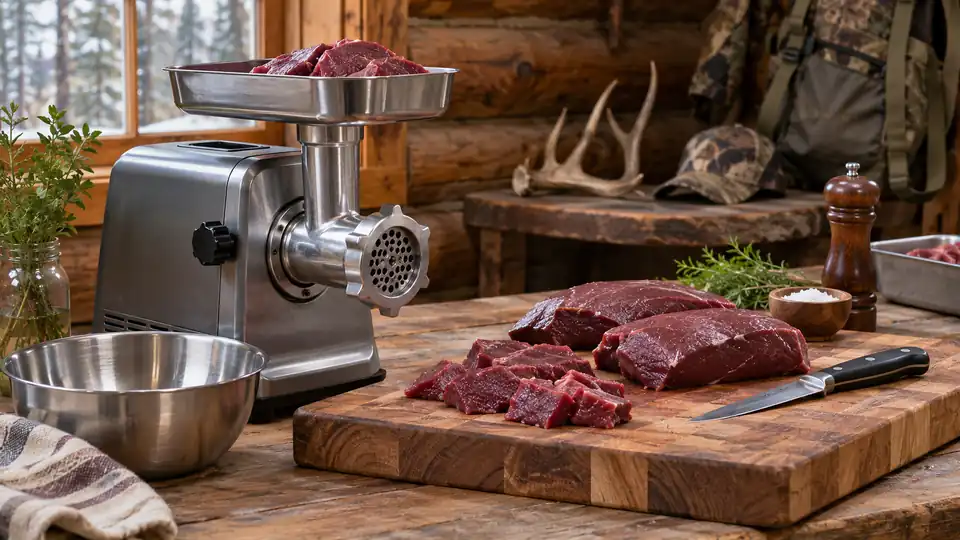
Processing a deer at home can turn into a long afternoon of trimming, chilling, grinding, and cleaning, especially when a small kitchen machine starts to slow down halfway through the batch. The right grinder for venison needs enough feeding capacity for properly prepared boneless meat, useful plate options, and a workload that matches how much game you actually process. A compact household model may suit one or two small batches, while a #22 or #32 machine makes more sense for hunters handling several deer or working with family and friends.
Motor labels deserve careful attention. A large maximum-wattage figure does not automatically mean a machine can grind continuously at that level, and advertised pounds-per-minute figures are not independent performance tests. Grinder size, rated motor power, hopper capacity, plate selection, construction, and operating limits all matter. Cleaning is another practical factor. Venison processing leaves meat, connective tissue, and fat across the head, auger, knife, and plates, so a grinder that comes apart readily can save a frustrating end-of-day chore.
The grinders below cover different amounts of boneless venison preparation, from occasional household batches to larger processing sessions. Compare head size, stated output, operating limits, cleaning, and storage with the quantity you expect to handle.
Quick Answer
The Commercial Meat Grinder #32 is the strongest overall match for large deer-processing sessions because its listing specifies a #32 head, a 1.5 HP motor, a 26-pound meat pan, and a stated capacity of up to 880 pounds per hour. It is a substantial machine, so it suits serious home processing or small-farm use better than casual kitchen grinding.
The ARINOO #12C is a more manageable choice for hunters who want a documented #12 grinder with a 1.0 HP-class motor, an oversized hopper, stainless-steel plates, and venison listed among its intended applications. For smaller household batches, the LEM BigBite #8 offers a smaller format with a 0.5 HP motor, three plates, sausage tubes, and a published rate of about seven pounds per minute.
Best Meat Grinders for Deer Comparison Table
| Product | Best For | Grinder Size | Motor or Capacity Information | Main Trade-Off |
|---|---|---|---|---|
| Commercial Meat Grinder #32 | Large deer-processing batches | #32 | 1.5 HP, up to 880 lb/h stated | Large footprint and heavier-duty format |
| ARINOO Commercial Meat Grinder #12C | Home butchering and small farms | #12C | 1.0 HP class, 650 W rated claim | Only two grinding plates included |
| STX Turboforce II 4000 | Versatile home game processing | #12 | 2,000 W locked motor claim | Aluminum head and many accessories to store |
| MEAT! Pro-Grade Grinder | Higher-volume stainless-steel processing | #22 | 1 HP, 11 to 14 lb/min stated | Coarse and fine plates only |
| MEAT! Pro-Grade Grinder | Stainless-steel #12 processing | #12 | 0.75 HP, 7 to 10 lb/min stated | Foot pedal sold as a compatible accessory |
| LEM BigBite | Small and medium household batches | #8 | 0.5 HP, about 7 lb/min stated | Smaller head limits batch throughput |
| STX Turboforce 3000 | Home users wanting a broad kit | #12 | 3,000 W locked motor claim | Household use only and no bone grinding |
| Sinyder Electric Meat Grinder | Multi-use home grinding | Not specified | 700 W rated, 3,000 W maximum claim | Plate sizes and machine size are limited in the listing |
| AAOBOSI Digital Meat Grinder | Convenient occasional processing | Not specified | Up to 4 lb/min stated, 10-minute limit | Requires breaks during longer sessions |
The detailed reviews explain how each machine fits a different venison-processing workload, from a single household batch to a full deer-processing setup.
1. Commercial Meat Grinder #32 Electric Meat Grinder Machine — Best Overall

Large deer-processing days are where the #32 format earns its place. The listing describes a 1.5 HP, 110-volt motor, an extra-large pan measuring 15.5 by 11 by 3 inches, and room for up to 26 pounds of prepared meat. That combination reduces the constant rhythm of loading a small tray, waiting for it to clear, and reaching for another bowl. The published capacity is up to 880 pounds per hour, which should be treated as a manufacturer-stated figure rather than a guaranteed rate in every venison-processing setup.
This grinder also arrives with a practical set of components for ground venison and sausage preparation. The coarse plate is listed at 10 mm and the fine plate at 4.5 mm, with a stainless-steel knife, stuffing plate, three stuffing tubes, and a meat stomper included. Its all-stainless construction covers the body, head, auger, and tray, while the removable design is useful after a messy batch. A machine this large needs a dedicated work surface and storage plan, but for a hunter processing multiple deer, the footprint may be easier to accept than repeated small-batch grinding.
Pros
- Documented #32 grinder format for large workloads
- 1.5 HP, 110-volt motor with integrated overload protection listed
- Extra-large pan holds up to 26 pounds of prepared meat
- All-stainless body, head, auger, and tray construction listed
- Includes coarse and fine plates plus three stuffing tubes
Cons
- Large size may overwhelm a typical kitchen counter
- The 880-pound-per-hour figure is a published claim, not an independent test result
This is the clearest choice for serious venison processing, small-farm work, or a group that shares equipment during hunting season. It is excessive for someone grinding a few pounds once or twice a year, and the electrical requirement and large footprint deserve attention before purchase. Buyers who need volume and a generous loading pan have a stronger case for this model than shoppers focused on easy cabinet storage.
To buy this product, click here.
2. ARINOO Commercial Meat Grinder #12C — Best for Home Butchering

The ARINOO #12C occupies a useful middle ground between compact kitchen grinders and oversized commercial equipment. Its listing identifies a #12C format, a 1.0 HP motor, 110-volt operation, and a normal rated power claim of 650 watts. Venison and deer are specifically named among the intended meats, which makes the product a direct fit for this roundup rather than a generic grinder being stretched into a hunting application.
An oversized hopper should make it easier to stage prepared meat before grinding, particularly during a busy table session where chilled cubes are waiting in a tray. The included 6 mm and 8 mm stainless-steel plates lean toward coarse grinding, so buyers wanting a finer second pass should verify whether a compatible plate is available before ordering. The machine includes two stainless-steel knives, a stomper, and three plastic stuffing tubes. Its detachable parts can be washed with water and should be dried thoroughly before storage.
Pros
- Documented #12C format suited to more substantial batches
- Venison and deer are listed among supported meats
- 1.0 HP and 110-volt specifications are provided
- Oversized hopper supports larger loading sessions
- Includes stainless-steel plates, knives, and sausage tubes
Cons
- Only 6 mm and 8 mm plates are listed
- Its larger format requires more dedicated storage than a compact kitchen grinder
Choose this model if your deer processing is too demanding for a small #8 machine but does not justify a #22 or #32 setup. The coarse plate selection suits burger blends and initial passes, while sausage makers should confirm that the included tubes match their preferred casings. It is a practical home-butchering option, though its stated commercial positioning should not be read as proof that it belongs in every commercial food-service environment.
To buy this product, click here.
3. STX International Turboforce II 4000 — Best Accessory Package
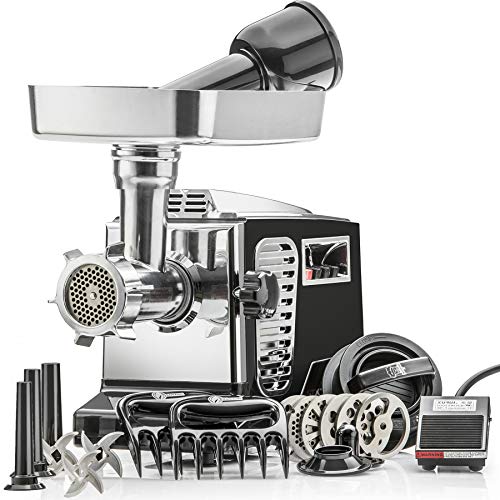
For a home processor who wants one machine to cover grinding, sausage preparation, and patty making, the Turboforce II 4000 offers an unusually broad package. It is listed as a #12 grinder with a high-capacity tray holding more than three pounds of prepared meat, a two-inch feed tube, and a 2,000-watt locked motor specification. Its air-induction cooling system and circuit breaker are part of the listed design, though neither feature should be treated as permission for unattended or unlimited operation.
The accessory list is especially useful during deer season. The package includes five grinding plate sizes, three stainless-steel cutting blades, a stuffing plate, three stuffing tubes, a kibbe attachment, a foot pedal, meat claws, and a burger-slider press. The listing also states that the machine can handle certain soft bones, but deer processing generally involves boneless venison, and that claim should not be generalized to hard or frozen bones. The polished aluminum head differs from an all-stainless machine, so cleaning and drying remain important after every session.
Pros
- Documented #12 grinder format with a large feed opening
- High-capacity tray holds more than three pounds of prepared meat
- Includes five grinding plate sizes and three cutting blades
- Foot pedal and sausage accessories support hands-free workflows
- Three-year warranty is listed for the product
Cons
- Polished aluminum head is not an all-stainless construction
- The large accessory collection requires organized storage
This model suits a household that wants flexibility after the venison is ground. A hunter making burger, sausage, and formed patties can use the included parts without immediately buying extra attachments. Buyers who want a simple, stainless-steel machine with fewer components may find the kit more elaborate than necessary, while those who appreciate a foot-pedal workflow will see a clear practical advantage.
To buy this product, click here.
4. MEAT! 1 HP Pro-Grade Meat Grinder #22 — Best for Higher-Volume Home Processing
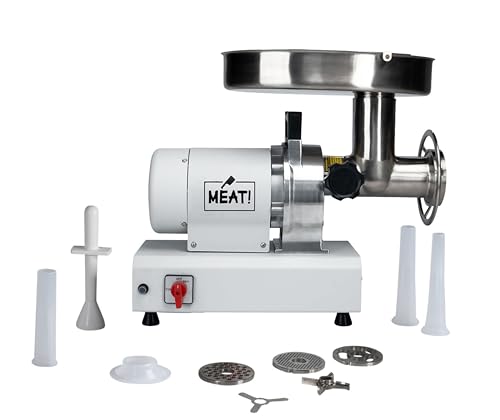
A #22 grinder gives venison processors more room than a #12 without moving all the way to the footprint of a #32 machine. This MEAT! model lists a 1 HP motor and a stated output of 11 to 14 pounds per minute. That figure comes from the product information, so actual throughput will still depend on meat preparation, temperature, connective tissue, feed rate, and plate choice.
The all-stainless construction is the main ownership feature. The description identifies stainless steel throughout the machine, down to the bolts, and includes coarse and fine grinding plates for different preparation styles. Stainless-steel stuffing plates and tubes add sausage functionality, while compatibility with a MEAT! foot pedal can support a hands-free setup. The available information does not specify the exact plate-hole measurements, so shoppers who have a particular grind texture in mind should verify those details before purchase.
Pros
- Documented #22 grinder size for larger household batches
- 1 HP motor and 11 to 14 lb/min published range
- All-stainless construction is listed
- Includes coarse and fine grinding plates
- Supports sausage stuffing and a compatible foot pedal
Cons
- Only coarse and fine plate categories are listed
- Foot pedal operation requires a compatible accessory
This grinder makes sense for hunters who process several deer or regularly buy bulk meat. Its size and stainless construction point toward a dedicated processing area rather than occasional countertop use. It may be more machine than a small household needs, but the #22 format offers a meaningful step up for buyers who have outgrown compact grinders and want a simpler accessory package than the STX kits provide.
To buy this product, click here.
5. MEAT! .75 HP Pro-Grade Meat Grinder #12 — Best Stainless-Steel #12

This #12 model is a straightforward option for buyers who want a smaller grinder head paired with a more substantial construction description. The listing specifies a .75 HP motor and a stated grinding range of 7 to 10 pounds per minute. It also describes stainless-steel construction throughout, which can be attractive after a venison session that leaves several removable parts needing careful washing and drying.
The included coarse and fine plates cover the basic two-pass approach many households use for burgers, meatloaf, or sausage blends. Stainless-steel stuffing plates and tubes extend its use beyond grinding, although a grinder-based stuffing setup behaves differently from a dedicated sausage stuffer. The optional foot-pedal compatibility may help a second person manage the meat tray while the operator controls the feed, but that pedal is not identified as included.
Pros
- Documented #12 grinder size fits moderate venison batches
- .75 HP motor with a 7 to 10 lb/min published range
- All-stainless construction is listed
- Coarse and fine plates are included
- Stainless stuffing components add sausage flexibility
Cons
- Only two plate types are listed
- Foot pedal is compatible but not included in the supplied product information
Pick this model for a cleaner, more focused #12 setup. It avoids the long list of extra tools found with the STX Turboforce II, which may appeal to buyers who already own burger presses or meat claws. The trade-off is less accessory variety and no stated large hopper capacity, so it is better matched with moderate batches than a full processing operation.
To buy this product, click here.
6. LEM Products BigBite #8 Meat Grinder — Best for Small Batches

Not every hunter needs a large processing machine. The LEM BigBite #8 is aimed at home kitchens and small to medium batches, with a 0.5 HP motor and a published rate of about seven pounds per minute. Its smaller head can be easier to position on a sturdy counter, especially for someone who grinds a few pounds of venison at a time and does not want a dedicated processing table.
The stainless-steel construction, three plates, knife, stomper, and sausage-stuffing tubes give it a balanced set of functions. The listing describes a noise-dampening design, a permanently lubricated motor, and easy disassembly for cleaning. It also clearly states that the grinder is not for bones, which is relevant for anyone comparing game-processing claims. Deer meat should be properly prepared as boneless pieces before feeding it into this machine.
Pros
- #8 format suits small household batches
- 0.5 HP motor with about seven pounds per minute stated
- Stainless-steel construction is listed
- Includes three plates, a knife, stomper, and stuffing tubes
- Five-year factory warranty and lifetime support are listed
Cons
- Smaller #8 head is less suited to repeated large batches
- The listing states that it is not for bones
This is the sensible pick for a household that processes one deer in manageable sessions, especially if the grinder will also handle beef, pork, or sausage ingredients during the rest of the year. A buyer who routinely processes multiple animals may spend too much time loading a smaller tray, but the simpler footprint and clear operating scope are valuable for occasional venison work.
To buy this product, click here.
7. STX International Turboforce 3000 Series — Best Home-Use #12 Kit

The Turboforce 3000 is another #12 home-use grinder, but its specifications and accessories create a different balance from the stainless-focused MEAT! model. The listing describes a 3,000-watt locked motor figure, normal under-load use between 800 and 1,200 watts, and a hopper that holds about three pounds of prepared meat. It also publishes a 180 to 240 pound-per-hour range under stated preparation conditions.
For deer processing, the five grinding plates and three stainless-steel blades provide useful flexibility, while the sausage plate and three stuffing tubes support follow-up preparation. A foot pedal, kibbe attachment, meat claws, and burger-slider press are included. The listing specifically identifies this as heavy-duty household equipment, not commercial equipment, and states that it will not grind bones. That distinction is more useful than the large locked-wattage number when planning a venison workflow.
Pros
- Documented #12 head with a three-pound hopper
- Five grinding plates and three stainless-steel blades included
- Three sausage tubes and a stuffing plate add versatility
- Foot pedal and meat-handling accessories are included
- Three-year warranty is listed
Cons
- Product information identifies it as household equipment rather than commercial equipment
- The listing states that it will not grind bones
This package suits a hunter who wants a broad set of tools without stepping up to a #22 or #32 machine. The three-pound hopper is practical for staged home processing, while the many accessories can help with burgers and sausage after the grinding is finished. Buyers should leave room for the attachments and follow the stated restriction against bones, tendons, plants, nuts, and fruits.
To buy this product, click here.
8. Sinyder Electric Meat Grinder — Best for Multi-Use Home Preparation

Sinyder takes a compact multi-function approach, combining a stainless-steel body with a pure copper motor, metal gears, reverse operation, and thermal protection. The listing gives a 700-watt rated power figure and a 3,000-watt maximum figure, along with a stated capacity of up to five pounds per minute. Since the grinder size is not provided in the available information, it should be judged as a general home grinder rather than assumed to match a #8, #12, or larger head.
The included components cover two plate sizes listed as 5 mm and 7 mm, two stainless-steel blades, a fan plate, three sausage tubes, and a kibbe kit. A storage box can hold accessories or receive ingredients, which is handy in a kitchen where grinder parts tend to migrate into random drawers. The product information says some accessories may be dishwasher-safe but also cautions that the grinder, tray, and certain grinder components should not go in the dishwasher, so hand cleaning and careful drying remain the safer planning assumption for the machine itself.
Pros
- 700-watt rated motor specification is provided
- Metal gears and stainless-steel body are listed
- Reverse, thermal protection, and circuit breaker features are included in the description
- Includes plates, blades, sausage tubes, and a kibbe kit
- Storage box helps keep smaller accessories together
Cons
- Grinder head size is not specified in the available information
- Dishwasher guidance is mixed, so parts require careful cleaning and sorting
This machine is best for a hunter who wants one home appliance for occasional venison, burgers, sausage, and other food preparation. It is less suitable for buyers selecting equipment by exact grinder size or planning heavy seasonal volume, because the supplied specifications do not establish a #12, #22, or #32 classification. Its storage design and broad accessory set make more sense in a regular kitchen than in a dedicated commercial processing room.
To buy this product, click here.
9. AAOBOSI Multifunctional Digital Meat Grinder — Best for Convenient Occasional Use
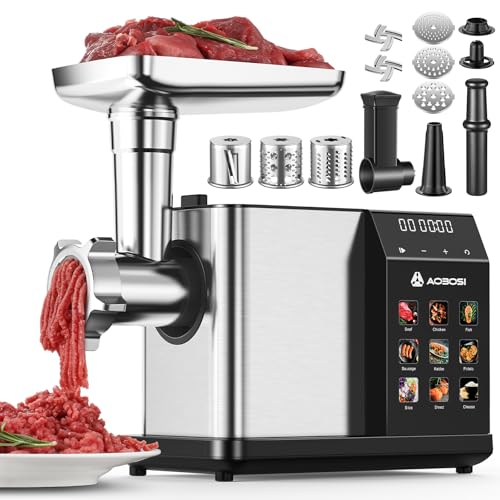
The AAOBOSI digital grinder is aimed at convenience. Its color touch screen offers nine presets and nine speed settings, with dedicated meat, sausage, and reverse modes. A hunter who processes a modest batch at home may appreciate the clear controls, while built-in storage keeps the two blades, three plates, and other attachments from scattering around the kitchen. The listing states that it can process up to four pounds per minute.
That convenience comes with a firm operating limitation. The available product information advises against continuous use beyond 10 minutes to help prevent overheating. This does not rule out deer processing, but it changes the workflow. The user should plan chilled, prepared batches and pauses rather than feeding a large amount continuously. Stainless-steel blades and plates are described as dishwasher-safe, yet the listing recommends hand washing attachments for best results, a sensible approach for parts that need prompt drying after venison work.
Pros
- Nine presets and nine speed settings provide control options
- Auto-reverse function is listed for clearing jams
- Built-in storage keeps accessories with the machine
- Includes three plates, two blades, and sausage and kibbe attachments
- Published capacity reaches up to four pounds per minute
Cons
- Continuous operation beyond 10 minutes is discouraged
- Its unspecified grinder size makes it difficult to compare directly with #12 or larger machines
This grinder fits occasional venison preparation where storage and simple controls matter more than uninterrupted volume. It can be a comfortable match for a household making burgers from a small batch, but a hunter processing several deer should move toward a larger head and a machine with a more substantial workload description. The ten-minute operating restriction is the key trade-off to keep in view.
To buy this product, click here.
Buying Guide
For grinders suited to a wider range of tasks, see our overall meat grinder guide.
Match the Grinder to Your Deer-Processing Volume
Start with the amount of boneless venison you expect to process in one session. A #8 grinder such as the LEM BigBite can suit small household batches, while #12 models offer a step up for more regular hunting use. The #22 and #32 machines are better aligned with large batches, shared processing days, or small-farm work. A larger head can reduce loading interruptions, but it also brings more weight, storage demand, and cleanup surface.
Read Motor Specifications Carefully
Maximum wattage, locked motor wattage, rated wattage, and horsepower describe different aspects of a machine. The STX Turboforce 3000 lists a 3,000-watt locked figure alongside lower under-load figures, while the Sinyder lists 700 watts rated and 3,000 watts maximum. Those numbers should not be compared as though they were the same measurement. A published capacity claim is also different from a verified continuous rate, particularly with cold venison, connective tissue, and different plate sizes.
Choose the Right Grinder Head Size
Nominal sizes such as #8, #12, #22, and #32 help indicate the general class of grinder, but they do not independently establish motor strength or actual throughput. The ARINOO, STX, and MEAT! products provide documented size information, while the Sinyder and AAOBOSI listings do not. If you need replacement plates or knives later, the exact head and component compatibility matter more than a broad description such as heavy-duty.
Our guide to choosing a grinder for deer and wild game also covers batch planning and cleaning.
Compare Plates, Knives, and Sausage Accessories
Grinding plates control the openings through which meat exits, while the knife works with the plate to cut the meat. The products in this roundup vary considerably. The ARINOO includes 6 mm and 8 mm plates, the MEAT! models include coarse and fine plates, and the STX packages include several plate sizes. Buyers who plan to grind venison twice for a smoother blend should verify that the included plates provide the textures they want.
Plan for Cleaning and Drying
Venison processing is easier to manage when the head, auger, knife, plates, tray, and stomper can be removed without a complicated procedure. Stainless-steel parts can still stain or corrode if left wet, so prompt washing and thorough drying are part of ownership. Dishwasher directions vary. The AAOBOSI listing describes dishwasher-safe blades and plates but recommends hand washing, while the Sinyder information warns that the grinder and tray should not enter the dishwasher.
Respect Operating Limits
A grinder designed for household use should not be treated like a commercial machine. The AAOBOSI listing advises against continuous operation beyond 10 minutes, and the STX Turboforce 3000 is explicitly described as household equipment. The LEM listing states that its grinder is not for bones, while the STX 3000 states that it will not grind bones. For deer processing, prepare boneless meat appropriately and follow the product’s feed, pause, and cleaning instructions.
Reserve Adequate Workspace
A large hopper and machine body can make batch processing smoother, but they need a stable work surface and a place to dry components. The #32 model’s 15.5-inch pan and 26-pound capacity are useful for high-volume work, yet they also demand more room than a compact kitchen grinder. Measure the counter, shelf, and storage area before choosing equipment based on capacity alone.
Best Meat Grinders for Deer FAQ
What size meat grinder is best for deer processing?
The right size depends on batch volume. A #8 grinder can suit occasional household processing, a #12 is a useful middle choice, and #22 or #32 machines are better for larger sessions. Head size alone does not establish motor power or guaranteed throughput, so compare the full specifications.
Is a high maximum-wattage rating enough for venison?
No. Maximum or locked motor wattage is not the same as rated operating power, and neither figure guarantees continuous grinding speed. Look at the rated motor description, published capacity, head size, operating limits, and included plates together.
Can these meat grinders process deer bones?
Do not assume that they can. The LEM BigBite and STX Turboforce 3000 listings specifically state restrictions against bones, while the STX Turboforce II lists support for certain soft bones. Deer processing should generally be planned around properly prepared boneless meat unless the exact product information explicitly supports another application.
Are grinder plates interchangeable between models?
Not automatically. Nominal grinder sizes do not guarantee identical plate diameter, center opening, thickness, or mounting geometry. Confirm compatibility with the exact grinder model before buying replacement plates or knives.
Do meat grinders also stuff sausage?
Several products here include stuffing plates and tubes, so they can support basic sausage preparation. That function is different from a dedicated sausage stuffer. Grinder-based stuffing may suit occasional batches, while frequent sausage production may justify separate equipment with a design focused on casing filling.
How should a deer-processing grinder be cleaned?
Disconnect the machine, remove the food-contact components, wash them according to the product instructions, and dry them thoroughly before storage. Do not immerse the motor housing. Dishwasher guidance varies by model, so follow the exact listing or manual rather than assuming every attachment is dishwasher-safe.
Final Verdict
The Commercial Meat Grinder #32 is the strongest overall choice for serious deer processing because the available information directly addresses large workloads. Its #32 format, 1.5 HP motor, 26-pound pan, stainless-steel construction, and listed 880-pound-per-hour capacity make it the best fit for hunters handling substantial batches. The scale is its main drawback, and a casual home user may find it unnecessarily large.
For a more manageable setup, the ARINOO #12C is a strong alternative with deer listed among its intended applications, while the LEM BigBite #8 is better suited to smaller household batches. The STX Turboforce II 4000 stands out for its broad accessory package, and the MEAT! #22 offers a useful step toward higher-volume stainless-steel processing. Match the grinder to the amount of venison you actually handle, the workspace available, and the time you are willing to spend cleaning after the last batch.
