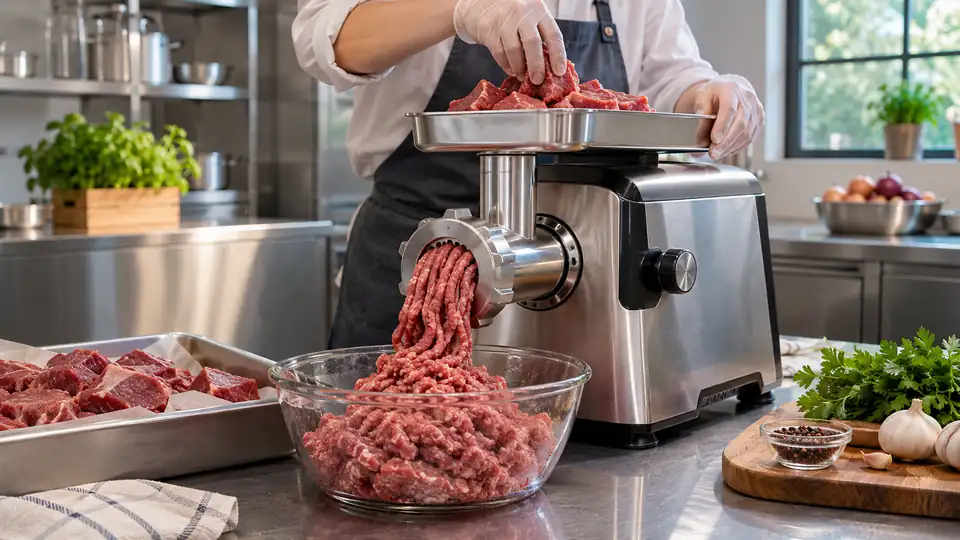
Large-batch grinding changes the buying decision. A machine that feels adequate for a few burgers can become frustrating when the table is covered with trimmed beef, venison, pork, or sausage ingredients. The useful question is not simply how much power appears on the label. It is whether the grinder has a suitable head size, a practical feed area, included plates for the textures you make, and operating guidance that matches the amount of meat you plan to process.
Many buyers get caught by peak-wattage figures that do not represent normal operating power. Others choose a compact grinder for a workload better suited to a #12, #22, or #32 machine. Published capacity claims also need context because meat temperature, connective tissue, preparation, plate selection, and feeding speed affect the result. Construction, cleaning, jam-clearing features, storage, and sausage accessories matter just as much after the first busy grinding session.
The grinders below span several head sizes and intended workloads. Compare stated capacity alongside operating limits, tray size, cleaning, and the amount of boneless meat normally prepared in one session.
Quick Answer
- Best Overall: The MEAT! 1 HP Pro-Grade Meat Grinder #22 combines a documented 1 HP motor, a published 11 to 14 pounds-per-minute claim, stainless-steel construction, and coarse and fine plates for substantial home or small-operation batches.
- Best for the Largest Workloads: The ARINOO #32 supplies the largest documented grinder size in this group, a 2.0 HP motor, an oversized hopper, and a 5-year factory warranty.
- Best Home-Focused Larger-Batch Choice: The LEM BigBite #12 offers a 0.75 HP motor, a published rate of up to 11 pounds per minute, three plates, sausage tubes, and a noise-dampening design.
- Best for Flexible Home Prep: The AAOBOSI #12 adds three speeds, reverse operation, three plates, sausage tubes, and a kubbe kit in a home-oriented format.
Best Meat Grinders for Large Batches Comparison Table
| Product | Best For | Grinder Size | Motor or Capacity Claim | Main Trade-Off |
|---|---|---|---|---|
| MEAT! 1 HP Pro-Grade Grinder | Overall large-batch use | #22 | 1 HP, 11 to 14 lb/min stated | Foot pedal sold separately |
| ARINOO 2.0 HP Grinder | Largest workloads | #32 | 1,500 W rated, 2,800 W maximum | Large footprint and heavier-duty format |
| LEM BigBite #12 | Home users processing larger batches | #12 | 0.75 HP, up to 11 lb/min stated | Smaller head than #22 and #32 machines |
| ARINOO 1.2 HP Grinder | High-volume #22 processing | #22 | 850 W rated, 2,400 W maximum | Only two grinding plates included |
| MEAT! Dual Grinder | Two-stage grinding in one pass | #22 | 1 HP, 10 lb/min stated | Specialized dual-grinding setup |
| VEVOR Electric Mincer | Accessory-rich #12 preparation | #12 | 750 W / 1 HP, 552 lb/h stated | Not for bones or frozen meat |
| AAOBOSI Heavy-Duty Grinder | Home batch prep and sausage | #12 | 800 W rated, 4.5 lb/min stated | Home-oriented capacity |
| LEM BigBite #8 | Small and medium large-batch sessions | #8 | 0.5 HP, about 7 lb/min stated | Not for bones |
| Aiheal Electric Grinder | Occasional bulk prep | Not stated | 300 W, 3,200 W locked-power claim | Cleaning requires hand washing and drying |
The detailed reviews explain how each grinder’s size, power description, accessories, and operating restrictions fit different large-batch routines.
1. MEAT! 1 HP Pro-Grade Meat Grinder #22 — Best Overall
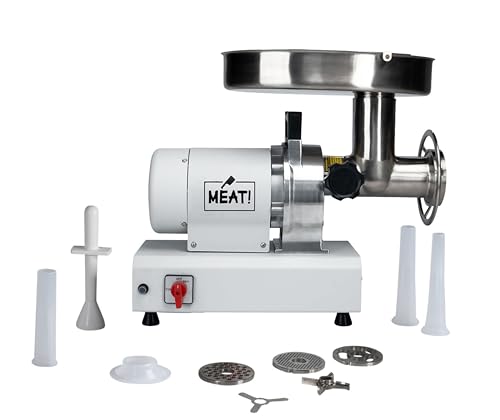
A #22 head gives this grinder a strong fit for buyers who routinely move beyond a family-sized tray of meat. The supplied specifications list a 1 HP motor and a manufacturer-stated output of 11 to 14 pounds per minute. That figure should be treated as a published claim rather than a guaranteed continuous rate, but it clearly places this machine above compact household grinders for bulk burger preparation, venison processing, and sausage work.
The all-stainless-steel construction is relevant during a long prep day because the grinder is built around a substantial processing format rather than a small countertop attachment. Coarse and fine plates expand the range of recipes, while the included stuffing components allow the same machine to prepare sausage after grinding. A compatible foot pedal switch can provide hands-free control, although that accessory is separate. For someone standing over a large bowl of trimmed meat, that option can make the workflow more manageable.
Pros
- Documented #22 grinder size suits substantial batches.
- 1 HP motor and published 11 to 14 lb/min capacity claim.
- All-stainless-steel construction is specified.
- Includes coarse and fine grinding plates.
- Supports sausage stuffing and optional foot-pedal control.
Cons
- The foot pedal switch is not included in the supplied package details.
- A #22 machine requires more counter and storage space than a compact grinder.
This is the most balanced choice for a buyer who wants a serious large-batch grinder without moving all the way to the largest #32 format. It suits bulk beef, pork, poultry, and game preparation where plate flexibility matters. A household that grinds only a few pounds several times a year may find the size excessive, while a buyer seeking a machine for continuous commercial production should verify electrical and duty-cycle requirements before purchase.
To buy this product, click here.
2. ARINOO #32 Commercial Electric Meat Grinder — Best for the Largest Workloads

The ARINOO #32 is the clearest choice for buyers who prioritize grinder size and motor specification over compact storage. Its listing identifies a #32 format, a 2.0 HP motor, 1,500 W rated power, and 2,800 W maximum power. Rated and maximum figures describe different electrical characteristics, so they should not be treated as interchangeable. Still, the combination signals a machine intended for larger workloads than the #12 models in this roundup.
An oversized hopper can reduce the need to refill the tray constantly during a bulk session. The package includes 6 mm and 8 mm plates, two blades, three sausage tubes, and a stomper. Detachable stainless-steel parts can be washed with water according to the supplied information, followed by thorough drying and dry storage. The five-year factory warranty and lifetime support are useful ownership details for a machine likely to receive regular use.
Pros
- Largest documented grinder size in this selection.
- 2.0 HP motor with rated and maximum power figures supplied.
- Oversized hopper is suited to larger loading tasks.
- Includes two plates, two blades, and three stuffing tubes.
- Five-year factory warranty and lifetime support are listed.
Cons
- The #32 format will demand more counter and storage space.
- Only 6 mm and 8 mm grinding plates are listed.
Choose this model if large quantities are a regular part of your routine, such as bulk meat buying, farm processing, or substantial game preparation. Its size can be unnecessary for occasional household grinding, and the supplied data does not establish a verified continuous commercial duty cycle. Plan a stable work surface and a practical cleaning area before choosing a grinder of this scale.
To buy this product, click here.
3. LEM Products BigBite #12 Meat Grinder — Best Home-Focused Larger-Batch Choice

The BigBite #12 occupies a useful middle ground for households that buy meat in bulk but do not need a #22 or #32 machine. Its 0.75 HP motor and published capacity of up to 11 pounds per minute give it a stronger large-batch profile than the #8 model from the same range. The claim still depends on preparation and operating conditions, yet the documented head size and capacity make the intended workload clear.
Three plates, a knife, a stomper, and sausage tubes arrive with the grinder, so buyers can move from burger meat to sausage without immediately adding another accessory. The noise-dampening design may be welcome in a home kitchen, while the permanently lubricated motor reduces one maintenance task. The product information also lists support for raw chicken bones, a claim specific to this model. Buyers should follow the product instructions closely rather than applying that claim to other grinders.
Pros
- Documented #12 size fits medium to large household batches.
- 0.75 HP motor and up to 11 lb/min published capacity.
- Includes three plates and sausage-stuffing components.
- Noise-dampening design is specified.
- Five-year factory warranty and replacement-part support are listed.
Cons
- It has less headroom than the #22 and #32 options.
- The supplied data does not identify a continuous duty-cycle rating.
This model makes sense for a hunter, bulk shopper, or serious home cook who wants a substantial grinder without the footprint of a commercial-size unit. It also suits buyers who value included plates and replacement-part support. Skip it if you need the largest hopper or a documented high-volume production specification, since the #22 and #32 choices are better aligned with that work.
To buy this product, click here.
4. ARINOO #22 Commercial Electric Meat Grinder — Best for High-Volume #22 Processing
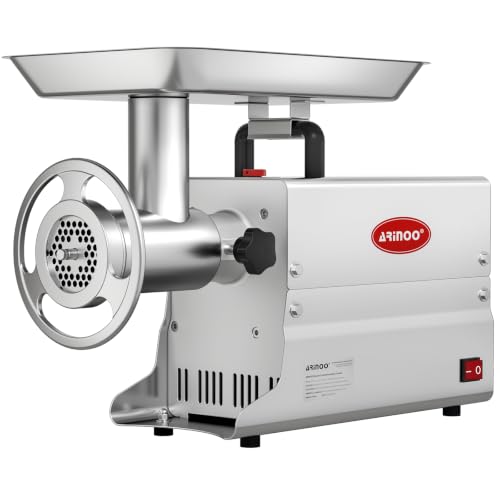
This ARINOO model targets buyers who want a #22 grinder with a 1.2 HP motor rather than the larger footprint of a #32 unit. The supplied specifications distinguish 850 W rated power from 2,400 W maximum power, which is useful context for reading the listing. It also states a large-batch orientation and a hopper intended to hold a substantial amount of meat, making the machine relevant for home butchering, small farms, and regular bulk preparation.
The accessory package is focused rather than oversized. Buyers receive 6 mm and 8 mm plates, two stainless-steel blades, three stuffing tubes, a pusher, and a stomper. The listing describes detachable stainless-steel parts that can be washed with water and dried afterward. That cleanup process is practical, but the motor housing still needs appropriate protection from water. A five-year factory warranty and lifetime support add useful product-specific support.
Pros
- Documented #22 head supports larger batch preparation.
- 1.2 HP motor with separate rated and maximum power figures.
- Large hopper is suited to bulk loading.
- Includes two plates, two blades, and three stuffing tubes.
- Five-year factory warranty and lifetime support are listed.
Cons
- The package lists two grinding plates rather than a three-plate set.
- The larger body is less convenient for limited counter space.
This grinder is a strong fit for buyers who have outgrown a #12 machine and want a #22 platform for repeated meat preparation. It is more machine than most occasional cooks need, and the supplied information does not verify a particular continuous production rate. Buyers comparing it with the MEAT! #22 should weigh the motor descriptions, plate configuration, and their preferred accessory setup.
To buy this product, click here.
5. MEAT! 1 HP Pro-Grade Dual Grinder #22 — Best for Two-Stage Grinding

The dual-grinding arrangement gives this MEAT! model a specific advantage for recipes that usually require two passes. Its throat uses a first stainless-steel plate followed by a choice of coarse or fine second plate, allowing the listing to claim dual grinding in one pass. That setup can be appealing during a large sausage or burger preparation session, where reducing handling and repeated feeding may simplify the workflow.
A 1 HP motor and published output of 10 pounds per minute place it firmly in the larger-batch category, although the rate remains a manufacturer-stated figure rather than an independent measurement. Stainless-steel construction and included stuffing components extend its usefulness beyond ordinary grinding. It is compatible with a MEAT! foot pedal switch for hands-free operation, but the supplied product information does not say that the pedal is included.
Pros
- Dual-grinding design can combine two grinding stages in one pass.
- Documented #22 grinder size suits substantial preparation.
- 1 HP motor and published 10 lb/min capacity.
- Stainless-steel construction is specified.
- Supports sausage stuffing and optional foot-pedal operation.
Cons
- The specialized dual-plate path may be unnecessary for single-pass grinding.
- The foot pedal is an additional accessory according to the supplied details.
Pick this grinder if your routine includes coarse-to-fine processing and you value a one-pass setup. It is less compelling for someone who uses one texture at a time or wants the simplest possible grinding path. Buyers should also make room for the #22 format and verify the included plate and stuffing components before ordering.
To buy this product, click here.
6. VEVOR #12 Electric Meat Mincer — Best Accessory-Rich #12 Option

The VEVOR combines a documented #12 head with a 750 W / 1 HP motor and a published capacity of up to 552 pounds per hour. That figure is useful for comparing the listing’s intended workload, but it should not be read as a verified continuous rate. A three-stage auger, cross-shaped blade, and metal body support the machine’s focus on regular kitchen, restaurant, and workshop preparation.
Accessory coverage is one of its clearest strengths. The package includes two blades, 6 mm and 8 mm plates, a kubbe kit, three stuffing tubes, and a pusher. Removable parts are listed as dishwasher-safe, while the motor housing must be kept out of water. The product is explicitly unsuitable for bones or frozen meat, an important restriction for anyone processing wild game or storing meat below workable temperatures.
Pros
- Documented #12 head and 750 W / 1 HP motor.
- Published capacity of up to 552 lb/h.
- Includes plates, blades, stuffing tubes, and a kubbe kit.
- Removable parts are listed as dishwasher-safe.
- Anti-vibration feet and a locking grinding-head knob are specified.
Cons
- The listing specifically excludes bones and frozen meat.
- Only 6 mm and 8 mm plates are included.
This model suits a buyer who wants a #12 grinder with a broad accessory package for burgers, meat sauce, sausage, and kubbe. It is less suitable for anyone whose large-batch routine includes bones or partially frozen material. Keep the removable components separate from the motor housing during cleanup, then dry them properly before storage.
To buy this product, click here.
7. AAOBOSI #12 Heavy-Duty Meat Grinder — Best for Flexible Home Batch Prep

The AAOBOSI #12 is aimed at the home cook who wants more control than a basic single-speed grinder provides. Its listing identifies an 800 W rated motor and a 3,000 W peak claim, along with a published processing rate of up to 4.5 pounds per minute. The rated and peak figures should be read separately, while the capacity should be treated as a stated maximum rather than a promise for every batch.
Three speeds, reverse operation, a large removable tray, and a wide feed tube give this grinder a practical home-prep profile. Three grinding plates cover coarse, medium, and fine work, while the package also includes two blades, sausage tubes, and a kubbe kit. Auto-reverse and overload protection can reduce the need to stop for manual jam clearing, but meat should still be prepared appropriately and fed with the supplied pusher.
Pros
- Documented #12 format for household bulk preparation.
- 800 W rated motor and published 4.5 lb/min capacity.
- Three speeds and reverse function provide control during prep.
- Includes three plates, sausage tubes, blades, and a kubbe kit.
- Auto-reverse and overload protection are listed.
Cons
- Its published capacity is below the leading #22 and #32 options.
- The peak-power figure should not be treated as normal operating power.
This is a sensible match for weekend burger batches, home sausage making, and occasional venison preparation. It gives a household more texture and control options without moving to the largest machines. Buyers processing large quantities every week may prefer the higher-capacity formats, while those who value simple controls will appreciate the single-button approach.
To buy this product, click here.
8. LEM Products BigBite #8 Meat Grinder — Best for Smaller Large-Batch Sessions

The #8 BigBite is the compact choice for readers whose idea of a large batch means several pounds rather than a full processing table. Its 0.5 HP motor and published rate of about 7 pounds per minute offer more room than a small personal grinder, while the stainless-steel build and included three plates make it useful for regular household work.
Noise-dampening construction, a permanently lubricated motor, a stomper, a knife, and sausage tubes all support a straightforward home setup. The product is identified for burgers, sausage, pet food, and game processing, but the listing clearly states that it is not for bones. Disassembly is described as easy, though buyers should still plan to wash and dry food-contact components promptly after each session.
Pros
- Compact #8 format is easier to store than larger commercial-size grinders.
- 0.5 HP motor and about 7 lb/min published capacity.
- Includes three plates, a knife, stomper, and stuffing tubes.
- Noise-dampening design is specified.
- Five-year factory warranty and lifetime support are listed.
Cons
- The listing states that it is not for bones.
- Its documented capacity is lower than the #12, #22, and #32 choices.
This grinder suits bulk meal prep, family burger making, and occasional game processing where storage space matters. It is a poor match for buyers who routinely process very large quantities or need a machine expressly suited to heavier workloads. The #8 size is its practical advantage, but it is also the reason to avoid overestimating its role.
To buy this product, click here.
9. Aiheal Electric Meat Grinder — Best for Occasional Bulk Prep

The Aiheal is the most home-oriented machine in this final group, but its three plates, two blades, sausage tubes, and overload protection give it useful flexibility for occasional bulk preparation. The listing identifies a 300 W motor and a separate 3,200 W locked-power claim. Those figures are not equivalent measures of ordinary operating output, so the higher number should not be used alone to compare it with the larger #12, #22, and #32 grinders.
Its reverse button is intended for unclogging, and the removable cutting attachment simplifies access after grinding beef, pork, chicken, fish, or venison. The supplied instructions say the components should not go in a dishwasher and should be wiped dry after washing. That extra hand-cleaning step matters during a large session, when several plates and tubes can quickly spread across the sink.
Pros
- Includes three grinding plates for varied textures.
- Two blades and three sausage-stuffing tubes are supplied.
- Reverse function helps with clearing resistance.
- Overload protection is listed.
- Removable cutting attachment supports cleanup access.
Cons
- The grinder size and processing capacity are not stated.
- Attachments should not be placed in a dishwasher according to the supplied instructions.
This model is best for occasional household batches where accessory coverage matters more than a documented high-volume capacity. It can help with family meal prep, sausage experiments, and modest game processing, but the missing head-size and throughput information makes it difficult to recommend for sustained large workloads. Buyers with frequent bulk sessions should favor a grinder with clearer capacity documentation.
To buy this product, click here.
Buying Guide
Match Grinder Size to the Workload
Nominal head sizes help frame the intended scale, although they do not directly specify motor power or actual throughput. The #8 LEM is easier to store and suits smaller household sessions. The #12 machines provide more room for recurring bulk prep, while the #22 and #32 models make more sense when a large amount of meat arrives at once. A larger head can improve the overall workflow, but it also brings more counter space, storage, and cleanup demands.
Separate Rated Power from Peak or Maximum Power
A product may list rated power, peak power, locked power, or horsepower. These descriptions are not interchangeable. The AAOBOSI, Aiheal, and ARINOO listings show why careful reading matters. A 3,000 W or 3,200 W peak-style figure should not be compared directly with a machine’s rated wattage as though both describe normal continuous operation. Capacity claims also come from product listings and can vary with meat preparation, temperature, connective tissue, and feed rate.
Use Published Capacity as a Comparison Point
Claims such as 7 pounds per minute, 11 to 14 pounds per minute, or 552 pounds per hour help show how manufacturers position their products. They do not establish a guaranteed result for every session. Large-batch buyers should ask how often they will grind, how much meat they process per session, and whether the product information gives any operating-duration guidance. A grinder that suits a weekend batch may not be appropriate for prolonged food-service work.
Compare Plates, Blades, and Stuffing Accessories
Plate openings affect the general texture, while the knife performs the cutting action against the plate. The exact hole descriptions supplied with these products differ, so avoid assuming that a coarse or fine label means an identical texture across brands. Three-plate packages offer more flexibility than two-plate sets. Stuffing tubes add convenience for sausage preparation, but a grinder with tubes is still a grinder, not automatically an equivalent replacement for a dedicated sausage stuffer.
Plan the Cleaning Routine
Large-batch equipment creates more parts to wash at the end of the day. The VEVOR listing identifies removable dishwasher-safe parts, while the Aiheal instructions call for hand washing and drying. LEM describes disassembly and permanently lubricated motors, and the ARINOO models specify detachable parts that should be washed and dried. Motor housings should be protected from water, and metal components should be dried before storage according to the product instructions.
Check Restrictions Before Processing Game or Bones
Venison and other boneless meats appear in several product descriptions, but that does not mean every grinder supports hard materials. The LEM #8 is listed as not for bones, and the VEVOR specifically excludes bones and frozen meat. The LEM #12 listing makes a model-specific raw chicken-bone claim. Do not transfer that claim to other grinders, and do not assume a larger motor makes unsupported applications appropriate.
Allow for Counter Space and Electrical Planning
A #32 grinder with an oversized hopper occupies a very different workspace from a #8 household unit. Before ordering, measure the area where meat will be loaded and where bowls will sit under the discharge. Larger machines may also have more demanding electrical requirements, so review the supplied product information and installation instructions rather than relying on the motor label alone.
Best Meat Grinders for Large Batches FAQ
What grinder size is best for large batches?
A #12 grinder is a practical middle choice for many households processing bulk meat. A #22 or #32 model is more appropriate when the batches are especially large or frequent. Head size alone does not establish capacity, so compare it with the supplied motor information, published throughput claim, hopper design, and operating guidance.
Is a higher wattage always better for batch grinding?
No. Listings may show rated, peak, maximum, or locked power, and those figures describe different things. A higher peak figure does not automatically establish higher continuous output. Look at the complete specification set, including grinder size, published capacity, included plates, and any operating restrictions.
Can these grinders process frozen meat?
The supplied information does not support a general yes. The VEVOR listing specifically says it is not suitable for frozen meat. Other products should be used according to their own instructions, and buyers should not infer frozen-meat capability from a heavy-duty label or a high motor figure.
Can a meat grinder replace a sausage stuffer?
Some of these grinders include stuffing tubes, so they can support sausage preparation after the meat is ground. That does not make them equivalent to a dedicated sausage stuffer. A grinder’s stuffing setup, tube selection, control, and capacity may differ from equipment built specifically for filling casings.
Are the grinding plates interchangeable between brands?
Do not assume so. Compatibility can depend on the nominal grinder size, plate diameter, center opening, thickness, mounting geometry, and blade design. Confirm that a replacement plate is specified for the exact grinder model before purchasing.
Which grinder is best for venison?
The answer depends on the amount of boneless venison and how often it is processed. The MEAT! #22, ARINOO #22, ARINOO #32, and LEM #12 offer formats suited to larger workloads based on their supplied size and capacity descriptions. Buyers should still follow each model’s restrictions and avoid assuming that venison support includes bones.
Can the motor housing be washed with water?
The supplied product information distinguishes removable food-contact parts from the motor housing. VEVOR specifically says not to immerse or rinse the motor housing, and other models should be cleaned according to their instructions. Remove the grinder head and attachments, wash the appropriate parts, dry them thoroughly, and keep electrical components protected.
Final Verdict
The MEAT! 1 HP Pro-Grade Meat Grinder #22 is the strongest overall match for large-batch buyers because it combines a documented #22 format, a 1 HP motor, a published 11 to 14 pounds-per-minute claim, stainless-steel construction, and coarse and fine plates. Its sausage-stuffing capability adds useful range, while the optional foot pedal may appeal to buyers who want hands-free control during repeated feeding.
The ARINOO #32 is the more suitable direction for the largest workloads, provided the buyer has room for its larger format and understands that listed power and capacity figures are manufacturer claims. For a home-focused middle ground, the LEM BigBite #12 offers a smaller footprint, three plates, and a published rate of up to 11 pounds per minute. Buyers who process meat only occasionally may be better served by the LEM #8 or Aiheal, while frequent bulk processors should prioritize grinder size, clear operating information, cleanup access, and restrictions over impressive peak-wattage numbers.
