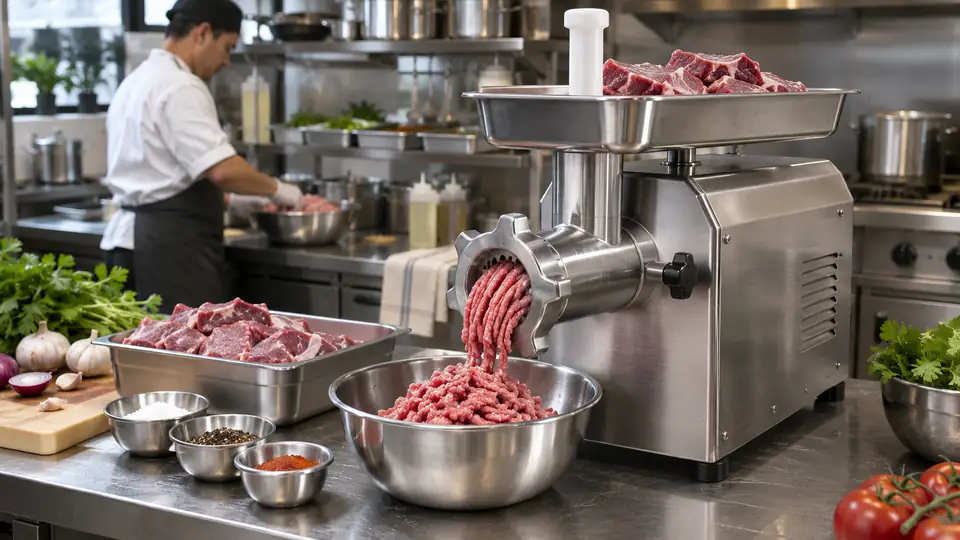
A commercial meat grinder has a different job from the compact appliance that sits in a home kitchen drawer. Restaurants, butcher shops, small farms, hunting processors, and serious bulk-prep cooks need equipment that can accept larger workloads, maintain a steady feed, and survive frequent cleaning. The challenge is separating genuinely useful commercial-style machines from listings that simply attach the word “commercial” to a household grinder.
Motor ratings, grinder head size, published throughput, construction, included plates, and operating restrictions all matter. A #32 machine can make sense for large batches, while a #12 grinder may be easier to place and sufficient for a small restaurant or seasonal venison processing. Advertised pounds-per-hour figures are manufacturer claims rather than guaranteed continuous output, so preparation, meat temperature, connective tissue, and feeding speed still affect the result. Cleaning also deserves attention because a stainless exterior does not automatically mean every component can be treated the same way.
Different buyers will prioritize different things. A butcher shop may need a large head and high stated capacity, while a small farm may care more about manageable size, replaceable parts, and straightforward cleanup. The nine grinders below include large commercial machines, smaller commercial-style units, and well-supported options for demanding home or small-business use.
Quick Answer
- Paladin Equipment #32: The strongest match for large-batch commercial work in this group, with a documented #32 head, 2 HP motor, 21-pound-per-minute stated capacity, reverse function, and overload-related protection features.
- LEM Products BigBite #32: A strong choice for buyers who want a large stainless steel grinder with a 1.5 HP motor, published 17-pound-per-minute capacity, included plates, and long-term manufacturer support.
- VEVOR #12: A practical middle-size option for kitchens and smaller commercial operations, with a 1 HP motor, two plates, three stuffing tubes, and a stated capacity of up to 552 pounds per hour.
- VEVOR #8: The most compact commercial-oriented choice here, suited to lower-volume work where a #32 machine would occupy more counter and storage space than necessary.
Best Commercial Meat Grinders Comparison Table
| Product | Best For | Grinder Size | Stated Capacity | Main Trade-Off |
|---|---|---|---|---|
| Paladin Equipment #32 | Large batches and heavy use | #32 | 21 lb/min | Large footprint and specialized capacity |
| LEM Products BigBite #32 | Professional and home processing | #32 | 17 lb/min | Large machine for smaller kitchens |
| VEVOR #32 | Large-batch grinding and sausage making | #32 | 21 lb/min | Published claims require sensible workload planning |
| ARINOO #22C | Small farms and venison processing | #22C | 550 lb/hr | Fewer documented grinding plates than some rivals |
| VEVOR #12 | Restaurants and daily prep | #12 | 552 lb/hr | Not for bones or frozen meat |
| Valley Sportsman #12 | Hunters and repeated batch work | #12 | 450 lb/hr | Lower stated output than larger-head models |
| 1100W Commercial Meat Grinder | General restaurant and shop prep | Not stated | 330 lb/hr | Head size is not documented |
| VEVOR #8 | Smaller commercial workloads | #8 | 5 lb/min | Lower capacity for large processing sessions |
| LEM Products BigBite #8 | Small to medium batches | #8 | About 7 lb/min | Not intended for bones |
The detailed reviews explain how these machines differ in capacity, head size, construction, accessories, and practical operating limits.
1. Paladin Equipment #32 Electric Commercial Meat Grinder Machine — Best Overall

Large-batch processing is where the Paladin Equipment #32 makes the most sense. Its documented #32 head, 2 HP motor, and stated capacity of up to 21 pounds per minute place it firmly in the higher-capacity portion of this roundup. That combination is relevant for butcher shops, deer-processing work, restaurants, and pet-food preparation where a small tray and narrow feed path could turn a long session into a stop-and-start chore.
The listed feature set also addresses several practical details that matter in a busy prep area. An air-cooled motor, pulse reverse function, non-slip feet, and built-in circuit breaker are intended to support steadier operation and help with interruptions or overload conditions. The package includes coarse and fine stainless steel plates, three sausage stuffers, and a treadle. The published specifications are ambitious, so buyers should still treat the 21-pound-per-minute figure as a stated maximum rather than a promise of continuous real-world output.
Pros
- Documented #32 grinder head suits larger-batch processing.
- 2 HP, 1,500-watt motor and stated 21-pound-per-minute capacity.
- Includes coarse and fine plates plus three sausage-stuffing tubes.
- Reverse function, air cooling, circuit breaker, and non-slip feet are useful operating features.
- Supports meat, game, and the bone-grinding applications specifically described in the listing.
Cons
- Large capacity can be excessive for a small kitchen or occasional user.
- The advertised throughput should not be treated as a verified continuous production rate.
This is the most complete fit for buyers who expect substantial batches and have a stable location for a large grinder. It is less convincing for someone who processes a few pounds at a time, since the larger head and commercial-oriented design bring more machine than that workload requires. Buyers should also review local electrical and food-service requirements before putting any commercial grinder into a business workflow.
To buy this product, click here.
2. LEM Products BigBite #32 Meat Grinder — Best for Long-Term Support

The LEM BigBite #32 takes a slightly different route from the highest-capacity machines here. Its 1.5 HP motor and stated processing rate of up to 17 pounds per minute still place it in serious large-batch territory, while the stainless steel construction and noise-dampening design suit buyers who expect to use the grinder repeatedly. A hunter filling freezer containers after a processing weekend or a kitchen preparing bulk sausage may appreciate the larger head without needing the absolute highest published rate.
LEM includes three plates, a knife, a stomper, and sausage-stuffing tubes, so the basic package covers grinding and stuffing tasks. The permanently lubricated motor reduces one maintenance task, while the removable parts support routine cleaning. The listing also identifies a five-year factory warranty, lifetime customer support, and replacement parts for many products. Those support details do not prove how a machine will perform under every commercial schedule, but they add practical value for owners who plan to keep equipment in service.
Pros
- Large #32 head is appropriate for substantial batches.
- 1.5 HP motor and stated capacity of up to 17 pounds per minute.
- Stainless steel construction suits frequent food-contact use.
- Includes three plates, knife, stomper, and sausage-stuffing accessories.
- Five-year factory warranty and lifetime support are clearly listed.
Cons
- Large format may be awkward for limited countertop or storage space.
- The product is not the highest-capacity #32 option in this selection.
This grinder is a sensible choice for a buyer who values a documented support program alongside capacity. It can suit professional and serious home use, but smaller operations should compare the footprint and workload against a #12 or #22 machine before choosing a #32. The included accessories are useful, although anyone with a specialized sausage workflow should confirm that the supplied tubes match the casings they plan to use.
To buy this product, click here.
3. VEVOR Commercial Meat Grinder #32 — Best for Accessory Variety

VEVOR’s #32 model is aimed at buyers who want a large grinder with a broad accessory package. The listed 1.5 HP motor and 21-pound-per-minute capacity match the highest stated throughput in this roundup, while the three-stage auger is intended to keep meat moving through the cutting area. The included 10 mm coarse plate, 4.5 mm fine plate, stuffing plate, and three tubes give a kitchen more flexibility for burgers, sausage fillings, and different preparation styles.
The stainless steel housing is paired with anti-vibration feet, a fixed head knob, a reset button, and a rapid cold-air cooling system. These details matter in a busy room where a machine needs to stay planted and be easy to wipe down between batches. The removable blades, plates, tubes, head, auger, and tray are listed as dishwasher-safe, while the motor body should be wiped rather than immersed. The product information also supports fresh, frozen, and bone-related applications, but users should follow the exact instructions for the materials they intend to process.
Pros
- #32 head and 1.5 HP motor suit large-batch work.
- Published capacity reaches up to 21 pounds per minute.
- Includes coarse, fine, and stuffing plates.
- Three sausage tubes, cleaning brush, meat claws, and pusher expand the package.
- Reset protection, cooling, fixed head knob, and anti-vibration feet support routine operation.
Cons
- Large size is unnecessary for low-volume grinding.
- Published maximum capacity is not an independently verified production rate.
Choose this model if the accessory selection matters as much as raw capacity. It is especially appealing for a workspace that moves between coarse grinding, finer mixtures, and sausage preparation. A smaller restaurant may find a #12 or #22 machine easier to position and clean, while large operations should verify that the electrical setup, work surface, and sanitation process accommodate a #32 grinder.
To buy this product, click here.
4. ARINOO Commercial Meat Grinder #22C — Best for Small Farms and Venison

The ARINOO #22C occupies a useful middle ground between compact #12 grinders and large #32 equipment. Its documented 1 HP, 1,100-watt motor and #22C designation suit small farms, hunting households, and operations that process meaningful batches without needing the largest available head. The listing states a capacity of up to 550 pounds per hour and describes the unit for beef, pork, lamb, chicken, and venison.
Food-contact components are described as 304 stainless steel, and the package includes two blades, 6 mm and 8 mm plates, a pusher, and three sausage tubes. Those plates give a buyer a basic fine and coarse choice, while the detachable design supports washing after a long processing day. The listing also states a four-hour continuous-operation design and includes a five-year warranty with lifetime support. Those are manufacturer or seller claims, so buyers with strict commercial production schedules should verify the operating requirements before relying on them.
Pros
- Documented #22C size offers more capacity than a typical #8 or #12 grinder.
- 1 HP, 1,100-watt motor and stated 550-pound-per-hour capacity.
- 304 stainless steel is specified for the machine and food-contact areas.
- Includes two blades, two plates, a pusher, and three stuffing tubes.
- Five-year warranty and lifetime support are listed.
Cons
- Only two grinding plates are included.
- The stated four-hour operating capability should be confirmed against the buyer’s exact workload and setup.
This model fits buyers who need more room and throughput than a small countertop grinder provides but who do not want to jump immediately to a #32 machine. Its documented venison application is useful for seasonal game work, although meat preparation and temperature still influence the workload. Commercial kitchens should also confirm cleaning procedures and available replacement components before placing it into daily production.
To buy this product, click here.
5. VEVOR #12 Electric Meat Grinder — Best Mid-Size Option

A #12 head is often a practical fit for a small restaurant, catering kitchen, or home butcher who needs meaningful batch capacity without the bulk of a #32 machine. This VEVOR model lists a 750-watt, 1 HP motor and a stated capacity of up to 552 pounds per hour. Its three-stage auger, two plates, and cross blade are intended for daily grinding tasks involving beef, pork, chicken, fish, and other listed ingredients.
The accessory package is unusually broad for a mid-size grinder. It includes 6 mm and 8 mm plates, three stuffing tubes, a kibbe kit, a pusher, and a second blade. Removable parts are listed as dishwasher-safe, but the motor housing must remain out of water. The machine also includes anti-vibration feet, a locking knob, and a rapid cooling system. One crucial restriction is clearly stated: this model is not intended for bones or frozen meat, which makes it a poor match for certain pet-food or specialized game-processing tasks.
Pros
- Documented #12 head balances capacity and manageable size.
- 1 HP motor with a stated capacity of up to 552 pounds per hour.
- Two plates, two blades, three stuffing tubes, and a kibbe kit are included.
- Removable components are listed as dishwasher-safe.
- Anti-vibration feet, cooling, and a locking head support routine use.
Cons
- Not suitable for bones or frozen meat according to the supplied product information.
- Smaller head than the #22 and #32 machines in this roundup.
This is a strong alternative for buyers whose commercial work centers on boneless, properly prepared meat. It is easier to justify for a compact food business than a massive #32 unit, especially when the stuffing and kibbe accessories will see regular use. Buyers processing frozen meat or bones should skip it rather than treating the accessory package as evidence of broader capability.
To buy this product, click here.
6. Valley Sportsman Commercial Meat Grinder #12 — Best for Hunters

The Valley Sportsman #12 is aimed at hunters, processors, and serious home butchers who need a stainless steel grinder for repeated batch work. Its 3/4 HP, 500-watt motor, overload protection, and stated capacity of up to 450 pounds per hour give it a clear practical identity. It is less powerful on paper than the 1 HP and 1.5 HP machines above, but the #12 format remains easier to place in a home processing area or smaller prep room.
The listing describes a stainless steel body, head, auger, and tray, along with a precision-shaped auger intended to keep meat feeding steadily. Two plates, a cutting blade, meat pusher, and three stuffing tubes are included. The 6-year limited warranty and lifetime support are useful ownership details, particularly for a buyer who expects seasonal use year after year. The published specifications do not establish a continuous commercial duty cycle, so larger businesses should match the machine to realistic batch sizes.
Pros
- Documented #12 head suits moderate commercial and game-processing workloads.
- Stainless steel body, head, auger, and tray are listed.
- Overload protection is included with the 3/4 HP motor.
- Two plates and three sausage tubes cover common preparation tasks.
- Six-year limited warranty and lifetime support are stated.
Cons
- 450-pound-per-hour stated capacity is lower than several larger machines here.
- Its #12 head may feel limiting for large commercial production runs.
This grinder makes sense for a hunter who processes several animals across a season, a small farm, or a kitchen that wants a stainless steel #12 setup without moving to a larger head. It may be too limited for a busy butcher shop with constant high-volume demand. Buyers should also verify the available workspace because the listed full-metal construction can make the machine more substantial than a small household grinder.
To buy this product, click here.
7. 1100W Commercial Meat Grinder — Best General-Purpose Package
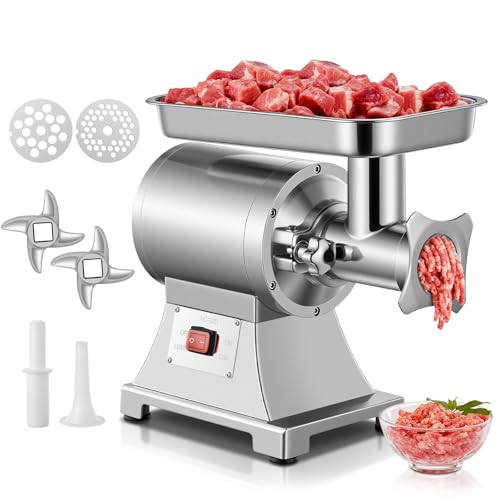
This grinder is a broad-use option for restaurants, butcher shops, sausage shops, and kitchens that want a high-wattage electric machine without a documented #12, #22, or #32 designation. The listing gives the motor as 1,100 watts and states a capacity of up to 330 pounds per hour, with a blade speed of 225 revolutions per minute. Those figures indicate the intended workload, but the absence of a stated head size makes direct comparison with size-specific commercial grinders more difficult.
The aluminum body is paired with a food-grade stainless steel hopper plate, T-shaped grinding head, and feed screw. Two blades, two plates, a pusher, and a sausage tube are included. Removable parts should be washed in low-temperature soapy water according to the supplied instructions, while the motor area requires normal electrical-appliance care. The package also supports vegetables, chili, and garlic, which may appeal to a prep kitchen that uses one machine for several food tasks.
Pros
- 1,100-watt motor and stated 330-pound-per-hour capacity.
- Stainless steel is specified for several food-contact components.
- Includes two blades and two grinding plates.
- Sausage tube adds a second practical function.
- Supports meat and selected vegetable-based preparation tasks.
Cons
- Grinder head size is not documented in the supplied information.
- Its listed capacity is lower than the largest #32 machines in this roundup.
This is a reasonable choice for a general prep kitchen that values a simple package and does not need to specify a particular grinder head size. It is harder to recommend for a buyer comparing equipment by #12, #22, or #32 standards because that missing detail affects parts and capacity comparisons. Confirm replacement-component compatibility before purchase, especially if the grinder will become part of a long-term commercial setup.
To buy this product, click here.
8. VEVOR Commercial Electric Meat Grinder #8 — Best Compact Commercial Option
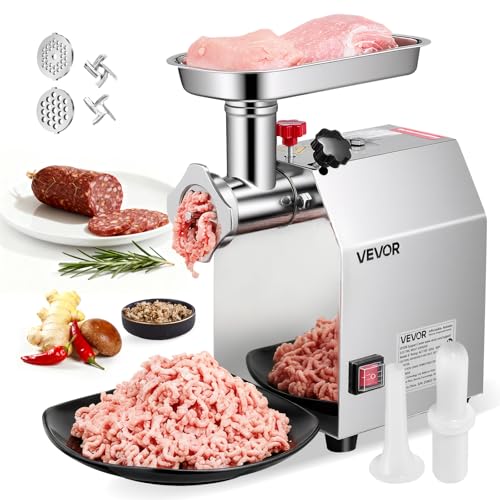
The VEVOR #8 is the smallest clearly size-designated grinder in this selection, making it useful for a café, hotel kitchen, corporate cafeteria, or small food business with modest batch requirements. Its 600-watt motor and stated capacity of approximately 5 pounds per minute are a better match for regular small runs than for a butcher shop processing large tubs of meat. A large tray and enlarged feed opening help with preparation, while the #8 head keeps the overall category more manageable.
Included equipment covers two stainless steel blades, 6 mm and 8 mm plates, a pusher, and sausage-making accessories. A reverse function may help clear minor feed interruptions, and the reset button adds a documented protective feature. The detachable head is useful for cleaning, but food-contact parts should still be handled according to the supplied instructions. The stainless steel construction described in the listing is a practical advantage in a busy prep space, though the smaller capacity remains the defining limitation.
Pros
- Documented #8 size suits smaller commercial workloads.
- 600-watt motor and stated capacity of about 5 pounds per minute.
- Includes two blades and two grinding plates.
- Reverse function, reset button, and air cooling are included.
- Detachable head, large tray, and sausage kit support varied prep tasks.
Cons
- Lower capacity than the #12, #22, and #32 machines reviewed here.
- Less suitable for large game-processing or production batches.
Pick this model when limited storage or moderate volume matters more than maximum throughput. It can fit a kitchen that grinds fresh meat several times a week but has no reason to stage a large commercial machine. Buyers should move up to a larger head if a single processing session regularly involves substantial quantities, since the smaller format will require more loading and unloading.
To buy this product, click here.
9. LEM Products BigBite #8 Meat Grinder — Best for Small to Medium Batches

The LEM BigBite #8 is a smaller machine, but its documented purpose is clear: home kitchens, small to medium batches, sausage stuffing, bulk meal preparation, and game processing without bones. Its 0.5 HP motor and stated output of about 7 pounds per minute give it more published capacity than the VEVOR #8, although these figures come from product information rather than independent testing. The stainless steel build and noise-dampening design make it a plausible bridge between household convenience and more demanding preparation.
Three plates, a knife, stomper, and stuffing tubes are supplied, so buyers can move from grinding to sausage preparation without immediately adding accessories. The permanently lubricated motor and easy disassembly simplify the ownership routine described by the listing. LEM also lists a five-year factory warranty, lifetime support, and replacement parts for many products. The clear restriction is equally important: this grinder is not for bones, so it should stay with properly prepared boneless meat.
Pros
- Documented #8 head fits small and medium batches.
- 0.5 HP motor with stated output of about 7 pounds per minute.
- Stainless steel construction and noise-dampening design are listed.
- Three plates, knife, stomper, and stuffing tubes are included.
- Five-year factory warranty and lifetime support are provided.
Cons
- Not intended for bones.
- Lower capacity than the larger commercial-head grinders in this roundup.
This grinder suits a buyer who wants a supported, compact machine for recurring household, hunting, or small-business preparation. It should be skipped by a high-volume processor that needs a #22 or #32 head, and the bone restriction rules it out for certain pet-food applications. For boneless burgers, sausage fillings, and moderate batches, its smaller size may be easier to live with than a machine built for an entirely different workload.
To buy this product, click here.
Buying Guide
For a wider comparison that also covers smaller workloads, see our meat grinder buying guide.
Match the Grinder Head to the Workload
Head size is a useful starting point because #8, #12, #22, and #32 machines represent different equipment classes, although size alone does not determine motor power or actual throughput. A #8 grinder can be sensible for a café or small prep kitchen, while a #32 model is more appropriate for large tubs of meat and repeated production. Think about the largest normal batch, not the occasional oversized job.
Our guide to grinder size numbers explains how nominal head sizes differ from other specifications.
Read Motor Ratings Alongside Capacity Claims
The products above list ratings from 0.5 HP to 2 HP and from 500 to 1,500 watts. Those figures are not interchangeable measures of continuous output. A manufacturer-stated pounds-per-hour or pounds-per-minute number is also not an independently verified guarantee. Meat temperature, connective tissue, plate selection, feed rate, and preparation all influence the real workload.
Check the Plate and Blade Package
Two plates may be enough for a basic coarse and fine workflow, while three plates or a stuffing plate add more flexibility. Plate hole sizes are listed for several products, but compatibility with replacement parts should never be assumed from a similar grinder number alone. Cutting knives and grinding plates perform different jobs, and both need to match the machine’s head and mounting arrangement.
Separate Grinding From Sausage Stuffing
A grinder with stuffing tubes can fill sausage casings, but it is not automatically equivalent to a dedicated sausage stuffer. Tube diameter, meat texture, casing size, and the way the feed system handles the mixture affect the experience. Buyers making large sausage batches should verify that the included tubes suit their process rather than treating every accessory kit as interchangeable.
Review Cleaning Requirements Before Purchase
Commercial-style grinders have more removable parts than many kitchen appliances. Plates, knives, augers, trays, tubes, and grinding heads need prompt cleaning and thorough drying. Several products in this roundup list dishwasher-safe removable components, while others specify hand washing in soapy water. Motor housings should not be immersed, and stainless steel construction does not eliminate the need for proper drying and storage.
Do Not Assume Bone or Frozen-Meat Capability
Bone grinding is a specialized application. Some listings explicitly support chicken bones, while others specifically exclude bones or frozen meat. Those claims apply to the exact model, not to every grinder from the same brand. If the intended workload includes bones, frozen material, or pet-food preparation, confirm that the specific machine supports it before purchase and follow its operating instructions.
Plan the Workspace
A large #32 grinder needs a stable work surface, convenient access to water and cleaning supplies, and enough clearance to load the tray safely. A #8 or #12 unit may be easier to store and reposition, but the smaller feed system can mean more batches for a large job. Commercial suitability also involves electrical setup, workflow space, sanitation procedures, and access to replacement parts.
Best Commercial Meat Grinders FAQ
What size meat grinder is suitable for commercial use?
There is no single size that suits every commercial operation. A #8 or #12 grinder can serve a café, small restaurant, or modest prep kitchen, while #22 and #32 machines are better aligned with larger batches. Compare the head size with the expected batch volume, available work surface, and cleaning routine.
Is a higher wattage motor always better?
No. Wattage is one specification among several, and listings may describe rated, maximum, or other power figures differently. A higher number does not establish continuous throughput by itself. Grinder head size, auger design, plate selection, meat preparation, and stated operating limitations also matter.
Can these commercial meat grinders grind bones?
Only some of the supplied listings specifically describe bone-related use. Several others exclude bones, frozen meat, or both. Do not infer bone capability from a high wattage, a large grinder head, or the word “commercial.” Check the exact product information for the model being purchased.
Are the included sausage tubes enough for commercial sausage production?
They may be enough for basic preparation, but the answer depends on casing sizes, batch volume, and how often sausage is made. A grinder’s stuffing tube is a convenience accessory, not proof that it can replace a dedicated stuffer. Check the listed tube diameters and compare them with the casings and production method you use.
Should removable grinder parts go in the dishwasher?
Follow the instructions for the exact model. The VEVOR #12 and #32 listings identify several removable parts as dishwasher-safe, while the 1,100-watt grinder specifies washing components in low-temperature soapy water. Motor housings should not be immersed or rinsed, and all washed metal parts should be dried before storage.
Is a #32 grinder too large for home use?
Not necessarily, especially for hunters, bulk-meat buyers, or households that process large batches. A #32 machine can be excessive for occasional burger preparation because it takes more space and may be heavier to position and clean. The right choice depends on batch size, storage, and how often the grinder will operate.
Are advertised pounds-per-hour figures guaranteed?
No. They are published product claims and should be used for comparison rather than treated as verified continuous production rates. Meat temperature, trimming, connective tissue, feeding pace, plate choice, and machine condition can all affect actual throughput.
Final Verdict
The Paladin Equipment #32 is the strongest overall match for Best Commercial Meat Grinders because its documented #32 head, 2 HP motor, 21-pound-per-minute stated capacity, large accessory package, reverse function, and protection features align with demanding batch work. The LEM BigBite #32 is a meaningful alternative for buyers who place greater emphasis on a listed five-year warranty, lifetime support, replacement parts, and a stainless steel large-format machine. Both require enough workspace and a workload that justifies their size.
For smaller operations, the VEVOR #12 offers a more manageable format with broad accessories, while the ARINOO #22C gives small farms and venison processors a middle-size option. The VEVOR #8 and LEM #8 are more appropriate for modest commercial tasks and small to medium batches. Match the grinder to the meat you process, the size of your normal workload, the plates and tubes you actually need, and the cleaning routine your workspace can support. That approach is more reliable than choosing by wattage or an impressive maximum-capacity number alone.
