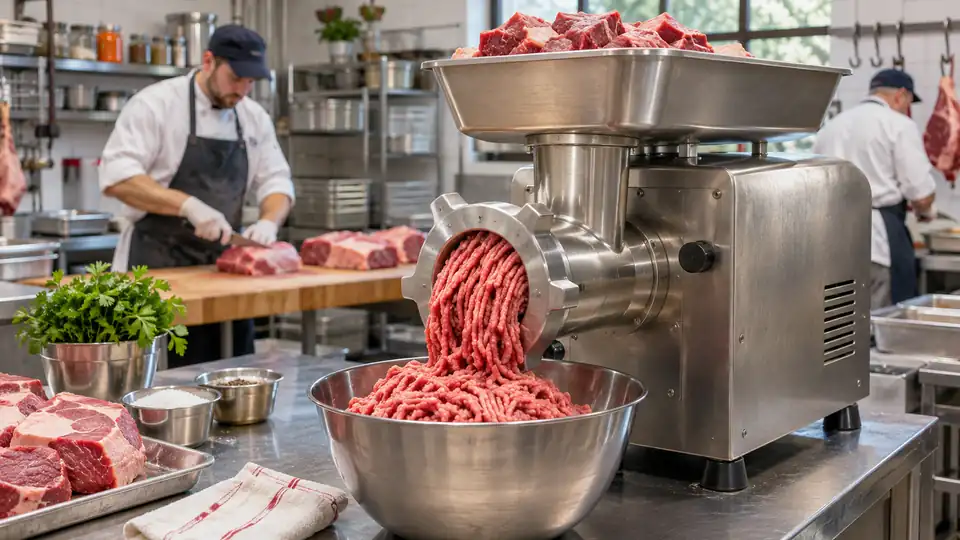
A heavy-duty meat grinder earns its place when a small countertop unit starts feeling slow, cramped, or strained during a large prep session. Hunters processing boneless venison, families buying meat in bulk, and cooks making sausage several times a season usually need more than a high wattage number on a product page. Grinder size, feed capacity, construction, included plates, and the machine’s stated operating limits all shape how useful it will be once the hopper is full and the work keeps coming.
A common mistake is treating peak wattage or a large pounds-per-hour claim as proof of continuous commercial capability. Those figures are not directly interchangeable, and published capacity depends on meat preparation, plate selection, temperature, and feed rate. The right choice also varies by buyer. A household user may value manageable cleanup and a compact #8 or #12 design, while a small farm or butcher shop may need a #22 or #32 machine with a larger hopper and a more substantial motor.
This comparison focuses on the supplied specifications for nine electric grinders suited to demanding home, hunting, restaurant, or small-processing applications. It separates documented features from assumptions, flags bone and operating restrictions, and gives each machine a practical role rather than ranking everything by motor size alone.
Quick Answer
- MEAT! 1 HP Pro-Grade #22 is the strongest overall fit for buyers who want a large grinder head, stainless steel construction, coarse and fine plates, and a published capacity of 11 to 14 pounds per minute.
- LEM Products BigBite #12 is a well-balanced choice for serious home users processing medium to large batches, with three plates, sausage tubes, and a stated capacity of up to 11 pounds per minute.
- ARINOO #32 is the largest option in this group and suits buyers who need a bigger hopper and documented 2.0 HP motor specification for large-batch work.
- STX International Turboforce II 4000 stands apart for its broad accessory package and explicitly stated support for soft bones, although that application should not be generalized to other grinders.
Best Heavy-Duty Meat Grinders Comparison Table
| Product | Best For | Grinder Size | Published Motor or Capacity | Main Trade-Off |
|---|---|---|---|---|
| MEAT! Pro-Grade Grinder | Large home or small-shop batches | #22 | 1 HP, 11 to 14 lb/min claim | Foot pedal is an optional compatibility feature |
| LEM BigBite #12 | Serious home processing | #12 | 0.75 HP, up to 11 lb/min claim | Smaller head than #22 and #32 models |
| ARINOO #32 | Largest stated grinder format | #32 | 2.0 HP, 1500W rated, 2800W max | Larger equipment footprint and heavier-duty scope |
| ARINOO #22C | Small farms and venison batches | #22 | 1 HP, up to 550 lb/hr claim | Only two grinding plates are listed |
| Valley Sportsman #22 | Stainless steel construction | #22 | 1 HP, 750W, up to 550 lb/hr claim | One-year seller-provided warranty |
| VEVOR #12 | Accessory-rich #12 setup | #12 | 1 HP, 750W, up to 552 lb/hr claim | Not for bones or frozen meat |
| 1100W Commercial Grinder | Restaurants and general prep | Not stated | 1100W, up to 330 lb/hr claim | Aluminum body rather than all-stainless construction |
| LEM BigBite #8 | Smaller heavy-duty home batches | #8 | 0.5 HP, about 7 lb/min claim | Not for bones |
| STX Turboforce II 4000 | Accessory versatility and soft bones | #12 | 2000W locked motor claim, 220 to 260 lb/hr claim | Aluminum grinding head and specialized bone limitation |
The detailed reviews below put those specifications into context, with particular attention to workload, cleaning, included components, and restrictions.
1. MEAT! 1 HP Pro-Grade Meat Grinder #22 — Best Overall
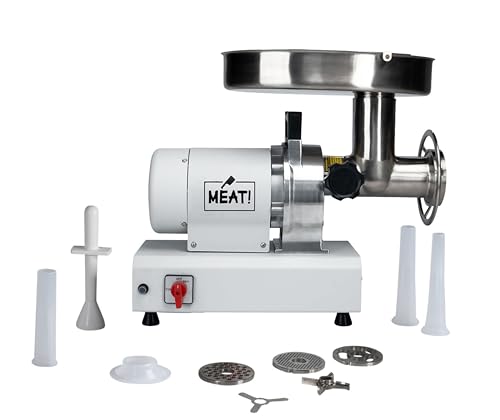
The MEAT! #22 earns the top position because its documented size and motor specification line up closely with the demands implied by a heavy-duty grinder search. A #22 head offers a larger processing format than the #8 and #12 machines here, while the listed 1 HP motor and published 11 to 14 pounds-per-minute claim give it a clear large-batch orientation. That claim should be read as manufacturer-stated capacity rather than a guaranteed continuous rate, but it still helps distinguish this machine from ordinary household grinders.
Its stainless steel construction is useful for buyers who expect frequent handling, and the included coarse and fine plates cover the two basic grind directions many cooks use for burgers, meatloaf, and sausage preparation. Stainless steel stuffing components and tube accessories make it a two-function machine, while compatibility with the optional MEAT! foot pedal may appeal to someone who wants hands-free control. Buyers should still confirm the pedal arrangement and allow enough room for a #22 machine before setting up a prep station.
Pros
- Documented #22 grinder format for larger workloads
- Listed 1 HP motor specification
- Published capacity claim of 11 to 14 pounds per minute
- All-stainless construction is listed for the machine
- Includes coarse, fine, and sausage-stuffing components
Cons
- The foot pedal is described as a compatible accessory rather than a standard inclusion
- The published processing rate is not independent continuous-use testing
This is the most convincing general-purpose choice for a household that buys whole cuts in bulk or a small operation preparing substantial batches without moving to the largest #32 format. It has the head size and accessory coverage to justify its heavy-duty placement, though buyers with limited counter space may prefer a #12 machine. Treat the capacity figure as a planning reference, keep the meat properly prepared, and follow the operating instructions rather than feeding continuously at the maximum claim.
To buy this product, click here.
2. LEM Products BigBite #12 Meat Grinder — Best for Serious Home Use

The LEM BigBite #12 occupies a useful middle ground. Its 0.75 HP motor and stated capacity of up to 11 pounds per minute put it above compact kitchen grinders, while the #12 format remains more approachable for a home prep area than a #22 or #32 unit. That balance matters during a deer season cleanup or a weekend of bulk burger preparation, when a machine must accept meaningful quantities without becoming a piece of permanent commercial equipment.
LEM lists three grinding plates, a knife, a stomper, and sausage tubes, so the package supports multiple recipes without requiring a separate stuffing setup. The product information also describes a noise-dampening design, permanently lubricated motor, stainless steel parts, and disassembly for cleaning. It is listed for beef, pork, poultry, lamb, and venison, with a separate claim that it can process raw chicken bones. That bone statement applies to this exact model and should not be extended to the other LEM or #12 products in the roundup.
Pros
- #12 format suits medium to large home batches
- Listed 0.75 HP motor and up to 11 lb/min capacity claim
- Three plates provide more grind options than a two-plate setup
- Includes sausage tubes, knife, and stomper
- Five-year factory warranty and lifetime support are listed
Cons
- Smaller grinder format than the #22 and #32 alternatives
- The bone-processing claim is specific to the listed application and needs careful handling
Choose this LEM when a large home batch is the target but a commercial-sized hopper would be excessive. It is also a sensible venison option for buyers who specifically want the supplied bone-processing claim, provided they follow the product’s instructions and distinguish raw chicken bones from harder bones. Those who need the biggest feed system or a more extensive commercial workflow should step up to a #22 or #32 machine instead.
To buy this product, click here.
3. ARINOO #32 Commercial Electric Meat Grinder — Best for the Largest Workloads

The ARINOO #32 is the largest grinder format in this selection, and that distinction matters more than a flashy maximum wattage label. Its product information lists a 2.0 HP motor, 1500W rated power, and 2800W maximum power, along with an oversized hopper intended for large batches. Those figures belong to the exact #32 model and should not be compared as though maximum power were the same as normal operating power.
This machine is aimed at restaurants, butcher shops, hunters, bulk buyers, and small-batch processing environments that can accommodate a larger piece of equipment. Two stainless steel plates, two blades, three stuffing tubes, and a meat stomper cover the basic grinding and sausage tasks. The listed stainless steel construction and detachable parts support a straightforward cleaning routine, but the larger format also means more storage planning and a work surface capable of handling the machine securely.
Pros
- #32 grinder format is the largest documented size in this comparison
- Lists 2.0 HP motor power with rated and maximum figures separated
- Oversized hopper is intended for large batches
- Includes two plates, two blades, three tubes, and a stomper
- Five-year factory warranty and lifetime support are listed
Cons
- Large format may be excessive for occasional household grinding
- Only two grinding plates are listed
The ARINOO #32 makes sense for a buyer whose workload justifies the footprint, rather than someone seeking a compact machine for occasional burgers. It offers more headroom than the #12 and #22 options, but the listing does not provide a verified continuous throughput figure, so the motor specifications should not be treated as a promise of uninterrupted production. Confirm available counter space, electrical requirements, and cleaning access before choosing this size.
To buy this product, click here.
4. ARINOO Commercial Meat Grinder #22C — Best for Small-Farm Processing

The ARINOO #22C is built around a documented 1 HP motor and #22 format, which gives it a practical place between home-focused #12 grinders and the larger #32 machine. Its listing states a processing claim of up to 550 pounds per hour and describes the unit for home butchering, small farms, restaurants, and food-processing work. That is a published figure, not a verified production rate, but the combination of size and intended application is relevant for buyers who routinely process larger quantities.
Construction is another part of its appeal. The product information identifies 304 stainless steel for the machine and food-contact surfaces, along with two blades, 6mm and 8mm plates, and three stuffing tubes. The finer listed plate suits burgers and similar preparations, while the coarser plate is aimed at a looser grind. The listing also describes detachable parts that can be washed with water and a five-year warranty, although buyers should dry components thoroughly after cleaning.
Pros
- Documented #22 size for substantial batches
- Listed 1 HP motor and up to 550 lb/hr capacity claim
- 304 stainless steel construction is specified
- Includes two blades, two plates, and three stuffing tubes
- Five-year warranty and lifetime support are listed
Cons
- Only two grind plates are included
- The four-hour continuous-operation description is a listing claim that still requires attention to the manufacturer’s instructions
This grinder suits a buyer who wants a #22 machine for venison, beef, pork, or sausage preparation without moving to a #32 hopper. It is more equipment than most occasional cooks need, and the stated hourly capacity should not be used as a guarantee for every meat type or work session. For a small farm or household that processes meaningful batches a few times a year, its documented size and accessory set are the main reasons to choose it.
To buy this product, click here.
5. Valley Sportsman Commercial Meat Grinder #22 — Best Stainless Steel Construction

The Valley Sportsman model targets the same broad workload as other #22 grinders, but its supplied description emphasizes stainless steel throughout the body, head, auger, and tray. That can simplify the buyer’s material comparison because the product data identifies more than a stainless exterior. It also lists a 1 HP, 120-volt motor, 750W power specification, overload protection, and a published capacity of up to 550 pounds per hour.
An auger intended to maintain steady intake is paired with a stainless steel blade, meat pan, stomper, and two plates. The listed 10mm coarse and 4.5mm fine plates give the buyer a clear choice between a more open grind and a finer preparation, while 15mm, 25mm, and 35mm stuffing tubes expand its sausage function. The machine is aimed at hunters, commercial kitchens, outdoor grilling, and raw pet-food preparation, though those applications do not remove the need to follow specific handling and cleaning instructions.
Pros
- Documented #22 grinder format
- Stainless steel body, head, auger, and tray are listed
- Includes 10mm and 4.5mm plates
- Three stuffing tubes cover different sausage sizes
- Overload protection is listed
Cons
- The one-year warranty is seller-provided
- The up-to-550-lb/hr figure is a published capacity claim, not an independent measurement
This is a strong fit for buyers who place construction and a broad sausage accessory set ahead of having many grinding plates. The #22 format and 120-volt specification should be checked against the intended workspace, especially for a home user with a crowded kitchen. It may be more machine than needed for a few pounds of burger meat, but it gives larger-batch users a clearly documented stainless steel configuration.
To buy this product, click here.
6. VEVOR #12 Electric Meat Grinder — Best Accessory Package

The VEVOR #12 is a useful choice for buyers who want a substantial grinder format and a wide range of included attachments without stepping up to a #22 machine. Its listing identifies a 750W, 1 HP motor, a three-stage auger, and a published capacity of up to 552 pounds per hour. The claimed rate is unusually prominent, but it should remain a planning figure rather than proof that every batch will move at that speed.
The accessory set is the main attraction. It includes 6mm and 8mm plates, two blades, a kibbe kit, three stuffing tubes, and a meat pusher. Removable parts are listed as dishwasher-safe, while the motor housing must be kept out of water and wiped separately. Anti-vibration feet, a locking knob, and a cooling system are also described. The product specifically excludes bones and frozen meat, a restriction that makes preparation requirements especially clear.
Pros
- Documented #12 grinder size and 1 HP motor
- Includes two plates, two blades, and a kibbe attachment
- Three stuffing tubes are included
- Removable parts are listed as dishwasher-safe
- Overheating support features and anti-vibration feet are described
Cons
- Not suitable for bones or frozen meat according to the listing
- Maximum hourly capacity is a published claim rather than verified continuous output
This machine fits a home cook, hunting household, or small food-prep station that values accessories and a clear no-bones operating boundary. The #12 size is more manageable than a #22 or #32, but the machine still needs storage space for its plates, tubes, and attachments. Buyers who regularly process frozen scraps or bones should choose a different documented application rather than treating the heavy-duty label as permission to exceed the stated limit.
To buy this product, click here.
7. 1100W Commercial Electric Meat Grinder — Best for General Restaurant Prep
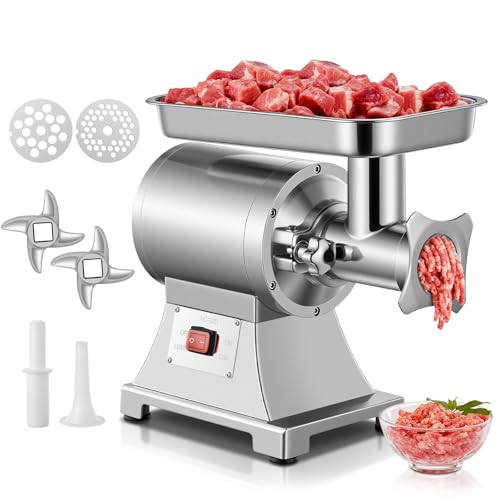
This grinder is positioned for kitchens, restaurants, butcher shops, and sausage shops, with an 1100W motor and a published capacity of up to 330 pounds per hour. Its exact grinder head size is not provided in the supplied information, so it should not be treated as equivalent to the documented #12, #22, or #32 models. That missing size is a meaningful purchasing detail for anyone comparing plates, blades, or replacement parts.
The construction is mixed rather than all stainless steel. The body is listed as aluminum, while the hopper plate, T-shaped grinding head, and feed screw are identified as food-grade stainless steel. Two blades, two cutting plates, and one sausage tube are included. The product also lists support for beef, pork, chicken, venison, vegetables, and other foods. Its removable parts can be washed in low-temperature soapy water according to the supplied instructions, followed by careful drying.
Pros
- 1100W motor specification is listed
- Published capacity claim reaches 330 pounds per hour
- Stainless steel is specified for the hopper, grinding head, and feed screw
- Includes two blades and two cutting plates
- Supports grinding and basic sausage stuffing
Cons
- Exact grinder head size is not supplied
- Only one sausage tube is listed
This option is best for a buyer who values a documented motor and commercial-use positioning but does not require a known #12, #22, or #32 replacement-parts ecosystem. The unspecified head size makes compatibility research more important than it would be with the other models here. It can suit general restaurant or shop prep, though buyers should confirm the exact plates and service components available for this model before committing to a long-term processing setup.
To buy this product, click here.
8. LEM Products BigBite #8 Meat Grinder — Best for Smaller Heavy-Duty Batches

The LEM BigBite #8 shows why heavy-duty does not always mean choosing the biggest available grinder. Its 0.5 HP motor and #8 format are aimed at small to medium batches, while the listing states a capacity of about seven pounds per minute. That is a lower published rate than the larger machines, yet it may be a better match for a household that wants repeated burger, sausage, or game preparation without storing a #22 or #32 unit.
Three plates, a knife, stomper, and stuffing tubes give this compact model a useful range of functions. LEM also lists stainless steel parts, a permanently lubricated motor, a noise-dampening design, and a five-year factory warranty. The machine is specifically described as unsuitable for bones, so it belongs with buyers processing boneless meat and ingredients rather than pet-food users seeking a bone-capable grinder.
Pros
- Compact #8 format for smaller work areas
- Listed 0.5 HP motor and about 7 lb/min capacity claim
- Includes three grinding plates
- Supports sausage stuffing with included tubes
- Five-year factory warranty and replacement-part support are listed
Cons
- Not for bones according to the product information
- Lower stated capacity than the #12, #22, and #32 alternatives
Pick the BigBite #8 when your normal session involves a few pounds rather than a full processing table. It offers a stronger accessory package than many small household machines, yet the lower head size limits how well it fits a large venison or bulk-meat workload. Buyers who want repeated small-batch control, easier storage, and a documented warranty may prefer it over a larger commercial-style grinder.
To buy this product, click here.
9. STX International Turboforce II 4000 — Best for Accessory Versatility
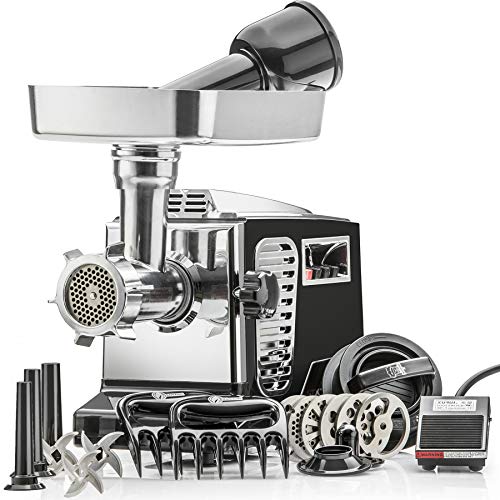
The STX Turboforce II takes a different approach from the stainless commercial-style machines. It is identified as a size #12 grinder and includes a large tray, three stainless steel cutting blades, five grinding plate sizes, a foot pedal, sausage components, a kibbe attachment, meat claws, and a patty press. That broad package can be attractive to a household that wants one machine for several food-preparation tasks rather than a narrower grinder setup.
The listing states a 2000 maximum-watt motor, locked motor wattage of 2000W, and a claimed output of 220 to 260 pounds per hour depending on the plate and meat. These power descriptions should not be compared directly with rated horsepower figures from other models. The product also explicitly states support for soft bones such as chicken, rabbit, squirrel, and quail bones. That is a specific claim for this model, not a general characteristic of heavy-duty grinders.
Pros
- Documented #12 grinder size
- Includes five grinding plate sizes
- Foot pedal is included
- Broad package includes sausage, kibbe, and patty-making accessories
- Soft-bone processing is explicitly listed for specified animal bones
Cons
- Polished aluminum grinding head differs from the all-stainless models
- Soft-bone support is limited to the types identified in the product information
This STX model suits buyers who care about accessory range and the stated soft-bone application as much as raw batch size. It is less straightforward for someone who wants an all-stainless commercial-style machine, and its maximum-wattage language requires careful comparison with rated motor specifications. Keep the bone claim narrow, avoid extending it to harder bones, and select this grinder for its documented package rather than assuming it has the highest sustained throughput.
To buy this product, click here.
Buying Guide
For smaller or less frequent jobs, compare other options in our guide to meat grinders for different workloads.
Match Grinder Size to the Workload
The #8, #12, #22, and #32 designations describe different grinder formats, but they do not independently guarantee a motor rating or continuous capacity. A #8 can be sensible for several pounds of meat at a time, while a #22 or #32 is more appropriate for large venison, restaurant, or farm-processing sessions. Larger machines also need more counter space, storage room, and a stable work surface.
For a closer explanation of numbered head sizes, see meat grinder sizes explained.
Read Motor Specifications Carefully
Rated power, horsepower, maximum wattage, and locked motor wattage describe different aspects of a grinder. The ARINOO #32 lists 1500W rated power and 2800W maximum power, while the STX uses locked motor wattage language. Neither figure should be treated as a universal measure of sustained output. Compare the motor description with grinder size, published capacity, and any operating restrictions.
Treat Capacity Claims as Planning Information
Published rates such as 330 pounds per hour, 550 pounds per hour, or 11 pounds per minute can help separate small-batch equipment from larger machines. They are still manufacturer or seller claims, not independent measurements. Meat temperature, connective tissue, preparation, plate choice, and feed rate affect the result. A buyer planning a long processing session should also look for clear operating instructions rather than relying on the largest number in the listing.
Check Plates, Blades, and Replacement Compatibility
Grinding plates control the openings through which meat exits, while the cutting knife works with the plate as part of the cutting system. Three included plates offer more flexibility than two, but the actual hole sizes and fit matter more than the count alone. The 1100W commercial grinder in this roundup does not state its grinder head size, so replacement-part compatibility requires extra confirmation.
Separate Grinding From Sausage Stuffing
A grinder with stuffing tubes can prepare sausage, but it is not automatically equal to a dedicated stuffer. Tube diameter, casing preparation, feed control, and batch size all affect the stuffing process. The Valley Sportsman includes three tube sizes, while the 1100W commercial model lists one. Think of the included tube as an added function, not proof that the machine is optimized for every sausage workflow.
Review Cleaning and Operating Restrictions
Removable parts should be cleaned according to the exact product instructions. The VEVOR listing identifies its removable parts as dishwasher-safe but excludes the motor housing from water exposure. The LEM #8 and VEVOR models have clear restrictions against bone use, while the STX and LEM #12 provide specific bone-related claims. Never turn a general heavy-duty label into permission to grind frozen meat, hard bones, or other unsupported materials.
Best Heavy-Duty Meat Grinders FAQ
What Makes a Meat Grinder Heavy-Duty?
A heavy-duty grinder is usually identified by a larger grinder format, stronger documented construction, a motor intended for demanding work, and a published capacity suited to larger batches. No single wattage number proves that a machine can operate continuously. Workload, grinder size, materials, cooling features, and stated restrictions should be evaluated together.
Is a #22 Grinder Better Than a #12 Grinder?
A #22 grinder is generally the more relevant format for larger processing sessions, but it is not automatically better for every buyer. It can require more space and may be unnecessary for occasional household batches. A #12 model can be easier to store and still provide substantial capacity for home sausage and burger preparation.
Can These Grinders Process Bones?
Only use a bone-processing application that is explicitly stated for the exact model. The LEM BigBite #12 lists raw chicken bones, and the STX Turboforce II lists specific soft bones such as chicken, rabbit, squirrel, and quail. The LEM #8 and VEVOR models are listed as unsuitable for bones. Do not generalize one product’s claim to another grinder.
Are Maximum Watts the Same as Rated Watts?
No. Maximum wattage, rated wattage, locked motor wattage, and horsepower are different descriptions. A maximum figure may describe a peak or locked condition rather than normal operating draw. Compare products using the complete specification set and treat published processing rates as claims rather than guaranteed continuous performance.
What Grinder Size Is Suitable for Venison?
The answer depends on the amount of boneless venison and how often it will be processed. A #8 or #12 can suit household batches, while a #22 or #32 is more appropriate for larger butchering sessions. Venison suitability does not automatically mean bone suitability, so check the exact restrictions and prepare the meat accordingly.
Are All #12 Plates and Blades Interchangeable?
No. A shared #12 designation does not prove that plates, knives, augers, or mounting hardware will fit across brands. Confirm the exact model, component dimensions, center opening, and manufacturer compatibility before purchasing replacement parts.
Can a Meat Grinder Replace a Sausage Stuffer?
A grinder with stuffing tubes can handle basic sausage stuffing, but its feed behavior and control may differ from a dedicated stuffer. Buyers making large sausage batches should review tube sizes, casing requirements, cleanup, and the machine’s intended workload. Included tubes are useful accessories, but they do not make every grinder equally suitable for high-volume stuffing.
Final Verdict
The MEAT! 1 HP Pro-Grade #22 is the strongest overall match for Best Heavy-Duty Meat Grinders because its documented #22 format, stainless steel construction, 1 HP motor, coarse and fine plates, and published 11 to 14 pounds-per-minute claim align with larger home and small-shop workloads. The LEM BigBite #12 is a more manageable alternative for serious home processing, especially for buyers who value three plates, sausage tubes, and a listed five-year factory warranty.
For the largest equipment format, the ARINOO #32 brings a documented 2.0 HP motor and oversized hopper, although its footprint should match the workload before purchase. The STX Turboforce II is the specialized pick for buyers who value a broad accessory package and the exact soft-bone applications listed for that model. Whichever grinder you choose, match the head size to your batch volume, treat capacity figures as published claims, verify replacement-part fit, and follow the exact restrictions for bones, frozen meat, cleaning, and operating time.
